All grains contain peptides that mimic morphine or endogenous opioid substances. This is where I deal with my latest loaf craving. Get your bread-based exorphin fix here.

Showing posts with label mother starter. Show all posts

Friday, December 10, 2010

Rye Bread with Steel Cut Oats


Rye Bread with Steel Cut Oats

This ugly loaf is one of those fast rye breads that I have been throwing together hastily lately just to have something to eat when I go to work. Nothing interesting here. I tossed in the steel cut oats, without any soaking or boiling of them, just to give the dough some extra texture. I used 1/4 cup of them and then sprinkled some on the surface a couple of times.

I let the dough sit out for a couple of hours before adding the salt. Then I kneaded the salt in and let it sit out for about 4 hours before baking.


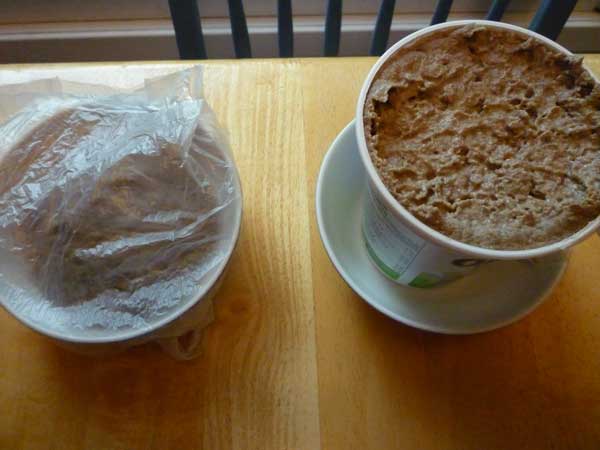
This is an ugly grey coloured loaf, probably because I am using some very old motherstarter that I should have tossed away. It was old, but it had been refrigerated. I threw out the hooch layer, and just incorporated the old spent rye.

I am very surprised that the resultant loaf is not more sour.

There was one thing different about this loaf. I tried a rye wash, with about 15 minutes left on the 65 minute long bake. It did turn the top of the loaf an unappetizing grey colour.


The wash was boiling water (150g) and rye flour (2 tbsp), stirred for 1 minute and then left to sit for 50 minutes before brushing on the top of the baking loaf. I coated the bread liberally. By then, the scores on the top of the bread had left deep fissures, and I coated them too.


Notes to Myself

Sunday, November 7, 2010

Sourdough Whole Wheat, Rye and Perhaps Teff Loaf


 Sourdough Whole Wheat, Rye and Perhaps Teff Loaf

This loaf was thrown together haphazardly, in order to use up the discards from day 5 of the new sourdough I have been making with Nils Schöner's rye sourdough methods.

I was already using some of the 'discards' in another bread of Nils -- a 60% rye with grains soaked in apple juice.  But that bread only used a teaspoon of the sourdough.  I needed to make a bread that would use up the rest of the discard.  So I just tossed this together, not really following a recipe, just the guidelines of the Lahey-style loaves.

Keep in mind that this sourdough is not fully developed.  Nils advises refreshing it another 2-3 times before it reaches full strength.  That is why I added the yeast here.

I used:

  • 161g of the sourdough starter @100% hydration
  • 143g freshly ground flour, mostly whole wheat, although there was probably some rye in there too.
  • 57g of all purpose wheat flour (total wheat flour, therefore = 200g)
  • 20g Rye flour (total rye flour, with what is in the sourdough starter = 100g)
  • 100g of What was supposed to be Teff (but might have been cocoa??)
  • 220g of H20 (with what was in the sourdough starter, total 300g water)
  • 8g of salt
  • 2g of yeast

I bought my 'Teff' a long time ago in the bulk food store, thinking I might one day find a use for it.  But these days, when I taste a bit of the flour, it seems to me almost like cocoa, or carob.   I hope it was real Teff: I certainly remember paying a premium price for it.


This dough sat at room temperature about 12 hours or so, and then I tried to shape it.


The gluten was tearing, and it made an awful mess.  It felt like too much rye. 


But I shaped it and put it in a basket to proof for 3 hours; at the 2 1/2 hour mark I preheated the oven and a casserole dish.  I baked for 30 minutes with the lid on, then 30 more minutes with the lid off.

When the bread was baked, I removed it to a baking stone and then rubbed some butter on the surface of the hot bread, to keep the outer crust a bit moist.


The loaf didn't rise much at all.  In fact, it sagged in the casserole dish substantially.  The scent of sourdough was very strong throughout the baking period, and the bread smells faintly of the sour tanginess of fresh wild yeast in grain.  But surprisingly, there is really no taste of sourdough.


The loaf is very nutty, and a little mysterious in taste.

Monday, July 12, 2010

Reinhart's Sandwich Rye Seigle

Reinhart's Sandwich Rye Siegle with Rye Motherstarter for a 70% Rye


Why the Hiatus with the Reinhart loaves?

It has been some time now since I baked a Reinhart loaf from his book Whole Grain Breads, and stopping between the Sandwich Rye Meteil and the Sandwich Rye Seigle seems like a strange place to take a rest.  In keeping with my many other experiments, it might have made sense to make the Meteil and the Seigle at the same time, to compare them.

Why I have set the Reinhart book aside to make other breads for the last few loaves is difficult to say.  Certainly it is not because I was tired of Rye Breads: I have made several rye loaves since the Meteil, and I have not been very happy with any of them.  I wasn't happy with the Meteil all that much either (Remember, I almost cursed Reinhart for my own inabilities to make a loaf that looked like his).  So I guess I had no great reason to believe that the Seigle Rye would be any different.

But the other night I had a few minutes to glance carefully at Reinhart's book again.  There is basically one idea in the book, and it is reproduced in what seems like endless variation of recipes for loaves of differing measurements.  The idea of Whole Grain Breads is the delayed fermentation and conjoining two pre-ferments into a final dough mixture, to capitalize on enzymatic processes within the grain.

The book starts off with Sandwich Loaves and other enriched breads, and only later does it devote space to Hearth Breads, which must be the taste I am looking for.  But I don't know yet.  If I do these loaves in order (as I have been), it will be some time before I leave the Sandwich loaves behind and move on to the Hearth loaves that I think I want to make.  And yet, there may be something in these loaves that my wife will absolutely love; and there is certainly much for me to learn.  At any rate, I should stop carping about how sweet these Reinhart loaves are.  They are enriched loaves!  Of course they are going to be sweet!  Get over it!


The Siegle Problem: this has got to be an Error in Reinhart's book

Something else has stopped me from baking this loaf, and it has been my struggle to understand one of Reinhart's side notes to this recipe.  I have come to the conclusion that the side note contains an error, but it has taken me a long time to figure this out, because I am a beginner here, and I struggle against my own ignorance.

The Siegle's definition, in the Glossary:
"Technically, it is French for rye bread, but is more often used in reference to breads that contain more than 50% rye flour (as opposed to Meteil, which connotes less than 50%".  
The same distinction is to be found in Reinhart's description of his Siegle recipe.

So what is a beginner like me to make of this comment from one of his marginal asides, or 'grace notes', beside the 'Siegle'?:

"The starter in this version is made from a whole wheat mother starter that is elaborated with rye flour.  The wheat starter provides just enough total whole wheat flour to tip this over to the meteil side of the equation.  If you already have a 100% rye mother starter, you can use it instead for a bread with a 50-50 balance of rye and wheat."

This is the same 'grace note' that Reinhart gives at the bottom of the marginal 'commentary' for his Rye Sandwich Meteil', where it makes sense.  Here, it is just confusing.  I am thinking he simply 'copy-and-pasted' it here, but here it just confuses the ignorant (me).

First, you have to remember that he is just talking about the starter, not about the entire dough.  The baker's percentage of the starter recipe gives the rye flour at 100%, and the whole wheat mother starter at 33.3%.  So there is no way that the whole wheat in the mother starter would tip the ratio of whole wheat and rye flours for the whole loaf to 50:50.  How can it?  There is no whole wheat in the Final Dough, just more rye.  So where is all the extra whole wheat coming from?  From the soaker?  Reinhart gives the baker's percentage of the soaker as 50% rye, and 50% whole wheat flour.  But that can't be right either: the weight of the rye flour in the soaker is 56.5 g, and the whole wheat flour is 170 g.  I'm no good at these baker's percentages, but it seems to me that this means the whole wheat flour should be 100% in this soaker, and the rye flour is then 25%.

Even then, if you add up the weights from soaker, starter and final dough ingredients, you get 326 g of rye flour, and 170 g of whole wheat flour (plus the 71 g of motherstarter, whether it contains rye or whole wheat).  So even if you used whole wheat motherstarter, you would only have 241 g of whole wheat, which is still below the 50% mark that would make this a meteil.  With a whole wheat motherstarter, this bread should be a 57% rye (still a seigle).

So the grace note is wrong.

And so is the baker's percentage listed in the soaker.

In any case I do have a rye motherstarter, which would make this seigle a 70% rye.  And that is what I used.

I am struggling with these baker's percentages on my own, and I'm finding different authors do slightly different things.  Reinhart never gives baker's percentages for his final doughs, unlike say, Jeffrey Hamelman.  Hamelman admits that percentages in final doughs are confusing (because the preferments in the final doughs are just listed as percentages of the flour used in the final dough too) -- which may be why Reinhart omits them -- but Hamelman says it is therefore better to give percentages of the overall formula.  But Reinhart doesn't even provide that, in all cases.


But who cares about the percentage of rye?

Well, me.  I love the taste of rye, and I realize that not everyone does.  But I have yet to find a rye bread recipe that works well.  It is an entirely different sort of grain flour to bake with.  That is why most rye breads have some (most have >50%) wheat flour.  How can you call it a rye bread if it isn't mostly rye?  I think that's false advertising.  But rye on its own is difficult (for me) to bake with.  Especially if you are thinking it should perform like wheat (and I know I am still struggling against my own expectations).  I expect rye to rise, to expand like a wheat loaf.  When it doesn't, I am disappointed.  I want my rye to fluff up but not give me wheat taste.  So I want a siegle that is actually 100%.  A rye loaf that is 100% won't be a sandwich loaf, of course; it can't possibly be.

But I thought by baking this loaf I could learn something here anyway.


Bad Timing

Oh, but I had problems with this loaf.

Soaker

Starter


First off: the timing was bad.  I was working nights all weekend, and when I awoke on Sunday afternoon, anticipating my last night shift, I decided to build the soaker and starter to bake on my first day off, Monday.  So around 5 pm, I mixed the soaker, and before 6 pm, I mixed the starter.  The starter is supposed to rise within 4-6 hours, but Reinhart says it might take as much as 8.  My motherstarter came right out of the fridge, so I expected it to take a long time to rise, but I went ahead anyway.  I set it on the kitchen table and simply asked my wife if she might glance at it before she went to bed.  If it was pushing the lid off the container, she was to punch it down and stick it in the fridge.  If it was not risen that far, she was to simply leave it alone.

Soaker and Starter sit out overnight

My wife left it alone.  By the time she went to bed, it had only risen about 3/4 of the way to double, she said.
Soaker and Starter in the morning

This morning, when I got home, the starter was risen and possibly deflated.  The yeast in it might be entirely spent.  I decided to go ahead and try to bake with it anyway, since Reinhart's recipe also uses commercial yeast.  The thing was supposed to be refrigerated at 8 hours, but it had been out at room temperature now for about 14 hours.


Instead of going to sleep, I decided to bake the bread.  Now I was exhausted, and set the oven timer for each rise, and slept at these odd intervals.  And my brain was a little fuzzy around the edges.  So the bread probably wasn't going to be as perfect as I wanted.  But I was determined to get past the Siegle barrier, at which I had stopped for far too long.


After 60 minutes, the loaf didn't look doubled to me, so I gave it an extra 30 minutes.


I still didn't see much change, and at that point I just decided to continue.  I would shape it for a loaf pan.


I coated the loaf pan with oil, and then decided to sprinkle some light rye on the oiled pan (as Reinhart describes on p. 220, when printing a picture of his Vollkornbrot; Reinhart gives credit to Jeffrey Hamelman for this trick).  It is supposed to make an interesting and rustic crust.  I just thought that it might be a nice way to use some of my light rye, which I bought some time ago, and haven't found much use for.  Mostly I use a dark rye to bake with.


After an hour in the loaf pan, the added yeast was having an effect, and I could see a visible rise.  I preheated the oven (with a stone - in case I needed to bake the loaf free of the loaf pan, see my last loaf bread, Beard's Cracked Wheat Loaf for the reason).  In that extra 30 minutes of preheating, the gluten sheath seemed to start to break apart.  Would ascorbic acid have stopped this, I wonder?


I scored it down the middle and baked it with steam.


Results

The loaf baked nicely, but there was no oven spring.  The scoring I did seemed invisible though, so perhaps the scoring contained the rapid expansion, if there was any.


I waited until the next morning to have some.  I had it with what I think is a Celtic Gold Cheese from Stratford's "Milky Whey" Cheese Shop.  This is a milder cheese that complements the rye in this loaf very nicely.  Thin slices for everything.


I'm happy with this bread.  (Finally).  It toasts up nicely too.  I will make it again, mostly to try out other things related to the delayed fermentation.  I forced my wife to try a bit this morning too.  From her paper, she took the offered nibble and said 'It's okay'.  Hardly a rave review, but at least it wasn't 'yuck'.

There is an interesting sweetness to this bread that appears after you've eaten it slowly and savoured it.  The 'Rye Bite', when the saliva's amylase lingers to awaken the entire mouth.  It is, indeed, okay.

Crumb of the Sandwich Rye Siegle


Notes to Myself:
  • Plough through these sandwich loaves to get to the hearth breads you want to bake if you must, but don't forget to keep your eyes open to learn something as you get a handle on what Reinhart is doing with these 'delayed fermentation' techniques.  To get such a handle, episodes like today's experiment are important learning devices: the 8 hour refrigeration of the biga makes a loaf differently than the 4-6 (possibly 8) hour room-temperature rise of the starter made from sourdough.  But what happens if that starter sits out 14 hours, like what happened here?  Does it defeat the entire plan of delayed fermentation?
  • Timing seems to be such a big issue with these recipes.  Refrigeration is used to delay fermentation.  But how much leeway is there, really?  If I had been around to refrigerate the dough at the 8 hour mark, it might have taken 2 hours to delay the fermentation, but it would have still taken 2 hours to bring it back to room temperature.  Are those 2 hours all-important?  What have I lost by not refrigerating my starter?
  • Possible Answer: the dough as I mixed it felt far too wet to knead.  It was just squooshy in my fingers, like mud pies.  And yet, as the soaker and the starter and the final dough ingredients came together and rested after being squoze, there was something like gluten forming, a kind of sleek and slippery rye cohesion.  That was very interesting to witness.
  • The rise did not truly double my dough.  Nevertheless, that resting period was significant.  The dough felt stronger for it, and it was finally workable.
  • The dough did rise during the proofing.
  • You didn't have enough light rye dust on the oiled pan to make a rustic crust.  Don't be afraid to use more next time.
  • Don't expect all the experts who write these books to get it right all the time.  I have sent an email to someone named Mike who runs the Q & A Forum for Reinhart's Whole Grain Breads book at the Bread Technique website where they are supposedly collecting errata related to this book.   While there are several posts there, this seems to be the first errata for this particular Reinhart book.  Am I the only one who is consciously trying to increase the amount of whole grains he bakes and ingests?
  • Formula for Baker's Percentages (From Bread Baker's Apprentice, p. 42):


    Ingredient % = Ingredient Weight / Total Flour Weight X 100


Wednesday, June 16, 2010

Reinhart's Meteil Rye


"I almost cursed Reinhart."

Motherstarter Update

The last time I refreshed my motherstarter, I tried to reduce the amount of what I was adding, to ultimately reduce the amount I was throwing away (see the sourdough bread-off, in the Notes to Myself section): I knew that I was just refreshing it, and wouldn't be baking with it for about a week, and it would be refreshed again before then anyway.  But the results were disappointing: after 14 hours, the motherstarter that had been refreshed with these lesser amounts had not risen.  I was afraid that I had killed my sourdough.  Even though it had not risen, I stuck it in the refrigerator.

Yesterday, when I refreshed it again, I took it out of the fridge and allowed it to warm to room temperature before doing anything with it.  I noticed that the wheat had a layer of liquid over top of the doughy parts, as if it had separated from the water content (I don't think it was all hooch, although some of it might have been; it was clearer than hooch, and somewhat foamier than hooch).  I stirred it back into the mix before measuring any.  The result was a very wet mix.

The rye starter had none of this, but it did have some bubbles on it that suggested to me that both motherstarters were still viable.  The rye was quite wet too, making me think that I had not properly figured out the ratios for the lower volume refreshing.  I would have to rethink those figures.

So this time I refreshed them both with the old amounts that Reinhart suggested, even though I wasn't going to bake with them.  They rose overnight, both of them, to a good double volume, in about 7 hours.  I was pleased: my wild yeast had definitely survived and were thriving.  I decided that I was going to do some baking with them after all.  It was time to try Reinhart's Meteil Rye.

I love rye breads.  I was looking forward to this one.


Reinhart's Meteil Rye

Originally today's experiment was going to be a comparison between the Meteil Recipe using the Whole Wheat Motherstarter and one made using the Rye Motherstarter (although, as Reinhart discusses in one of his commentaries, this would put the ratio of Rye:Wheat at exactly 50:50, so the question then would be, is it still a Meteil?

But that is not the comparison that I ended up with.  As I was measuring and weighing two different soakers, I noticed that my wheat motherstarter had lifted the lid of the container and had expanded a lot more, since I had punched it down and enclosed it, prior to refrigerating it. It was super active, and I had a choice: either throw some of it away, since it no longer was contained in its bucket, or use it.

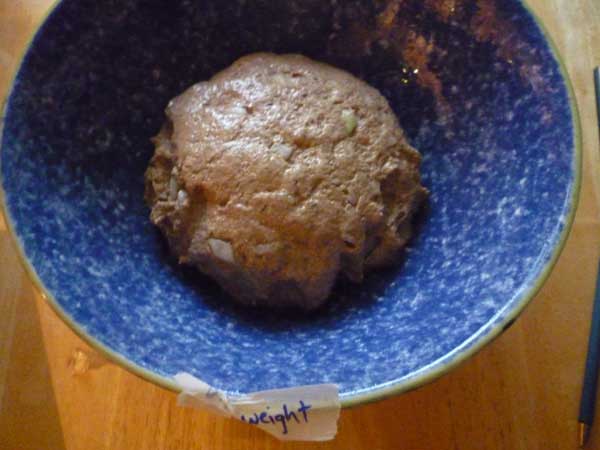
So I ended up using the Whole Wheat Motherstarter (WWMS) for both of these Rye Meteil loaves that I was going to be making.  I set two bits of the WWMS aside for later when the soaker would be done.  One of the bits I measured by weight, the other I measured by volume.  I weighed the volume measured WWMS too, for comparison.  By weight, Reinhart suggests 71 g; but my volume measurement of 1/3 c weighed 89 g.

So I decided to compare all the volume-weight ingredients as given in the recipe.

Soaker

For the first soaker,  I used Reinhart's suggested volume measurements, and then weighed them;  for the second, I weighed all ingredients and recorded what volume I got.  Here is a table of what I found:

            Volume Soaker 1         Weighed Soaker 2   
WW Flour:        360 g                1 1/2 c + 2 tsp
Salt:            2 g                    almost 1 tsp       
Yogurt:        166 g                very close     to 3/4 c

End weight:       400 g                430 g

This just goes to show you that weighing the dough is going to be more accurate.  The end weight is supposed to be 401 g.  If you measure by volume, your dough could be off by a lot.  But as it turns out, the recipe is fairly forgiving.

The name "Soaker" is a misnomer, I find.  This pre-soaked flour mixture is very dry.  Maybe that is just the nature of the beast when one uses yogurt to hydrate it, I don't know.  But it takes a lot longer than the 1 minute that Reinhart suggests to incorporate this large amount of flour into this small amount of yogurt by hand, because the mixture is so dry.  It could be that my whole wheat flour is quite different from Reinhart's, and requires more hydration.  I don't know.

This soaker is essentially what other bakers discuss as an autolyse -- which wikipedia tells me is a period of rest following the hydration of flour.  I suppose that it is closely related to autolysis, a word which I do know how to use, from my days in Anatomy Class in nursing school.  I suppose there are enzymes in the mixture which do start breaking down the cells of the wheat even further.  However, there is no added yeast in it, so I would guess there is not much fermentation going on yet.

But I don't know if the word autolyse in baking is supposed to be a noun or a verb, so I don't really know if I'm using the term correctly.  To me, it sounds like a verb, and it seems to describes a process (as in, you autolyse something - but that doesn't make sense, since it is not something that I am doing to the pre-ferment, but it is something that the pre-ferment is doing to itself, automatically); but bakers seem to talk about it as an object, e.g. "That lump of wet flour over there is the autolyse" -- but that doesn't make sense either, since the word seems to describe a process, not a thing: for example, when is it an autolyse, when the flour first touches the hydration, or when it is thoroughly mixed, or when it has sat 6 hours, or when it is finished at 12-24 hours?  I am afraid that I have been unable to resolve the use of this word.  I think that it is a nebulous term, ambiguously defined, like the word 'consciousness' or 'love'.  Perhaps this problem can be found in any word that describes something with a self-referential aspect.

I guess it is easier to just refer to them as 'soakers' as Reinhart does.  Even though, to me, a 'soaker' is when you step into a deep snowbank with your red rubber boots on, and the bottom of the snowbank is melted and it is so deep that the water runs over the top of your red rubber boots and 'soaks' your socks.  Despite the huge size of our country, and the variation for regional dialect, every kid who grew up in Canada knows what I mean when I say that is a soaker.  And I say that this pre-fermentation step is not nearly as moist as that.

I labeled both of these soakers and set them aside for 12 hours.

The Starter

I made the starter in the early afternoon, trying to coordinate when the starter would be ready to coincide with the 12 hour window of the soaker.  For the longest time, I was pretty nervous: I didn't see much action in the starter, which is supposed to rise using only the motherstarter as leaven.  Would my motherstarter be up to the task?

At the sixth hour, I noticed that the dough was expanding rapidly, and my hopes were kindled.  I didn't get to the final dough stage until the soaker had sat 13 hours, and the starter 9 hours though.  Perhaps at that stage, it had exhausted itself, who knows?

The Final Dough

This is a lot of work, getting two complete and separate recipe ingredients together.  This took a lot longer than I anticipated.  When I finally had everything mixed and measured, I began the kneading cycle.  Once again, I was unprepared for the way rye dough (even with this amount of whole wheat) acts.  It feels like putty.  Why am I always surprised by this?  The dough is strange to work with.  And all you can smell when you are kneading it -- first with wet hands, then with floured hands -- is the onions.

I could compare the doughs by weight and volume again here (and I did), but really, besides me, who cares?  Reinhart had his recipe testers check these things over before he published.  His recipes are as exact as anyone would like them to be.  He includes weights in ounces and grams, and volume measurements for every recipe.  You don't have to go far to see how superior this method is, as no matter what kind of baker you are -- meticulous or slap-happy --everybody is getting what they want.

The one that I meticulously weighed, I had to add a lot of flour and water during the kneading stage, just to get it to combine.  So much for the careful weighing of ingredients.  The next one I didn't have to make any adjustments for.


I put the dough together and kneaded it with the 5 minute rest that Reinhart advises.  I set it aside to rise, which should have taken 45-60 minutes.  But there was no appreciable rise until 1 hour and 45 minutes.  By then  I was falling asleep.  Nevertheless I formed the loaves (one a boule, the other a batard) and set them aside to proof.

Neither loaf had anything like a gluten sheath when I tried to form them.  It was just putty, with a hint of gluiness.   It was like the 50% whole wheat had added nothing to the rye in terms of structure.  Reinhart does say that this loaf is going to be gluten challenged.  I should say so.

I had high hopes for these loaves.  Even up to the point where I tried to slide the boule into the oven, I was hopeful.  Then, the wetness of the dough stuck to the well-dusted metal peel (my wooden peel had the batard on it, in a cloche).  The batard skidded clumsily onto the stone, now sadly misshapen.  And of course, after being so badly mistreated and overhanded on the oven transfer, there was no oven spring.  Another flat loaf.

Here is the crumb shot.  I didn't get into this loaf for a couple of days, but it remains moist, and the rye flavour comes through the onions and caraway now.  If it weren't for the fact that this loaf is flat and misshapen, this might have been a nice bread.  My wife doesn't mind the onions, but she complained about the caraway.  She hates caraway in bread.  It is just too overpowering for her.


The batard in the cloche was so wet, it oozed both sideways and lengthways.


It could not be contained by the cloth.  It dripped.  I floured the surface when I went to move it into the oven.  The only way I could get it in there was by taking the entire cloche with it, and shaking it over the stone.  It had already oozed beyond the size of the stone, lengthwise, so now it sagged from one stone onto another.  It was going to drip between the stones onto the water pan beneath, and there was nothing I could do about it.  I wouldn't be able to turn this loaf in the oven at 20 minutes.

(There was a lot of drippings from the ends of the loaf, and I just formed some balls with it and stuck them in the oven too.  They were actually the nicest little rye onion buns, by the way.  It is bread, moister than a timbit, but not nearly so doughy.  If I never learn how to form a nice boule, I can still live on these tiny crumbs, I think.)


But after all this work, to have the transfer into the oven defeat me thus - again -  I was bitterly unhappy.   I almost cursed Reinhart, even though I knew it was my fault.  I felt such utter failure, I thought about giving up the quest to work through his cookbook.  Seriously.

That is how much my hopes were dashed.


So… How's it taste?

It tastes like onions.  And sweet.  Oh, somewhere in the overtones of taste, there is a hint of rye, the sourness of sourdough and yogurt, and perhaps even some umami.  I mean, it is a complex taste.  The whole wheat flavour is lost, except maybe as a hint of some bitterness within the sourness of the whole wheat sourdough.  Also lost is much of the caraway, unless you happen to get a slice that had some caraway near the crust, and then you get a bit of a scent of it in the back of your nose.  Mostly though, the loaf tastes like onions.  The onions are really that overpowering.  I like onions well enough, but there was too much of it in this bread.

The next time I make this, I will leave that optional ingredient out; and maybe also the caraway, since my wife doesn't care for it.  And probably I will change the oils and sugars -- the dough is simply far too wet with all of that moist sugar and fat (honey and molasses and oil and yogurt).  The bread is once again too sweet for my taste anyway.  I will likely add some ascorbic acid as Reinhart suggests in one of his asides.

The batard that fell apart in the oven, I cracked open even further this morning, to eat some for breakfast.  The crumb is very moist - nothing at all like the picture in Reinhart's book, which looks almost pumpernickely.  So moist is my version of his bread, it sags flaccidly when you pick up a piece, even after toasting.  Perhaps if I waited a day or two, the bread might improve by staling a bit.


Beyond the Recipe

Just as I was searching the fridge for some cheese to put on this onion rye bread, I noticed that my Rye motherstarter had pushed the lid of the container up about an inch, just as the whole wheat motherstarter did when it was still on the counter the other day.  I would have to either throw some of it away to get the lid back on to it, or bake with it.

Throw it away?  You must be joking.

I immediately made both a soaker and a starter, and prepared to make the Meteil again.  But this time...this time, I would neither measure by volume nor wholly by weight.  I would measure by the feel of the dough.  I would let the dough guide me.  Or the Rheological Force.

Whatever, Yoda.

I began by weighing the starter and flours, happy if I got just close to the amount the recipe called for.  Then I started adding way more yogurt to the soaker.  Like, double.  And then I hydrated the starter ad lib.

The recipe card that I had made up from the book, in preparation for yesterday's bake (but which I didn't use, I still used the book -- now I was using the card), said I should use 6 g of water in the starter.  I started from there, but ended up adding about 3/4 of a cup.  And you know what?  Turns out that is what the recipe actually calls for: not 6 g but 6 oz (about 170 g).  Suddenly I felt vindicated, empowered: I sort of knew what I was doing.  I could step away from the recipe if I thought it wasn't working out right.  I could trust my inward sense now.

Let it rise while I'm sleeping today.  I'll put it in the fridge when I wake up, until I can get back to it and bake.  I can sleep like a man at peace.

Notes to Myself
  • Make it again, and this time, use no onions, no caraway, no added fat or sugar, less hydration.   Feel the Rheological Force, Luke.
  • Use ascorbic acid with this recipe
  • Don't let it rise too long.  If it is doubled, put it into the fridge.  You didn't do this with this loaf because Reinhart says that you need 2 hours to bring it back to room temperature, and that is when I was going to bake it, in 2 hours, so what was the point?  But the point was, at that moment you should have put the dough in the fridge and not baked it at all that day.  You should have waited until the next day.
  • There are two places during the baking process that you are artisanly challenged: 1) during the forming of the loaves, and 2) during the transfer of the proofed loaf onto the hot stone.  Are you ever going to get good at this?
  • I am beginning to suspect my whole wheat flour is crap.  Every time I use it I have a disaster loaf.  A poor tool-less craftsman blames his materials, I guess.