All grains contain peptides that mimic morphine or endogenous opioid substances. This is where I deal with my latest loaf craving. Get your bread-based exorphin fix here.

Showing posts with label healthy bread in five minutes a day. Show all posts

Friday, January 14, 2011

HBin5's 10grain recipe as an 8-grain with turmeric


HBin5's 10grain recipe as an 8-grain with turmeric

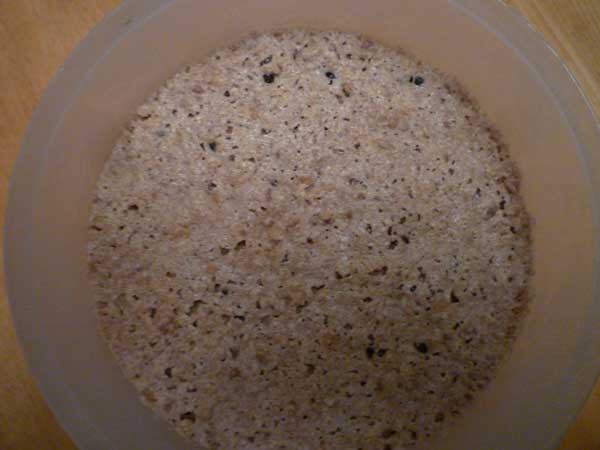
I was just using up this dough, that still contained papaya seeds.  I used a longer basket here, just to use up the dough in a single loaf.

I've always wanted to try adding some turmeric to the interior of a bread.  That was the only plan here.

I sprinkled a bit of ginger in the flour that coated the couche, and you know what?  That is actually the best part.  I think that next time I want a gingery crust like this, I will mix the ginger and the flour completely, and use it liberally to line the couche. 


I love the colour of turmeric, and of course, it is just so good for you. I flattened out the dough gently with my fingers and sprinkled lots on before rolling up the dough and placing it in the basket to proof for 90 minutes.


I also tossed a bit of dill on what became the bottom of the loaf, but this really got lost in the process.

The loaf turned out fine, sagging a bit, but it worked as a stone-baked artisan loaf with 3 slashes.


I think that the golden colour of the turmeric interior is amazing.  Although, it does seem to me as though the colour fades somewhat as the loaf is exposed to air.


Notes to Myself
  • What if you add the turmeric to the dough itself?
  • Add the ginger to the flour that you will line the couche with; or better yet, roll the dough in flour mixed with ginger before proofing.
  • What other spices would work here?

Wednesday, January 12, 2011

HBin5's 10grain recipe as an 8-grain with papaya seeds


8-grain bread with papaya seeds based on HBin5's 10grain recipe

This was just a quick bread to make, an everyday bread, so I would have something to take with me to work.  I didn't have time for it to sit, I just wanted to make it and be done with it.  The Healthy Bread in 5 Minutes a Day book is always a good bet for this sort of recipe.  I'm still a bit leery over the extra gluten and the all-purpose flour that is used, but anything you make is going to be better than what you buy.

And besides, I've wanted to try some papaya seeds in a bread for a long time now.  Here was my opportunity: we had some fresh ones sitting on the counter.  I tossed them in the dough.


Here are the weights or measures of the ingredients I used:

  • 239g Arva Flour Mill's 8-grain mixture
  • 467g wwflour
  • 310g ap flour
  • 21g instant dry yeast
  • 3g kosher salt
  • 38g vital wheat gluten
  • 873g lukewarm water
  • seeds from one freshly cut papaya, about 1/3 cup (not weighed)
  • some extra flour, and some of my home-made bread spice for lining the couche 


This is a high hydration dough.  I mixed it easily with a spoon, it didn't require me to get my hands in it.  It sat on the counter a long time before I got around to making the dough: longer than the 2 hours suggested in the book.  I didn't refrigerate it before using it, either.

That's one of the reasons why I baked it in a casserole dish, at 450 degrees, 20 minutes with the lid on and 25 minutes with lid off: I didn't think that I would be able to form a nice gluten cloak, and I was right about that.


The papaya seeds taste a bit peppery.  They might give the dough a slightly greyish, purplish-brown cast that is not entirely appealing.  The bread spice, which is more on the crust than in the crumb, merely gives it a nice scent.

Other than that, this is just an okay-tasting bread. Good for sandwiches, or toasted.  This is just one of those everyday breads that is baked fresh, fits into my lifestyle, where I don't have to monitor the dough too closely.


Notes to Myself
  • Try some dried papaya seeds next time.
  • Try other granola-like things, like dried fruit.  What would that be like, I wonder?

Monday, December 27, 2010

HBin5's Pseudo-Bavarian Pumpernickel - a new tactic


HBin5's Pseudo-Bavarian Pumpernickel

With the last experiment of the HBin5 Bavarian Pumpernickel a total failure, this time I decided to try a longer bulk fermentation, and a longer baking cycle, and a different method of baking.  Pumpernickel is traditionally steamed, and to approximate this, I returned to a Lahey-style method of baking it inside a pre-heated old crock pot interior.

I rolled the soaked rye seeds in the interior as I had previously, but I put it in a floured, cloth-lined basket for about 2 1/2 hours prior to baking.

The baking was done at 450 degrees F for 30 minutes with the lid on, another 30 minutes with the lid off, and then a further 15 minutes with a boiled rye flour starchy coating to the crust to keep it from getting too hard -- a total of 75 minutes.


Results:

It still was not long enough.  The interior of the loaf is still far too moist (even a full day after baking, before slicing into it).  The loaf did stick to the preheated container -- probably due to the damp rye seeds that were sprinkled on what ended up being the bottom of the loaf prior at the time of bulk fermentation; or it could be because of the rye starch wash that was placed on the loaf during the final 15 minutes of baking.

The crust is crunchy and has a nice taste.  The loaf was damaged in digging it out of the container with a spoon when stuck.  It is very airy inside, and far lighter than it looks.

When you get an edge piece of the loaf, it tastes quite nice (although not a thing like pumpernickel) -- a nice, mild rye bread.  But the interior remains gummy, that no amount of toasting will correct.


Notes to Myself
  • This will be the last time I make this recipe.  It is not a good one.
  • When baking rye breads in this manner, and this thick, you best consider a time of 45-60 minutes with the lid on, then another 30-45 minutes with the lid off.

Friday, December 24, 2010

Variation of HBin5's Bavarian Pumpernickel


Pseudo-Bavarian Pumpernickel

These are dangerous times.  This morning I realized I had no bread to take to work with me, when I work nights over the holidays: Christmas eve and Christmas night (Like all nurses, I take my turn at working holidays).  I wouldn't have time to bake on those days, between sleeping and family visits.  I was going to be exhausted, with no bread.

So I had to make some bread on the 23rd.  The bread I made on the 22nd -- a playful, experimental loaf and a 123 loaf that utterly failed --- is inedible. 

But baking on Dec. 23 meant sharing the kitchen with my wife, who needed to use the space for her holiday baking.  We generally share this kitchen space by taking turns.  But this morning there was no way around it: we had to co-exist in the same space.  Holiday tempers flared.

I opted for something fairly simple: I would make a big batch of Bavarian Pumpernickel from "Healthy Bread in 5 Minutes a Day" (something I've never made before, but sounded interesting). 

I measured what I scooped, to determine the baking percentages.  Here is what I found:

More or less Mis en place

    •    364g whole wheat flour
    •    268g rye flour
    •    378g all purpose flour
    •    19g yeast
    •    9g kosher salt
    •    40g vital wheat gluten
    •    17g bread spice
Plenty gooey to mix up: you have to do it by hand, the spoon isn't enough

My family has an aversion to caraway.  This is my own home-made bread spice, that I made here.  I used 2 TBSP here, not one.  I have to say that the reason this bread smelled great while baking was due to the spice used.
 Everything is mixed, and then it is set aside to sit for 2 hours or so

 It sees a substantial rise in that time, and then it gets refrigerated.

 Overnight in the fridge it will have settled a bit more

Making the liquid caramel was a really fun thing to do, but it does bounce dangerously hot drops of supersaturated solution around when you pour the boiling water over it.  The warnings in the book are to be heeded. 

    •    76g liquid caramel
    •    36g molasses
    •    904g water (961g - 1/4 cup)


I decided to also make up some soaked rye kernels too -- I would boil them 30 minutes and then soak them overnight in some apple cider, and add them to the dough at the last minute before baking. 

    •    1 c rye berries 170g
    •    2 c water

 I boiled the rye kernels for 30 minutes, then soaked them overnight in cider

Now this little change that I made would ultimately change the way this loaf was shaped, and I had no great expectations that my loaf would be as nice as the one promised by the HBin5 authors.  With no great expectations, I was not so very disappointed, therefore, when my bread didn't perform well.  I can't really blame the HBin5 authors here.  I didn't follow directions, so I was bound to have something quite different.


 I flattened the dough gently with my fingers...
 ... and tossed some soaked rye berries on top

I proofed the dough in a basket lined with a tea towel.

 Just prior to baking


Regarding Pumpernickel: 
This "HBin5" pumpernickel bread is not a real, traditional Pumpernickel, but rather a North American variation.  I understand the traditional dark black pumpernickel loaf is mostly rye meal, steam-baked a long time, upwards of 16 hours, to achieve a taste and dark black colour derived from the Maillard reaction.  We know that this is dangerous, due to the Acrylamides that are also formed (although the long steaming process might slow their creation, who knows?).  But something in me wants to try and make it anyway. 

This method is supposed to approximate the taste, the flavour and some of the colour of this dough is supposed to come from the caramelization of some sugar that is boiled on the stove.  This is inauthentic, but it is apparently the best I can do unless I have more time.  I have been recently interested in the discussion of what gets added to pumpernickel to make it so dark.  The experts say nothing gets added: it is the method alone which gives the pumpernickel its taste and its texture and dark colour.

Results of my Bake:

 Before I shook off the excess flour
Pancake thin loaf!

Results

Although this baked for 50 minutes at 450 degrees F. (the HBin5 recipe called for only 30 minutes), it is not baked.  And it tastes nothing like a pumpernickel.  In fact, it tastes very bland -- it is wet inside, and has no Geschmack at all.  If it were not for the fact that it is Christmas and there is nothing else at all to eat when I go to work, I would not eat this at all.  It is awful.


Take a look at the many underbaked areas of the bread, especially on the edge at the bottom, where the bread sat directly on the stone.  This stone was preheated for 30 minutes.  There is no way that it was not hot enough.  What happened?  This looks nothing like pumpernickel, and doesn't even look like a rye bread.  This bread was a disaster.

Merry Christmas.

Notes to Myself

  • This bread cannot be salvaged.  When the holiday nights of work are finished, soak it in water and give it to the chickens, along with the last few "breads" you've made.
  • Informative Links on Rye (Things I've been reading while preparing to bake this):
  • Shiao-Ping writes on her pure rye bread here; I consider her breads to be the very best looking of all the Fresh Loaf Bloggers, and her advice is always on the money.  She makes very nice looking rye loaves and then tells us that her family doesn't like them!  She has made many other rye loaves that I really want to bake too.  She makes it seem so effortless.
  • See also Horst Bandel's Black Pumpernickel recipe, care of The Fresh Loaf Blog.  Another blogger, Franco, attempted it and had good results here.
  • I like the etymologies given in the Wikipedia article on Pumpernickel: "The Devil's Fart" indeed.

Tuesday, December 14, 2010

Again with the Peppery Pumpkin Bread from HBin5 (almost)

 Finishing off the Peppery Pumpkin Bread Dough

This is the same bread dough as before (recipe from Healthy Bread in 5 minutes a day, except for a mistake of too little hydration).  I'm just shaping this loaf differently.  No attempt here to make a pretty crust picture.  I kneaded it a few minutes cold, and then shaped it into a tight oblong.  It then warmed to room temperature in a floured basket, about 3 hours while I was shoveling the driveway.  Then I scored it and tossed it into the oven for 30 minutes.  No further comment necessary.

Except to say that the last pumpkin bread, half way through eating it, was a bit of a gooey disaster: there was a big empty hole inside, and a lot of unbaked dough around it.  Not sure why.  But this has happened before to me, on other loaves.

The Last Ugly Pumpkin Loaf: what went wrong?
Not enough kneading?
Not baked long enough?
Underproofed?

What caused this bread to fail?


I ended up giving a lot of that last loaf to the chickens to eat.  I'm hopeful that this one is at least completely baked.

Bread is made.  Dog is snowbound, watching birds and squirrels at the backyard feeder.

I cut into this bread while it was still a bit warm.  Crap.  The crumb was fine on the edges, but not baked properly all the way through.  This bread required 10 more minutes of baking at least.  I had some with the last of my pumpkin soup.  The end pieces were fine, but the inside slices, even if you toasted them, are gummy.


Jack Pumpkin bread with the last of the jack pumpkin soup
Middle of the loaf fail

Notes to Myself
  • Put some herbs in your next bread.  We grew some basil last year, and it might really spice up a loaf.
  • Bake this recipe 10 minutes longer next time.