All grains contain peptides that mimic morphine or endogenous opioid substances. This is where I deal with my latest loaf craving. Get your bread-based exorphin fix here.

Showing posts with label everyday bread. Show all posts

Wednesday, October 5, 2011

Spelt and Light Rye loaves for Others' Thanksgiving

Thanksgiving Loaves for Family
Good, Better, Best:
Let us never rest
Until our good is better
And our better best.
  • My Grandmother, who will be 102 yrs old this year
    (reciting a rhyme she learned in public school)

Here are a couple of everyday breads made with my wild yeast.  I haven't used commercial yeast in quite a while now.  Why not?  Well, pick any one of several reasons: (1) I have the sourdough, so I might as well use it, (2) wild yeast tastes better, (3) it is healthier for me.

As usual, I am basing this spelt loaf on the Tartine technique, although you will look in vain for the recipe in the Tartine Bread book.  I think the Rye bread is actually the Rye Bread recipe from Tartine; it uses all purpose flour, and my intention is to give it away.  It is Canadian Thanksgiving this weekend.  Of course, I have to work, but my wife is meeting with my son, and so I hope he gets one of these loaves to take home with him.  Since it has rye in it, it theoretically should keep slightly longer.


My wife wanted a slice for her lunch, so I've had a look at the crumb.  Her verdict: no good for honey.


A. The Spelt Loaf
  • 200g starter, made with spelt
  • 650g water + 50g water later
  • 200g barley flour
  • 600g spelt flour
  • 200g ww flour
  • 20g salt

B. The Rye Loaf
  • 630g ap flour
  • 200g ww flour
  • 170g rye flour
  • 700g water + 100g water later
  • 100g cracked wheat
  • 20g salt


I have been wondering if my bread baking is getting any better.  How do you compare the bread you are eating now to the bread you ate a week ago, a month ago, a year ago?  Yet the mind has the faculty of discrimination: we can place two images beside each other and choose the best of the two, whether that image is a literal photographic image, or an imagined image or a memory of an actual loaf.  We can compare.  And like everything else in the real world, we must choose.

Skip the rest of this if you just want the usual bread info.  There's not much more bread info from here on in.  It is all segue to 'Back to Bread'.


Political Scale: a quick lesson
Many years ago, when he was very young, I offered to my young son a quick and dirty explanation of the linear scale that popular media uses to differentiate political parties.  We often hear the terms "Right wing policies" or "On some issues he leans to the Left".  This scale is not taught in school, evidently.  We pick it up by osmosis because everybody uses it.  But it really isn't all that useful, as it tends to gloss the reality, which is complicated.  Nevertheless, it can certainly show you when and where the media has become overly simplistic.  On the eve of another Provincial Election, I am reminded of this scale again.  With three main political parties in Canada (Conservatives, Liberals, and the New Democratic Party), this scale has become a sort of short-hand:

<------------------------------------------------------------------------------------------------------>
                                      |                                |                                |
                                         NDP                    Liberal                Conservative

As I told my son about this scale, I also gave him a little family history lesson.  His mother's family came from Germany, and to understand why they came to Canada, one had to know something of German politics and how it affected everyday life there.  Just prior to the advent of the second world war, Germany was still reeling under the weight of reparation payments following the first world war.  In an attempt to alleviate the plight of the ordinary people, the German populace used their democracy to try everything they could think of: right wing, left wing, and everything in between.  When the conservative parties were not far enough right, they looked to fascists; when the union parties were not far enough left, they looked to communists.  The ideological rifts that occurred plunged the world into another world war, and physically divided the entire country for more than a generation.

And the recent history of Canadian politics can also be written on this simplistic linear scale: in the 80's and early 90's, the conservative government of Brian Mulroney moved toward the liberal centre of the scale, squeezing the liberals and achieving successive majority governments for the conservative party.  Unfortunately, this alienated some of the long-time members of the conservative party, who actually splintered off from the main conservative political party and formed their own "Reform" party, particularly in the west.  When the Liberal party came back even stronger and pushed the conservative party back toward the right, the old conservative party was crushed and obliterated.  The current conservative party is built largely on the ashes of Mulroney's legacy, with a good smattering of Reform.  But they have grown stronger again, largely due to the lack of leadership of the Liberals.

In practice, most people in Canada are not card-carrying members of any one political party.  They like some things about the NDP: for example, our universal health care (an idea that came from the heart of Tommy Douglas, one in a long line of excellent NDP leaders that Canadians love but do not elect to the highest position (the latest being Jack Layton, may he Rest In Peace.)).  But they also like the basic idea of the conservative parties -- that is, keep ownership private, and keep the government out of our business.  What this means is, most people are liberal in practice: we like our services, we just don't want to be the ones who pay for it.  It's not always the most realistic choice, but we do tend to gravitate toward the middle, like a bell curve.

We call ourselves a democracy, but we don't get a personal vote on every issue.  We really have to choose a single person to represent us in government, and they are always affiliated with a political party, and we take a lot of baggage we don't necessarily want, along with the personality.

But I really don't want to talk so much about politics and my oversimplification of it.  what I really wanted to talk about was the idea of a scale.

ESAS
In palliative care in Canada, we regularly use a scale that was developed in Edmonton to assess the needs of our patients.  The Edmonton Symptom Assessment Scale (ESAS) would have a person assign a number, between 0 an 10, to some symptom or quality in their life.  When first introduced to this scale, many people have difficulty wrapping their head around the concept.  Rarely do we ever associate a quantity (the number you are asked to choose) with a quality (usually something fairly nebulous and not well-defined, like a subjective feeling).  For example, right now, try this:  on a scale of 0 to 10, 0 being the best possible quality of life, and 10 being the worst quality of life, where would your quality of life fall on this number line?

Many things affect your quality of life.  If I asked this right after you stubbed your toe, you might, between hopping around holding your foot and cursing, give your life a quality rating of 7, or 8.  Or if I asked this of you just before you nodded off to sleep after the greatest sex of your life, you might mumble 1, or 2 (it wouldn't be 0, because I would be pissing you off, annoying you about assigning a number when you really just want to fall asleep in the rainbow afterglow...).

ESAS attempts to measure a lot of different symptoms that always seem to pop up in end-of-life care:  pain, tiredness, nausea, depression, anxiety, drowsiness, appetite, wellbeing, shortness of breath, and other.  The "Other" category is for patients to define their own category that is important to them.  You can then use these scales to plot any given symptom or category at any given time, to see the changes that have occurred using a chart like this.  Obviously if a person categorizes their pain at a 3 or greater, we have to make an intervention, and deal with it.

On the other hand, I am concerned about the over-use of such scales, because I believe that placing attention on pain certainly ensures that pain will be experienced.  A study has been done that suggests talking about pain increases pain.  In other words, when I ask a patient if they are experiencing pain, they experience it...so how do I assess them, if as we are taught in nursing school, 'pain is what the patient says it is'?

Quantified Self Scales
Every since I have skim-read Douglas Hubbarrd's book "How to Measure Anything - finding the value of 'intangibles' in business", I have been interested in scales that quantify what are essentially subjective qualities.

I have been a closet follower now for some time of the Quantified Self website, interested in how people put together their independent self-studies, and curious as to what sorts of things they are interested in.  A lot of fascinating people are using tools they have invented that are similar to ESAS, in order to examine quantitatively how they feel about various things.  Just a few recent examples:

Ari Meisel - curing the incurable through self-experimentation
Ari cured himself of Crohn's disease by self-monitoring of his experiments related to diet and fitness.  In this short video of his talk he casually mentions a ton of computerized tracker devices and software that he tried.

Robin Barooah - "I am broken, or I can learn"
Robin used a much simpler binary process of attending to what he ate and how it made him feel three hours later, and ended up losing 45 pounds.  It was apparently enough to place the attention on how he felt (energized or lethargic?) to awaken the unconscious mind to deal with the issues of his weight.

Roger Craig "Knowledge Tracking"
Using a lot of web-based tools he wrote himself, using text-mining, a Jeopardy Q-A database, and various mathematical tools to improve his answering ability, Roger went on the Jeopardy show and kicked ass.

There are tons of other examples.  Check them out.


Emotional Connoisseur
My friend and I have had a recent conversation about how he and his wife trained their girls to describe their emotional life with a rich vocabulary.  Their intention was to provide the girls with a more refined ability to experience their emotions, by more carefully naming the affective states.  You teach a child the parts of the body by pointing to their "head and shoulders, knees and toes"; but as they grow, they may need to learn more exacting terms for the body parts: scapula, uvula, antecubital.
But what about our emotions?  Mostly we learn the basic terms, and you know when you feel sad, happy, angry.  To quote my friend:


A person, after all, who understands that something can be moving, touching, poignant, bittersweet, crushing, haunting, unsettling, depressing, etc., could have a richer, deeper experience in life, say, that someone whose only word to describe these things is "sad."  A person who understands that something might be exhilarating, liberating, joyous, triumphant, empowering, satisfying, etc., etc., could have a richer experience in life than someone whose only word for these things is "good."

And that brought to mind this short comic by xkcd, which suggests that we can become connoisseurs of almost anything.
See the original cartoon on xkcd
Randall Munroe, the cartoonist of xkcd always includes a "hover message" -- if you hover the mouse over the cartoon, an editorial line shows briefly.  The editorial line for this cartoon says, "Our brains have just one scale, and we resize our experiences to fit."

I was thinking about that, and about how some of our perceived scales are actually naturally logarithmic.  Take a look at this video (Vi and Sal Explore How We Think About Scale/ How Humans Perceive Nonlinearity) that I found to understand what I mean.

Before Freud, no one paid any attention to the unconscious mind.  Things seem to be invisible to us until we can name them -- whether it be the recently discovered (?but still unconfirmed) neutrino that travels at hyperlight speeds, or the rarest emotion that humans can experience (Lets call it Self Actualization, after Maslow, even if that is not exactly or merely an affective state).

The point I am making: what is going on, really, deeply, wholly, inside of us, or outside of us, that we are not aware of?  How do we name it, how do we quantify it, how do we study it?

 
Back to Bread
I have, for the past couple of years, been blogging about every single bread I've made.  Some have been absolute disasters, some have been very good indeed.  I think I've been getting a bit better at baking bread, but this is a very difficult thing to measure as it involves a whole lot of different metrics, not to mention different types of bread for different purposes.  I probably would have to develop my own personal "bread tracking scale," for my own personal use.  But what should I be tracking?  The more data, the more one can play with the numbers; but too much data, and all you get is noise, and you can't really make sense of it. 

There are things that you would expect that would be on such a scale:  grain, hydration, ferment, taste, crust, crumb, aroma, healthfulness, shelf-life, appearance, shape, etc.

Still, it makes sense that I should be elevating my experience of bread to the same level of language as the connoisseur of wines.  Things like mouthfeel, aftertaste, the layers of flavour -- these are all things that can be named, scaled, refined.  What other things are measurable?


Notes to Myself
  • Learn what scales already exist for the description of bread, and dough, and flours. Probably this has already been done. What about the rules of every fall fair where people enter their bread to be judged? What are the criteria? This should give you an idea of how judging is done.
  • Do you have enough info on each bread that you have blogged about to determine which bread you have made is the best?

Monday, September 12, 2011

Barley-Rye-WW-AP loaf, and a Whole Wheat Bread with 17% Rye


In the wake of my second millet loaf disaster, I decided to steer clear of millet flour for a while.  Today's Tartine-style loaf started out with 170g of rye flour, but to that I added 200g of Barley flour, 200g of ww flour, and the rest was AP flour.  My wife is seeing an acupuncturist for her sciatica, and he advised her to eat barley.  These loaves were originally for her.

I needed to make more rye bread for me too, since the rye breads I made the other day were being given away.  This was almost the actual Tartine Rye Recipe, at 170g of Rye flour; but for this loaf, I used 830g of Whole Wheat, used the whole wheat starter, brought the hydration to 85% and dusted it with a combination of rye meal and rice flour.

First time ever I used my wicker baskets with a tartine-style loaf and no couche liner.  I dusted heavily, but I still worried it would stick.  They did not.

The loaves were retarded overnight in the fridge, and baked in the morning.
Forcing Bread
My folks came by for a short visit.  We gave them some fresh eggs from our backyard chickens, and I asked them if they also wanted to take home some fresh bread, too.  I had these 4 loaves on the counter, and another 2 or 3 in the cupboards.  My wife was actually a little frustrated that we had so much bread on hand, and I just kept making more.

"You want some bread too?" I asked them.

"No," my dad said, a little bit too quickly.  It was blunt.  There was no hint that he had even contemplated saying, "No, thank you" (like he had taught me to do, since I was knee-high to a grass-hopper).

He blinked.  I blinked.

There was a long beat, a deep silence that enlarged the distance between us.  Then I foolishly insisted he take some.  I thrust a loaf of my newly made bread into a bag and set it on top of the eggs for him to take with him when he left, whether he wanted to or not, barely registering how his shoulders fell slightly, hardly seeing his frustration rise.  He was annoyed at having to once again eat some of my bread.

You see, my dad is a "white bread" kind of guy.  He likes his peanut butter, he likes his jam, but he likes it on toasted tasteless white bread, the stuff he is used to.  And my bread -- even the white loaf I gave him, the one I made from all purpose and barley flour -- he simply doesn't like.

This is what the barley flour loaf looked like just before adding salt
So there you have it.  My bread makes no one in my family happy, except for me.

Sorry Dad.  But even if you don't like it, you can tear it up and throw it in your compost.  The worms will like it.


Results

My sweetie ate the remaining barley loaf, but before she finished it she complained that it staled quickly.  Good thing she didn't have 2 loaves to get through.
Signs of fermentation in the bread. 
Oh, that was the day I put some grapes through the Dampfentsafter.


Barley bread can be sliced thin.
But it won't hold jam, Dad: sorry.
I had a slice or two of this bread, and I enjoyed it. But I prefer more whole grains now.  The 17% Rye bread that I made for myself was much more to my liking:

ww&17%Rye Sourdough with cracked rye crust

This Rye Bread was tasty


Notes to Myself
  • Do not force people to eat your bread, no matter how much you have on hand.
  • I was particularly pleased with these rye loaves.  They were so good.  The cracked rye crust was especially tasty and interesting.  The crumb was soft and tasty.

Monday, July 18, 2011

An Everyday Bread: WW bread from ABin5


The Whole Wheat Bread from Artisan Bread in 5 Minutes a Day

Here's a bread that I come back to from time to time, just for the ease of it.  Last time I made it was with ginger, and some dried peppers.

The bread does contain some honey, so it is fairly sweet, but it works up fast.  It fit into my schedule this week.  I knew that I'd need a bread today, since I was down to crusts, and I wouldn't have time to properly bake a Tartine-style loaf using wild yeast. 

The dynamic duo that author the '5 Minutes a Day' books gave us this whole wheat bread in their first book, and I actually like it better than most of the breads that I've tried in the second book, which mostly contain vital wheat gluten.

I stirred up the dough last night and it sat in the fridge until morning after rising at room temperature about 2 1/2 hours.
misshapen

the loaf remains in the cooling oven


I baked it at a lower temperature

Today I was making some Sourdough Discard Whole Wheat Apple Cinnamon Muffins, using the recipe from 'The Baking Barrister', and made this loaf at the same time.  I didn't let the loaf rise in the tin any length of time, just took it from the fridge, formed the loaf, put it in the tin and right into the oven, at the muffin temperatures, which is kind of low for this recipe (350 degrees).  It baked for the first 20 minutes under another, overturned tin, and then 20 minutes more with the lid off.  Then I took it from the tin and turned off the oven, leaving the bread in a cooling oven until I could return, about 7 hours later.

I didn't expect the bread to rise much, I was rather expecting the crumb to be dense.  And certainly it is, but that's okay for a sandwich bread: it holds the butter and tomatoes just fine.  For a quickly made bread, its okay.

More about the Muffins

I'm always on the lookout for good sourdough discard muffin recipes.


These were a failure (no doubt my fault, not the fault of the original recipe).  My sourdough was likely a bit wet.  The recipe calls for 100% wild yeast discard, and mine was just mixed up ad lib, Tartine-style.  And my backyard-chicken-laid egg might have been a trifle large.


The original recipe, and the weights I found as I made it:

  • 3/4 c sourdough discards 200g
  • 1 c ww flour 148g  - I think I would increase this to perhaps 175g next time
  • 1/2 c sugar 103g  - I think I would decrease this to 50g next time
  • 1 tsp baking powder 3g
  • 1 tsp baking soda 5g
  • 3 Tbsp cinnamon 9g
  • 1 egg 63g - a smaller egg would be okay here, since the mixture was a bit wet
  • 2 tsp vanilla 11g
  • 1/4 c oil 52g  - I would back this off to about 30g next time
  • 1 large apple, peeled, cored, cubed 106g  - use some sour apples, even dried apples
  • Topping: 3 Tbsp brown sugar 42g
  • 1 tsp cinnamon

The muffins flowed too much, but they did show some promise.  They did appear to be rising a bit as I spooned them into the tins.  But they didn't mushroom up over the top of the muffin tins like a muffin is supposed to.  Instead, they spilled out onto the floor of our new, used oven, causing quite a lot of smoke.

But they taste okay -- if a bit too sweet for my liking.  There is a lot of sugar in them.

Here's another bread from the batch.  This one sat for 1 1/2 hours after being shaped, then baked for 50 minutes at 350 degrees.


Notes to Myself
  • As for the muffins: 
    • cut way back on the oil, next time.
    • Use less sugar.  More whole wheat flour.
    • Use a sour apple.  Would your dried apples work here?
  • As for the bread:
    • Of course, if there is time, let it proof in the tin at least until it comes to the top of the tin
    • Try this with no honey, some time.

Friday, December 10, 2010

Peppery Pumpkin Bread from HBin5 (almost)

Peppery Pumpkin Bread from HBin5

I gave this recipe my own special touch: I added far less water than the recipe called for. 

As usual, this was by mistake rather than by intention.  The liquid measuring cup that I used is only 2 cups big, and so I measured out the first 2 cups and set it in a bowl; then I measured out the 1 1/2 cups (to make the full measure of 3 1/2 cups that the recipe called for) -- and when mixing up the ingredients, I forgot to add the bowl of water.  Mis en place?  It was right there, I couldn't have missed it.  But I did.

The result was a dough that required kneading, a lot of kneading, to get the ingredients incorporated.  By the time I had it kneaded, I saw the bowl of water, and I could still have incorporated it, but I figured, what the heck, let's see what I get.

I was using a jack-o-lantern pumpkin that I had roasted and pureed a day earlier.  These are a good bit wetter than the usual baking pumpkins, I think.

The dough was left out for 2 hours and did see some rise.


 Then it was refrigerated for 24 hours.  There was even more evidence of fermentation.

At that point, I tore off about half of it and punched it down while cold.  I shaped it into a tight boule and set it in a floured basket to see if it would rise some more when it warmed to room temperature.


It didn't really look like it expanded much.  It is only later, when I look at these pictures, that I see that it did indeed have some swelling. 


But I decided to score it and bake it anyway.  I preheated the stone to 450 degrees F and decorated my loaf.  You can't really see it in the end result, since I used pumpkin spice, and that turns out to be the same colour as the baked bread.  Next time I'll use white flour or rice flour, I guess.

Results

The bread is surprisingly light.  I suppose it is the extra gluten that was added.  This bread is like a sandwich loaf, with a crunchy crust that is not too brittle.  The taste is good, but I could have used a bit more pepper.


Notes to Myself
  • Try some other recipes from HBin5 this way: i.e., less hydration, shaped when cold. The shape of the boule seems to hold together far better, you get a lot less sag.
  • In terms of decoration: try keeping the cookie cutter on the loaf as it bakes. Try white flour, try glaze everywhere on the bread. Try embedding parsley or other herbs with colour.
  • What other vegetables could be added to bread?

Thursday, October 28, 2010

Everyday Bread: 70 Percent Rye Sourdough Hearth Bread


70 Percent plus Rye Sourdough Hearth Bread

This is not exactly a 70 percent rye, with 30 percent whole wheat; it also includes a lot of rye in the sourdough starter.  I could figure out the ratio, but who cares?  I am using the same old recipe for the tinned loaves I've been making, the only difference here is that part of the flour I am working into the final dough is some whole wheat.


I start with the Rye Starter; this one is at about 70 percent hydration.  I consider that to be 92.7% of the total flour I will use, and after weighing the starter, I calculate the amount of flour to be 100%.  

Formula:  Assume the weight of your starter is n.  n X 100 / 92.7 = w, where w is the weight of the total flour.

In this case, my starter weighed 598g.  So:       59800 / 92.7 = 645g.

I wanted to have about 30% of this total flour weight to be whole wheat, the rest to be rye flour.  So if 645g is 100%, then 30% is going to be 194g, and the rye at 70% will be 452g.  Yes, I said I didn't care how much flour was in the starter today.

The water is supposed to be 85.4% of this total flour, but since the thing is too wet for a hearth loaf, I will try backing this off by 5 % next time, and each time hereafter until I get a consistency that actually holds together on a hot stone.

Here is the latest whole recipe in a nutshell:


  • Ingredients:
    • Rye Starter 92.7% (598g)
    • Flour 100% (645g; 452g was dark rye, 194g whole wheat)
    • Yeast 1% (4g)
    • Salt 2% (13g)
    • Water 85.4% (551g)
  • Method:
    • Mix all the ingredients together with your hands and shape to a basket-sized lump.  Place in a couche-lined basket that is liberally sprinkled with some multi-grain flour.
    • Let rise min 2 hours, max 6.  You are looking for some expansion, but not a doubling in size.
    • Dock dough, then turn it over onto a hot stone and Bake at 450 degrees F for 65 minutes with steam.


I was hoping that this dough would hold together more, and retain its height, but it sagged a lot.  Would cutting down on the hydration help?  Would kneading it help?  I very nearly tried putting it in a bread machine and letting it knead for a while.  But I decided against it, and just floured a couche in a basket and after letting it rest for about 2 1/2 hours, I docked it, turned it out onto a hot stone, and baked it for 65 minutes at 450 degrees F with a bit of steam in the beginning.


Bread and 2 Goldfish that we saved from the pond yesterday before it freezes

The crust of this dark rye loaf is very hard and difficult to cut: it should keep out anyone but the very determined. But those who, like myself, are very determined, will find that this bread is very tasty.  It does have a mild sourdough scent, but there is no sourness in the taste.  I ate some with a Gouda cheese the morning after baking it, and it was very nice without being toasted.  I also toasted some to see how it would hold up under those conditions, and it was fine.  There is a lot of wheat on the surface of the crust, left over from sitting in the couche, and I really should shake some off outside, as otherwise it gets all over the slices that I cut.

Although I like the way this loaf tastes, and even how the crumb looks, my big complaint is that this loaf, as so many others that I bake, has sagged rather than plumped in the oven.  This happens to all of these highly hydrated loaves when they are baked freeform, i.e., not in a tin or some other container.  If they would just retain their shape on a hot stone, I would be a happy home baker.


Notes to Myself
  • Try 80% hydration next time for a hearth loaf.  And if that is too saggy, next try 75%.  Then 70%.  Etc. until you find the right hydration.
  • Try kneading this in a bread machine for a cycle before putting it in the basket to rise.
  • Let it rise more than 2 hours, but less than 6.
  • Does the old rule apply when making a rye bread that is not 100% (i.e. let it sit until cracks form in the surface)?

Friday, October 22, 2010

Everyday Bread: A No-Knead Rye Sourdough with whole rye soaker


 No-Knead Rye Sourdough with whole rye soaker

I dunno.  This loaf just got tossed together without much forethought.  Haphazard loaf.

When I was refreshing my rye sourdough motherstarter, I thought I'd save some and make another that could be used to make bread.  Unfortunately, I forgot about it, and it sat on top of the refrigerator for about 24 hours.  That meant that it was more Lactobacillus Bacteria than Yeast, pretty sour stuff.


I persisted anyway, and made a dough based on one of my current recipes that I've been using:

  • 92.7% Rye Starter:  444g
  • 100%  Flour:  479g
  • 1%      Yeast: 5g
  • 1.5%   Salt: 7g
  • 85.4% Water: 409g
  • 1%      Homemade Bread Spice 5g
  • 31%    Seeds or Grains 148g
 I thought that this time I might put it together with some rye berries that were soaked overnight (rather than boiled, as in last everyday bread experiment).  The rye berries were to be soaked in 2X the amount of water (296g).  Rather than add this water, I simply divided the water that was already in the recipe.

Mixing up  the rest of the ingredients, I kneaded until I arrived at a very dry dough which I figured out to be a  31% hydration dough (311g of flour in the starter, plus the flour at 479g is 790g total, compared to 113g water plus the water in the starter, 133g for a total of 246g).


I then plopped that round ball of dough into the seed water overnight.  Not knowing what to expect, I put that container inside another one, in case the first one overflowed.


In the morning it was found to be expanded somewhat, and I mixed the soaked seeds altogether into the dough.  It made for a pretty wet mix.


Then I went to work and didn't get back to the dough for 14 hours.  The dough had expanded, but it hadn't quite doubled.


I poured the mixture into a pan.


Starch

I made up a starch glaze, based on Nils Schöner's version of a starch bread glazing, on the page devoted to his Quarkbrot. 

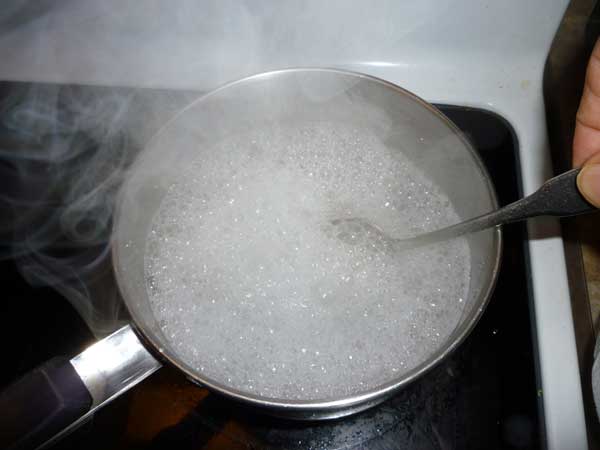
To cool down the boiled starch solution quicker, I changed bowls several times, put it in the freezer, and added a tablespoon of plain yogurt and stirred until it had totally incorporated.


I docked the loaf deeply, and then painted on the starch glaze.  Finally, I sprinkled some sesame seeds on top of that.


After I baked it, I let it sit for another 24 hours before cutting into it.


The resultant dough was far too sour.  Nevertheless, I baked a bread that reminds me of a Rye Vollkornbrot.

It is edible, but I'll likely be eating it all myself.  The crust is a bit hard, and I doubt that this loaf would be to the liking of anyone else.  The whole rye seeds probably needed a longer soak, or would have been better cracked first.


Notes to Myself
  • Does it need to be said?  Try making this when your sourdough peaks, and not when it is spent.
  • Soak some cracked rye, not whole rye berries, or soak the whole berries longer.  Would they be better off soaking in brine first?  They need to be softened up a little bit more, but not too much more, because I like the texture.
  • The most unusual part of this experiment was floating the early 31% rye dough in some water that had grain soaking in it, and allowing the dough to expand into the water.  The water will never be entirely incorporated on its own in this way, of course, but it remains a curiosity.  What if you had docked the ball of dough?  Would it have expanded more? 
  • What is better for whole grains incorporated into a bread: boiling, like the last loaf, or soaking, like this loaf?  I think, boiling.