Reinhart's Sourdough Hearth Bread
made (Lahey-style) in a Casserole Dish
So here again, fast on the heals of the blunderbread (which, despite its name, tasted okay and didn't last long), I am making another sourdough hearth bread, using Reinhart's recipe. However, I am not making it on a stone (so is it still a hearth bread?), but am using Lahey's method of baking it in an enclosed pot within the oven, so that moisture is retained during the initial part of the baking, and the oven rise is more dramatic. My hope is that there will also be less sag in the loaf, because the pot will shore up the sides -- although now that I've got the hydration correct, that should be less of a problem.
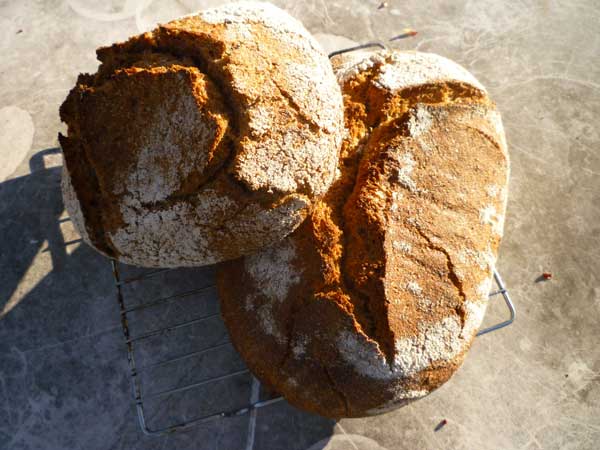
There are a couple of problems with this approach. The first is, it is very difficult to score the loaves properly in the casserole dish, because things have to happen quickly when the time comes to plop the dough into the pot. You have to get that lid back on fairly quickly, or you are losing moisture. You have to get that pot back into the oven fast, or you are losing heat. You could, I suppose, forget about taking a picture for posterity. But I chose instead to forego the scoring, which meant these loaves blew themselves apart where-they-will. That is a common feature of my Lahey loaves.
The second problem is, how hot should I make it? Reinhart gives some direction on how hot the oven should be for his hearth-baking (hot!), but it is not the same temperature that Lahey advises for his recipes (also hot, but not quite as hot). The timing is approximately the same though, for Reinhart and Lahey's loaves. I opted to use Reinhart's temperature for the initial baking, but to back it off to Lahey's temperature about 10 minutes into it. So the temperature for the final baking, where the lid comes off, is somewhat less than Reinhart advises.
Ingredients
I left all the ingredients out at room temperature for 24 hours, whether or not I should have.
 |
| I set the containers on a high shelf, atop the quilting frame, to get them out of the way |


The soaker saw some fermentation: you could even see little ponds of hooch forming already here and there. I divided up the soaker equally between the doughs.

These loaves are made identically, except the longer one has some agave and oil. The boule-shaped loaf has no optional ingredients at all. This time no extra water was dumped on them accidentally.
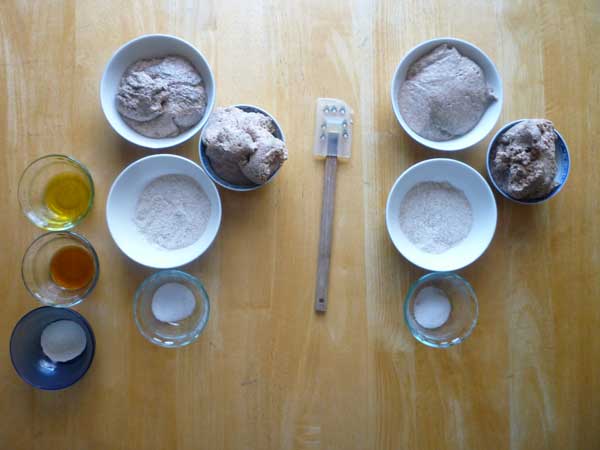
First I mixed up the one with agave and olive oil. It also got some extra yeast, so this loaf is a hybrid of wild and commercial yeasts.


Then I mixed up the one with no optional ingredients. I did find that the dough with no sweetener or oil was fairly dry and required me to wet my hands once to get all the flour incorporated. That's all it required though.


Method
I bulk fermented and proofed it as Reinhart would have us do.


Forming the dough: First, the batardy shape:


Then the boule:


During the last 30 minutes of the proofing in baskets, I preheated the oven with 2 casserole dishes in it, to 500 degrees F. As stated above, I plopped them into the hot pots and closed them without scoring the loaves, expecting them to blow apart wherever they would.


 |
| The boule wasn't in the middle of the dish, so would bake a little unevenly |
That gives the loaves this sort of haphazard, rustic look.
The temperature was turned down to 425 degrees F ten minutes into the baking. Then minutes later, the lids came off and the bread was baked another 15 minutes.


Getting them out of the casserole dish required a bit of persuasion with a spatula, always dangerous.


I took them outside to the picnic table for a few shots. The sun was going down in a brilliant blue sky -- the first lovely day in a week or more of rain.

The loaves look and smell wheaten.
Results
Sliced into the unenhanced loaf the next morning. Despite its misshapen appearance, the bread's crumb looks similar to the bread I made the other day with my blunder -- perhaps even a bit of a tighter crumb. I suspect that this is because the blunderbread I made the other day had a longer bulk fermentation (it could, of course, and this one couldn't. Why? Because all the material in this loaf is already fermented, and I had to add extra wheat to that blunderbread to get it to adhere together.)
The crust is substantially crunchier. I suspect that this is merely a result of how it was made (and perhaps how hot I made it). Depends upon what you want in a bread, I guess. I enjoy this. My mother-in-law would break her tooth on it.
Tastes okay.


Notes to Myself
- These look okay. But the crust might be a trifle too crunchy. Would it have been better to try to rub something on them, to moisten them during the last few moments of the baking? Recently Shao-Ping -- who is easily THE BEST bread-blogger in the world today (even if she claims not to like the taste of whole wheat breads, and even if she has decided she cannot get the bread results she likes by using 100% whole grains, and even if she claims to be burning herself out recently!) did an interesting looking garlic-wash during the last 5-10 minutes of baking. That looked good. Try that some time.
- What have you decided, about keeping the sourdough starter out for 24 hours? Probably not the best idea, but because of my working situation, and my full fridge situation, I couldn't really correct this. Next time, I think I'd like to leave it in the fridge after 2 hours of room temp, if at all possible. It wasn't, this time.
- Now I've made this a few different ways. I know I haven't mastered it, but I'm comfortable with the possibilities. Time to move on.