All grains contain peptides that mimic morphine or endogenous opioid substances. This is where I deal with my latest loaf craving. Get your bread-based exorphin fix here.

Showing posts with label casserole. Show all posts

Wednesday, May 4, 2011

Reinhart's Sourdough Hearth Bread in a Casserole Dish


Reinhart's Sourdough Hearth Bread
made (Lahey-style) in a Casserole Dish

So here again, fast on the heals of the blunderbread (which, despite its name, tasted okay and didn't last long), I am making another sourdough hearth bread, using Reinhart's recipe.  However, I am not making it on a stone (so is it still a hearth bread?), but am using Lahey's method of baking it in an enclosed pot within the oven, so that moisture is retained during the initial part of the baking, and the oven rise is more dramatic.  My hope is that there will also be less sag in the loaf, because the pot will shore up the sides -- although now that I've got the hydration correct, that should be less of a problem.

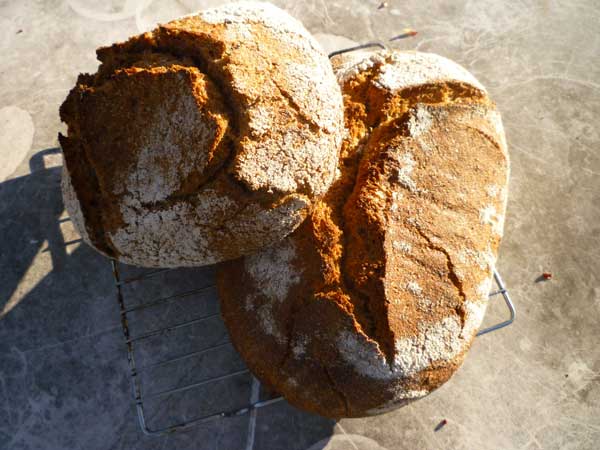
There are a couple of problems with this approach.  The first is, it is very difficult to score the loaves properly in the casserole dish, because things have to happen quickly when the time comes to plop the dough into the pot.  You have to get that lid back on fairly quickly, or you are losing moisture.  You have to get that pot back into the oven fast, or you are losing heat.  You could, I suppose, forget about taking a picture for posterity.  But I chose instead to forego the scoring, which meant these loaves blew themselves apart where-they-will.  That is a common feature of my Lahey loaves.

The second problem is, how hot should I make it?  Reinhart gives some direction on how hot the oven should be for his hearth-baking (hot!), but it is not the same temperature that Lahey advises for his recipes (also hot, but not quite as hot).  The timing is approximately the same though, for Reinhart and Lahey's loaves.  I opted to use Reinhart's temperature for the initial baking, but to back it off to Lahey's temperature about 10 minutes into it.  So the temperature for the final baking, where the lid comes off, is somewhat less than Reinhart advises.

Ingredients

I left all the ingredients out at room temperature for 24 hours, whether or not I should have.

I set the containers on a high shelf, atop the quilting frame, to get them out of the way
It was a new sourdough build, and the yeasts were active.


The soaker saw some fermentation: you could even see little ponds of hooch forming already here and there.  I divided up the soaker equally between the doughs.

These loaves are made identically, except the longer one has some agave and oil.  The boule-shaped loaf has no optional ingredients at all.  This time no extra water was dumped on them accidentally.
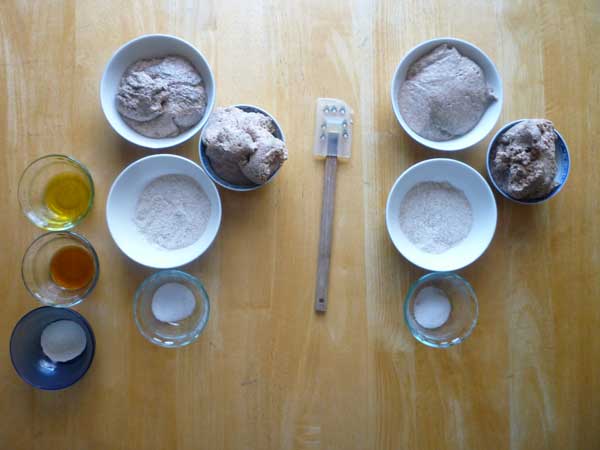

First I mixed up the one with agave and olive oil.  It also got some extra yeast, so this loaf is a hybrid of wild and commercial yeasts.


Then I mixed up the one with no optional ingredients.  I did find that the dough with no sweetener or oil was fairly dry and required me to wet my hands once to get all the flour incorporated.  That's all it required though.


Method

I bulk fermented and proofed it as Reinhart would have us do.


Forming the dough: First, the batardy shape:


Then the boule:


During the last 30 minutes of the proofing in baskets, I preheated the oven with 2 casserole dishes in it, to 500 degrees F.  As stated above, I plopped them into the hot pots and closed them without scoring the loaves, expecting them to blow apart wherever they would.


The boule wasn't in the middle of the dish, so would bake a little unevenly

That gives the loaves this sort of haphazard, rustic look.

The temperature was turned down to 425 degrees F ten minutes into the baking.  Then minutes later, the lids came off and the bread was baked another 15 minutes.


Getting them out of the casserole dish required a bit of persuasion with a spatula, always dangerous.

I took them outside to the picnic table for a few shots.  The sun was going down in a brilliant blue sky -- the first lovely day in a week or more of rain.


The loaves look and smell wheaten.


Results

Sliced into the unenhanced loaf the next morning.  Despite its misshapen appearance, the bread's crumb looks similar to the bread I made the other day with my blunder -- perhaps even a bit of a tighter crumb. I suspect that this is because the blunderbread I made the other day had a longer bulk fermentation (it could, of course, and this one couldn't.  Why?  Because all the material in this loaf is already fermented, and I had to add extra wheat to that blunderbread to get it to adhere together.)

The crust is substantially crunchier.   I suspect that this is merely a result of how it was made (and perhaps how hot I made it).  Depends upon what you want in a bread, I guess.  I enjoy this.  My mother-in-law would break her tooth on it.

Tastes okay.


Notes to Myself

Tuesday, April 20, 2010

Everyday Bread #11

Schnelles Brotrezept


It's not like I need more bread.  I have four loaves on the counter that I'm working my way through, and some in the freezer.  But there's this recipe I want to try...

On the German website chefkoch.de, someone has posted a 'Schnelles Brotrezept', or Quick Bread Recipe.  It sounds easy enough.  It uses lots of yeast and a quick mix, no-rise method.  Here is the recipe, as I translated it from the chefkoch web site (I've already changed it a bit here):

Schnelles Brotrezept - German Quick Bread Recipe

  • 500 g flour (to taste)
  • 2 pkts dried instant yeast (4 1/2 tsp)
  • 2 tsp salt
  • 2 TBSP vinegar
  • 200 g sunflower seeds
  • 500 ml hot water or milk
  • 1 tsp honey
  • spice mix for bread
Preheat the Oven (and a casserole dish!) to 200 degrees C (390 degrees F).
Dissolve yeast in Lukewarm liquid, sweetened with honey.
Add all the other ingredients to the flour in a big bowl, and whisk.
When the oven is preheated, add the vinegar to the yeast mixture.
Blend into the flour mix.
Do not let rise; pour in a casserole dish.
Bake covered at 200 degrees C for 45 minutes, then 15 minutes uncovered.

My Variations and Method:

This recipe calls for a spice mix for bread that I didn't have.  I looked up the Brotgewürz online and soon discovered a homemade recipe for the German Kotänyi bread spice somewhere online:
  • 2 T Anise seeds
  • 2 T Caraway seeds
  • 2 T Fennel seeds
  • 1 T Coriander seeds
Use 2 T of this mix for every 1 kg of flour in breads.  
You can use either whole seeds or ground seeds.

I didn't have any caraway seeds (my wife doesn't care for them, so we rarely buy them).  I mixed up the rest of the ingredients, but I only used a teaspoon of each.  And I was using whole seeds.

As for the flour for the bread recipe, I was told to use 500 g of any flour, 'to your taste'.  I decided to use a mixture.  Not really knowing what my taste is yet, having little experience with various flours, for this experiment I merely used 100 g each of:
  • All Purpose Wheat Flour
  • Whole Wheat Flour
  • Spelt Flour
  • Dark Rye Flour
  • Oat Flour
For the hydration, I used buttermilk that was slightly past its 'best before' date.  It still smelled okay to me.  I mean, it still smelled like buttermilk.  I'm not sure why we had buttermilk, but no one else was using it, so I felt justified in using it up.

I also didn't have enough sunflower seeds.  I had only 150 grams of them; the remainder I made up with sesame seeds.  Someone online said that they used roasted onion instead of seeds; that sounded good, but not so 'Schnelles' for me today.

Although the original recipe didn't tell me to let the yeast foam, and it didn't tell me to keep the vinegar separate until I was going to add it to the flour, I decided to let the yeast sit at least as long as the oven was pre-heating.

I had just mixed the dough all together with the yeast mix and vinegar, and the oven was preheated, when I realized that I had not pre-heated the casserole dish with the oven.  The recipe hadn't said to do this (well, maybe it did, is that what schieben means in this context?), but on the basis of my last disaster loaf, where the dough stuck miserably to a cold pot, I figured it would be better made hot.  So I stuck it in for about 5 minutes.  So the dough was waiting at least that long before I put it in the oven (although it didn't have time to rise).

Unfortunately, this meant that the casserole dish was warm, but it wasn't entirely preheated.  Like the last disaster loaf, I had some difficulty getting this bread out of the pan intact.  Perhaps placing some steel cut oats, cracked wheat, or bran on the bottom of the casserole dish might actually help get the bread out in the future.  The original recipe in German says you are to grease the pan, but I don't want to go that route if I can help it.

My wife came by as I was digging it out of the pan, and asked suspiciously, "Is it baked?"  I told her I didn't know.  But when I got it out -- pretty much in one piece, thankfully -- I decided to stick it back onto a rack in the oven for a few minutes while it was preheating for the next loaf I was baking today (probably only about 5 minutes tops, but I was trying to get the oven to 475 degrees F).  This was enough to crisp up the overly moist bottom for me.  However, I don't know if the bottom crust was breaking off later because I so heated it, or because I was hacking at it with flat utensils to get the loaf out in one piece, or if that is just the nature of the 5 flours I threw together.


The loaf has a pleasant taste.  I think the anise is a tiny bit overpowering, but once in awhile you crunch another spice (the coriander?) and there is something subtle going on, an overlay of taste, like an overtone in music, it is a harmonic that evens it all out.  When you hit a sunflower seed, there is a texture surprise that creates interest and a gentle sweetness in the upper palate.  The crust is not too crunchy, and the crumb is not too dry.  I have toasted this bread, and it is good that way too.  It's pretty good bread.  And it came together pretty quick, too, despite my somewhat anal need to measure out each ingredient exactly. 

While cooking, this loaf smells great.  I think it is the spices.  I wonder what a curry loaf would smell like?  Or cinnamon?  Or nutmeg?  Or rosemary?  Could I use fresh herbs from my garden?

The wheels are turning.


Notes to Myself:
  • Try this recipe again or a version of it, only reduce the yeast by half; 
  • How many times do I have to say this?  PREHEAT THE DISH.
  • Put something on the bottom of the casserole dish before pouring in the liquid: something like bran, or cracked wheat, or steel-rolled oats.
  • See if you think that the loaf could use a bit longer bake
  • Experiment with spices that you like and think are healthy.  Try turmeric for its healthful properties, for instance, or paprika.  These might add some interesting colour, too.

Sunday, April 11, 2010

Lahey #4 - a 25% rye bread


My wife has been talking to my mother-in-law, who apparently wanted to try a loaf of my bread.  I think that she really wanted to try my loaf with the bran swirl (the idea of which made her wrinkle her nose, but also intrigued her), but I am trying something else today.  She'll get a rye loaf instead, made with Lahey's recipe and methods.  I got the word that I was to make her "a nice bread.  Something that won't sit like a rock in the stomach."  But I am still experimenting.  I can't guarantee anything.


The experiment here was to see if I could double Lahey's recipes and make two loaves at once.  I only had the one couche and the one crockpot; so I would have to double up on the couche using a fold, and use an oven-safe casserole dish for the second loaf.  I could cook them together, though, since they are self-contained.

Another thing I want to try: I am going to squirt a bit of water on the top of the dough, just because I've noticed that these doughs seem to dry out a bit as they rise over the 12-18 hrs of fermentation.  Will this help or hinder the final product?


I liked the way this dough worked up.  I used all purpose flour, and some dark rye flour.  By the time I had all the flours incorporated, it was starting to get quite sticky.  But it wasn't a totally wet dough, like the previous all bread flour doughs have been.


I did two things differently next: for one thing, I tamped down the dough, so it was all together, and didn't have more parts sticking up in the air to dry out.  The second thing I did was, I spritzed a little bit of mist on top.  Just a couple of squirts.  Then I let it rise about 13 hours.

The dough had a nice consistency to it at this stage.  It was still a bit gooey, but it held together well and was fairly easy to cut with a wet pastry scraper.  It also formed a couple of nice boules.  It was sticky but not totally unmanageable.
I plopped the prettiest, roundest loaf into the crock pot, and the other one I put in the casserole dish.  My intention was to give the nicest one to my mother-in-law.  Actually, I let her choose.
The trickiest part of the double loaf experiment was, I could not pick up both loaves at the same time from the same couche.  So unfortunately, the first loaf that went into the casserole dish was kind of misshapen, sort of manhandled.  The one that went into the deeper crockpot was easier to handle.

Side by side, enclosed in their own independent 'ovens', they both baked well.  But not evenly.
 These were baked for an hour.  Probably it didn't need to be baked for 30 full minutes with the tops off, 20 minutes would have been preferable.

I love these loaves.  They have a chewiness, and a lovely bitter early note and later sweet note as the rye develops its full flavour while you are chewing.

My mother-in-law took the rounder, crockpot baked loaf.  I sliced a couple of pieces for her supper tonight (and then she is on her own).  She doesn't think that she will be able to chew through the crust.  She also wondered why there were so many holes in the bread (it is not the familiar German style crumb or crust that she grew up with, so she remains suspicious).

I had proved by demonstration that it is possible to use a deep covered casserole dish to make these Lahey loaves.  I think that these dishes would be suited for a mini-batard shaping; this particular loaf ended up that way, sort of, through a certain amount of mishandling.  But I could do it better if I made the batard shape to begin with.

Still, I think that if I am going to make two loaves in the future using this method, I will a) have 2 different couches, and b) turn the loaf half-way through the baking when the cover is removed.

Update: How did my mother-in-law like the bread?

When she first laid eyes on it, she was suspicious of the holes in the bread -- Germans apparently like a denser crumb.  She was also dubious about the crust, and said, "I'm going to  break a tooth on that."  I advised her to cut it off.

She did cut off the crust -- most of it.  I guess a little bit was still on it.  She says she likes crunchy things, so she decided to try it.  Against her better judgment.  And yes, she broke a tooth on it.  She realized it this morning when she looked in the mirror and saw a piece of her tooth was missing.  She wonders how I, or anyone else for that matter, can eat a bread with a crust so hard.

"Oh well," she sighed, ending the story of her awful day that started with the tooth breaking.  "I think the squirrels enjoyed the bread.  At least they looked like they enjoyed it."

Notes to myself:
  • Have a separate couche for each loaf you want to bake, to help you guide the final dough gently into the Dutch Oven
  • Use a longer dish, like a casserole dish, for a batard shape.
  • The rye bread recipe doesn't need a full 30 minutes in the oven with the cover off; try 20 minutes next time you make this 
  • If you give away your bread, it should come with a complete disclaimer of any and all responsibility if people lose a tooth on it.