All grains contain peptides that mimic morphine or endogenous opioid substances. This is where I deal with my latest loaf craving. Get your bread-based exorphin fix here.

Showing posts with label pagnotta. Show all posts

Saturday, June 12, 2010

Everyday Bread #34 - Again with the Whole wheat Pagnotta


 I usually eat my own bread fails.  But now I don't have to.
My chickens are seen here picking at the latest sourdough pagnotta disaster.

"Wait, there's just one more thing I want to try before I leave the pagnotta forever."  That's what I told myself the other day, when I found myself mixing up some dough before yoga.  Unfortunately, I didn't finish gathering ingredients before my ride came to the door, so it had to wait until 2100 when I got home to add the water and stir it all up.

The experiment was originally designed to see what would happen if I let this 100% whole wheat sourdough sit for 12 hours minimum.  Would I then be able to do the bowl folding and get the gluten aligned easier, stronger, better?

But experiments of mine often go awry.  By not mixing it until 2100, I had to wait until 0900 to form it.  And since we were leaving for my son's graduation shortly after 1000, I wouldn't be able to do any folding at all.  I had it in the back of my mind that I would simply stick the dough in the fridge to retard it until I got back.  But as it turned out, this became another sort of experiment.

I noticed when I got up at 0630 that the dough had approximately tripled, not just doubled.  I felt that was a good sign, but I still had it in my mind that the experiment was about waiting a full 12 hours.  I waited until 0900.


But by that time, I think that the dough had actually settled a little.  Who knows?  Anyway, when I turned it out of the bucket and put it on the counter to shape once before putting it in the bowl, I noticed that there was really no gluten structure to this dough at all.  It was all just falling apart.  It felt spent, and I had the impression that no amount of folding or kneading would ever get this moist stuff to stick together.  It just felt wrong -- not like dough at all.  Even rye dough will have some cohesiveness to it.  This goo-dough just wanted to drip off the table.

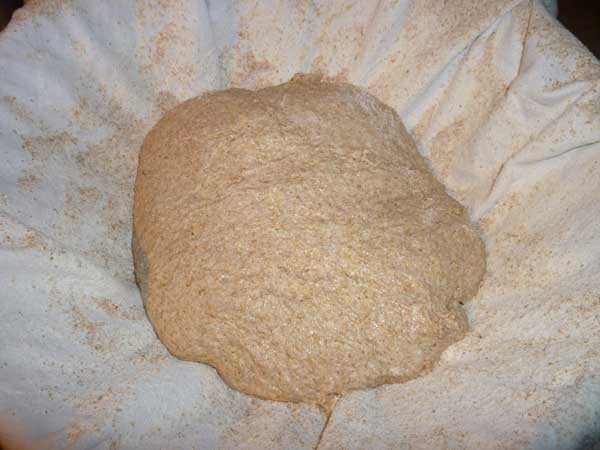
I didn't have time to fold it anyway, so I decided on a different sort of experiment at the last moment.  I would form it into a loaf shape as best I could, put it in a couche-lined basket or banneton or bowl, and then refrigerate it.  Actually, there was only room for one of these divided 'formed' goo-doughs to be refrigerated.  The other I put in the freezer.  Voila!  A new experiment!  When I got home from the graduation, I would bake them and see if by putting them into coldness I could get the bread to remain firm during the baking cycle, since the problem with these whole wheat pagnottas of mine is that they sag and flow over the edges of the baking stone.  Or they flatten out and look like gigantic cookies.


So the formed dough had been sitting for 12-14 hours in the fridge or freezer when I got home and decided to bake them. They had 'proofed' not at all.  That's okay, I thought, since I didn't think any amount of proofing would save this goo-dough.  I would bake them 'as-is' and see what happened.


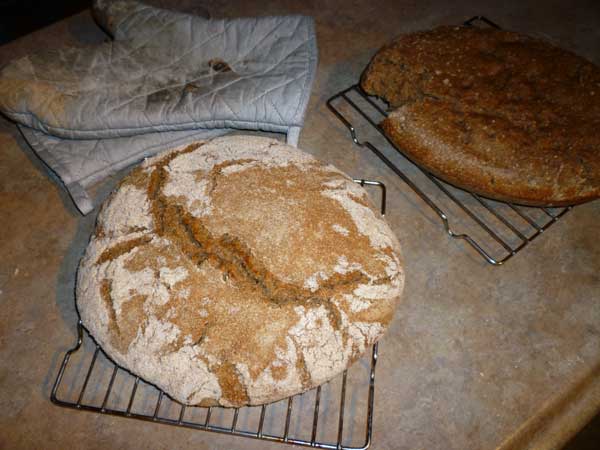
The one from the fridge turned out okay.  I baked it an extra 5 minutes (i.e. 35 min.) because I wasn't waiting for it to come to room temperature before baking it, and I thought that might help.   I didn't score the loaf, and it cracked along what looks like veins in a Klingon forehead.  But there was no rise, and the cool temperatures of the refrigerator were not enough to stop the bread from flattening out.  Once again, it looks like a giant cookie.  A ginger snap.


It stuck a little to my stone getting it from the oven, but all things considered, this loaf turned out fairly reasonable.  The crumb is acceptable to me.  This bread is not pretty, but at least it is edible.

The one I baked directly from the freezer was another story.

It was certainly a popsicle when I flipped it out of the couche-lined basket.  It was hard as a rock.  I tossed it into the 425 degree F oven for 40 minutes.


This one didn't settle like the others but it stuck really badly to the baking stone.  I tore it while trying to spatula it off.  There was a lot of goo inside.  It wasn't baked through!  So I just upended it and tossed it back into the cooling, turned-off oven for about 30 more minutes.

It did firm up, but I can't really say that it baked.  I knew that this bread would be a disaster.  So I checked the crumb with a couple of slices.  I knew that if I ate this, I would feel awful.  I've eaten worse, but I don't feel good when I do.

But I hate to throw anything out, even this disaster.

So I let the chickens eat it.

Notes to Myself:
  • Putting dough in the freezer to try to keep it from sagging during baking doesn't work!
  • Chickens will eat sourdough bread failures!
  • Time to stop trying to make 100% whole wheat sourdough pagnottas this way.

Thursday, June 10, 2010

Everyday Bread #33 - Whole wheat Pagnotta


So much for kitchen science: I guess I rarely take my own advice, so there goes any iterative methodology.  Every time I have a bread disaster (which happens quite frequently, actually), my wife will say to me, "You have made some good bread in the past, why don't you just make those breads again?"  But I want a whole grain loaf that she and I can both enjoy, and I really want to make it out of sourdough, fermenting the grain.  In other words, I want a bread that tastes good, is healthy, makes you feel good about yourself and the planet, even as it nourishes.  That's the holy grail of my bread blog.  I haven't made one of those yet.  So here I am, fresh on the heels of a pagnotta all purpose loaf failure, trying out the same recipe but this time with whole wheat, when my best advice to myself was, "Stop".

This is the exact same recipe, only instead of using any all purpose flour, I'm using whole wheat flour.  I still use 50 g of rye and 50 g of spelt, but the bulk of the dough is from the 700 g of whole wheat, and about 400 g of assorted sourdough starter (a mixture of wheat, rye and assorted) at 75% hydration.  This time, the starter has not been refreshed for a few days.  I'm still trying to deal with what should be a discard.


I did do something substantially different: I waited about 3 hours before I did the first fold, but the dough had not yet doubled when I began.  I turned it out of the initial plastic container into the blue bowl and did all the folds within this bowl.  It occurred to me that I would have liked to try a 12-18 hour fermentation, like Lahey advises.  I wonder what would have happened to the dough at that point?  Hmmm.  Next time I make this, perhaps I'll try that long of a fermentation period...

I used the same bowl folding technique, using the spatula.

After that initial 3 hour rise, I folded the dough in the bowl with the spatula every 30-60 minutes, and then let it rest.  I did this cycle of fold-rest about 4 times (each folding takes less than 2 minutes; I can do it as I walk by).  I decided to stop when the outer gluten cloak of the dough began to pull apart with my spatula-pulling and folding action.  Then I let it rest one last time.


After that final 30 minute resting stage, I poured the dough on a lightly floured surface and divided the dough in two, prior to a gentle forming of loaves.  I intended to put one in the banneton, covered with my couche; that was my number one, primary loaf.  The other, I would merely do something experimental with. 

2. The Experimental Loaf in the Casserole Dish


The second, totally experimental loaf, I formed like a loafpan bread but proofed it on the inside of a casserole dish lid.  I put the casserole dish on top of it, so it would contain any sideways spreading. (why didn't I just put it in the casserole dish?  Why did I invert it?  There is no reason to do it this way.  It didn't make any sense.  I don't know what I was thinking)

Then the formed loaves proofed for 2 hours and I preheated the oven.

I didn't look under the casserole dish to examine my dough before putting it in the oven.  Now remember, the casserole dish itself is not preheated here.  So I kept the temperature hot -- 475 degrees F. and I kept it in the oven for 35 minutes, instead of the recipe's 25 minutes.

It didn't matter.  The bread pretty much failed to rise in the casserole dish.  Still, I was pleased with the way the crumb formed on this loaf.  It was fairly light and airy, in the corners that got stuck and fell off when I tried to take the lid off.

But the loaf doesn't particularly taste all that good.  I don't know if it is the bitterness of the whole wheat, or the sourness of the sourdough, but something just isn't right here.  It is a complex taste, but I can't define it as good tasting.  Would a longer fermentation have helped it become a bit more sour and thus improve the taste?  I don't know.


1. The Banneton-Raised Loaf


The banneton-proofed loaf slipped easily onto the hot stone, but it really failed to rise nicely in the oven.  It held some promise, but there was really no oven spring.  Does that term only apply when one has a bread made from all-purpose or bread dough?

Later, when I looked at the bottom of this loaf, I noticed a lot of very interesting holes, probably due to the fermenting of the dough by the sourdough starter.  It is my opinion that a longer initial rising time (the 12-18 hours I originally suggested) might have made a difference.  On the other hand, the folding that I did may have theoretically shortened the time that was required for the gluten to build longer strands.  In other words, this might be as good as it ever gets.

Overall, I guess I was just pleased that this loaf didn't flow over the edge of the baking stone like the last one, and that it didn't drip onto the lower pan or elements and stink up the joint.  So I can't call it a total failure, even though it sure ain't pretty.

Notes to Myself:
  • You might as well try this one again, but this time give it a full 12-18 hour fermentation period like Lahey uses.  Actually, you will have to try this twice: 1) the full 18 hours, with no bowl folding, and 2) a full 18 hours, then four "bowl folding and rest" cycles, to see which method works better.
  • Work iteratively.  Compare results.  Experiment like scientists would: create a hypothesis, devise an experiment, collect your data, verify results.
  • Use a freshly refreshed starter.  Why are you still using discards, even on these hybrid loaves that also use some commercially prepared yeasts?
  • Would scoring the loaf have helped with its rise?  Do all whole wheat breads crack open this way as they relax in the oven?