All grains contain peptides that mimic morphine or endogenous opioid substances. This is where I deal with my latest loaf craving. Get your bread-based exorphin fix here.

Showing posts with label pizza. Show all posts

Saturday, May 28, 2011

pizza with minced ginger and sourdough starter


Pizza with Minced Ginger

This is a rather ordinary pizza that I threw together for lunch, but it is important to me personally because it sort of marks a turning point.

I recently caved in and bought the book "Tartine Bread", which contains a lot of pizza recipes.  Now, I want to quickly point out that this pizza recipe is not from that book.  The dough isn't yet a Tartine dough, because my starter isn't ready.  So my pizza doesn't look anything like Tartine's (yet), and in fact my pizza is quite pedestrian looking.  Utilitarian even.  However, it marks a change for me in the way I deal with my sourdough.

I have been trying to get the Tartine starter up and running, and in the first few days, you have to throw away a substantial amount of starter, because you are refreshing it at room temperature daily (or more frequently).  At first, I was just giving my discards to my chickens, but by the fifth day, they appeared to be rebelling, and they didn't eat all of it.  Now, the starter is still not quite ready for the Tartine loaf, I think.  I am seeing some fermentation, but it isn't performing as well as my older starters yet, and I think another couple of days ought to do it.
The newly refreshed Tartine starter on the left, my whole wheat starter on the right,
and behind it is the discards from today's refreshing.
Anyway, more about the Tartine Bread book in later posts.

For now, I want to just show that I can eat this daily starter discard now, even if the chickens won't: I can bake pizza with it, for example.

This morning, I refreshed the Tartine starter as usual, and set the discard aside.  Before I went off to a yoga class, I mixed this discarded starter with some flour, kneaded it into a ball, and then let it sit.  Even if it wouldn't rise a bread in a timely manner yet, it would be good enough to make pizza which doesn't really require a lot of puffiness.
How much flour?  Who knows?
We don't need no stinkin' measuring cup.

When I returned from yoga, I simply spread this dough apart with my fingers and some olive oil.  I looked through the fridge for some ingredients and noticed I had a little bit of spelt sourdough in there that I had forgotten.  I took it out, mixed it with some flour too, and made a long rope of dough with it.  It wasn't long enough to go completely around the diameter, but I simply used what I had.  Same with the other ingredients:

I tossed on these ingredients (yes, I realize I'm still overdoing this)...

  • tomato sauce
  • green olives
  • red peppers coated with a bit of oil
  • canned mushrooms (disappointed I didn't buy those fresh mushies yesterday when I had the chance!)
  • minced ginger - just fling some on here and there
  • grated Canadian cheddar cheese
  • grated peccorino cheese
 
... and I baked it in the oven at 525 degrees for about 14 minutes.  Now, the last 3-4 minutes of the bake, I walked to the garden and pulled some herbs, and tossed those on while it was still in the oven.  I think I've got some chives, green onions, and something else, maybe it's mint.

The best part was the minced ginger, it went surprisingly well with the tomato sauce.


But the point is, I can use up my discard in meals, I don't have to consign it to the compost.  Nothing from now on will be wasted.  Even if the chickens do turn their noses up at it.

Notes to Myself
  • As much as you like pizza, you probably should look for some other recipes too, for using up the discards.  Even once you are able to make bread with the starter, you will want to refresh the starter at least daily.  So what can you do with this stuff?  Pancakes and Pizza, sure: but what else?  Start looking around and use your imagination.
  • The bottom crust was a trifle gooey: try putting it closer to the bottom element in the oven, instead of on the middle rack.

Saturday, April 30, 2011

Sourdough PIzza a'la Farine with Portabellos


Sourdough PIzza a'la Farine with Portabellos 

In response to popular demand I am blogging about today's pizza.

By 'popular demand' I mean one anonymous coward suggested I continue, out of the perhaps units or even tens and dozens of people who might have stumbled upon my blog (no doubt most of them family)  -- when I last wrote about I had lost my drive to blog about pizza).  I swear, blogs are like a message-in-a-bottle-to the-universe.  To get one comment, even from someone who doesn't leave their name, is a big deal.  Why I should change what I do, based on such minuscule feedback is laughable.  But there it is.

I previously said that the pizzas were boring me now, and that is why I haven't been blogging about them.  I suspected it was because the ones I was making were not whole grain, they were white flour.  They were tasty enough, but they weren't interesting to me.  They seemed too much like junk food.

I really wanted a whole grain pizza, if I was ever going to blog about them again.

For some time now, I've been wanting to try the whole grain pizza dough recipe that one of the top bread bloggers in the world (IMHO) has shared.  The baker who blogs by the name of "Farine" posted this recipe, which was her sourdough take on the 'Five-Minute-A-Day' recipes.  She used it for pizzas that her grandchildren enjoyed.

By the way, it is worth following the link to her recipe, just to learn about phytate in grain (especially whole grain) and the reasoning behind why she uses sourdough instead of commercial yeast.  (How great a problem this really is, however, is anybody's guess.  As "Laurel's Kitchen: A Handbook for Vegetarian Cookery and Nutrition" states, longer leavening periods even with yeast doughs will increase the amount of phytase, the enzyme that reduces the amount of phytic acid that binds up the calcium, iron and zinc and prevents it from being absorbed by the body.  Laurel Robertson suggests that if the body needs the mineral or vitamin, it will find a way to absorb it despite the phytate.  Also, look here for some suggestions on benefits of phytochemicals in food, and a rather extensive list of them.)

I didn't have quite enough spelt on hand to duplicate Farine's recipe, so I used as much as I had and then I improvised.  I don't think I improved on her recipe, but it was the best I could do today.

Here is what I used:

Dough Ingredients

  • 150g sourdough, mine was 100% hydrated
  • 950g flour:
    • 427g whole wheat flour
    • 340g spelt flour
    • 131g kamut flour
    • 82g garbanzo flour
    • 95g rye flour
  • 50g vital wheat gluten
  • 787g water
  • 18g salt
  • 100g olive oil

Method

Mix together with no-knead techniques.  I had to use my hands because it was somewhat sloppy and I couldn't stir it up with a spoon.


It is supposed to stay on the counter 2 hours and then be refrigerated.  Mine sat out about 6 hours before it hit the fridge, because we went out for dinner at the last moment.


I used it the next day, instead.  I took out a handful (softball sized piece), and just set it in a ball in the middle of a pizza stone that had been liberally coated with olive oil.  Then I just spread it out, like I usually do, pressing it thinner and thinner with my fingers until it fits the stone.

This dough felt substantially different; while there was some gluten, it didn't take much effort to push it to the edges, so it was not very elastic.  I may have used a bit too much dough, too.

Today's Toppings

Since today I wanted to showcase the dough more than the toppings, I was fairly pedestrian in what I choose to put on today.


  • Tomato Sauce (to cover to the edge)
  • Sundried Tomatoes in Oil
  • Sliced Olives with Pimento
  • Half a Leftover Veggie Sausage, sliced pepperoni-thin (rubbed some oil from the sundried tomatoes over top of these so they wouldn't dry out in the heat)
  • A tiny bit of a tiny red onion
  • A small handful of oregano
  • Some Mozzarella, grated
  • Some Cheddar, grated
  • A Couple of Portabello Mushrooms, sliced thin (put some right on the edge of the pizza, so the edge wouldn't dry out in the heat)


I put on the toppings, then I stuck it back into the refrigerator while the barbecue preheated, and I took the dog for a walk.  It does take some time for the firebricks in the barbecue to heat up; probably it isn't worth it to do one pizza, like we did today -- more economical to do two this way.  But it was just us, so one pizza was all we required.

The dog and I were gone about 45 minutes, by which time the barbecue read about 600 degrees F.

The pizza on the stone is placed on the firebrick, and the lid goes down.  By lifting the lid just once like that, the temperature falls to about 500 degrees.  What you don't want to do is lift the lid again to have a peek at it.  You have to let it sit 14-15 minutes, and by then the toppings will have cooked.  You can now take it out, and it will be very hot still.  Another 10 minutes on the baking stone, and the bottom crust will firm up some more.  You can eat it right away, of course -- and we did -- but the second piece is always just a little bit better, I think.

Results

I probably used too much dough; and leaving it sit once the toppings were on was not a great idea: even in the refrigerator, it expanded a bit, and made it a bit too doughy for my taste.  I like a thinner crust.
The first piece is always a bit gooey, and very very hot.  Waiting ten minutes -- if you can -- improves the bottom crust.
Not that it was bad, per se.  I think that the kamut and garbanzo flour didn't improve it.  My wife said that the dough was okay.  She said that with her second piece, the crust had the consistency of a cookie.

I'd like to try more rye, maybe a 50:50 mix with rye and whole wheat.

I also put too much tomato sauce on this pizza.  It was a bit overpowering.  Couldn't taste the mushrooms.

Leftovers. When it cools, this pizza is even better.  I prefer cold pizza, I don't like it microwaved the next day.
I have to use the rest of the dough in the next seven days.


Notes to Myself
  • try the real farina recipe
  • try a 50:50 recipe, whole wheat and rye flour
  • go easy on the toppings, especially the tomato sauce, which is going to soften the dough


Friday, December 31, 2010

Pizzadough Recipe Whole Wheat Bread

 Pizzadough Recipe Whole Wheat Bread

This is just Lahey's basic Pizzadough recipe, only I have substituted whole wheat flour for the bread flour.  I actually intended to make this into a pizza, but we made another batch using all purpose flour for that meal.  So I had this dough left over: it had actually been sitting in a covered container over 24 hours before I decided to just make it into a bread.

I shaped it into a sort of elongated boule and let it rise again in a floured basket.  I baked it free standing on a hot stone with steam for 15 minutes at 475 degrees F and then another 30 minutes at 450 degrees F.

During the busy Christmas season, it was a very quick bread to make, and although it was nothing special, it filled a void when I had to take a sandwich with me while I worked nights.


This bread staled quickly.

Notes to Myself
  • This was made with 500g wwflour and 300g water, so is only 60% hydrated.  Even still, there was quite a bit of sag once the dough fell free of the basket, and only barely enough oven spring for the scores I made in the loaf to fill in. How to get the hydration level up, but get less sag?  The whole wheat does not allow me to shape the dough nicely: the gluten cloak is not nearly elastic enough, tears far too easily. 
  • Question: did letting the dough sit for such a long time before deciding to bake make it better or worse? 
  • This is essentially a no-knead bread.  Would a gluten cloak have formed if I had kneaded it?

Friday, November 12, 2010

Pizza with Peccorino


Pizza with Peccorino Cheese


This was just a quick pizza, made on the spur of the moment, but with dough that was perhaps 3 days old and needed to be used up.


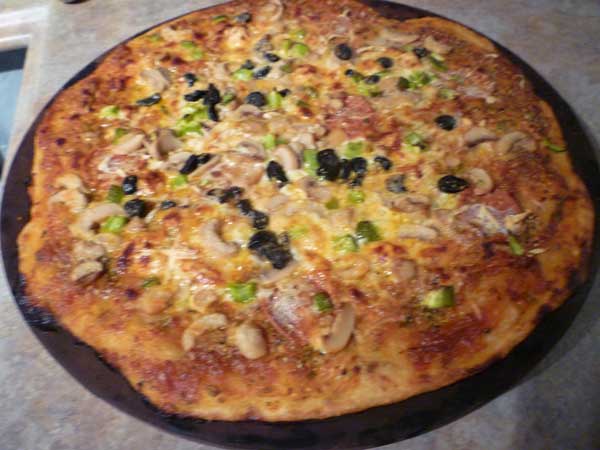
Lets see: I've got green peppers, mushrooms, black olives, homemade tomato sauce (homemade ketchup for the edges), some vidalia onion, some old orange cheddar, some white mozzarella, and some peccorino cheese.

The Peccorino cheese has a wonderful flavour. You really don't need too much to make the pizza special.

This pizza could have cooked for a little less time.  Or the edges could have been shored up with a bit more moist items.

Friday, November 5, 2010

Pizza on a Hot Stone


Mushroom and Cheese Pizza on a Hot Stone

There is little to say about this pizza except that it was thrown together rather hurriedly, for two people, to nibble before they went off for yoga.  The dough was spread out on a stone that had just baked a bread, and so was very hot.  The oven didn't take long to preheat, as it was already very hot from the bread.
Homemade tomato sauce, tofu pepperoni, mushrooms, black olives, cheddar and mozzarella cheese

The failure came from leaving it in the oven a trifle too long.  The upper ingredients need about 25 minutes to bake at 500 degrees, but the crust on a hot stone does burn at that length of time.

It was nice and crispy, where it wasn't totally burnt.  I do like that in a pizza, but this was a bit too much.

Notes to Myself
  • Don't roll out your pizza dough on a hot stone.

Saturday, September 25, 2010

Pizza #11: Pizza Fungi after Lahey with Smokey Tomato Sauce


Pizza Fungi

I made a couple of these Lahey-dough pizzas, both with portobello mushrooms and some red onions, shaved thin on my mandoline, and fresh thyme from our garden.  One pizza had some dried tomatoes, the other had some fresh diced tomatoes, and a few olives.  Both had some mozzarella cheese, but each one had its own, unique cheese too:
  • Italian Pecorino Cheese
  • Portuguese Sao Jorge Cheese (Lorais)


The dough takes 2 hours to rise, and then you have enough for 2 pizzas

I liked the one with the Portuguese cheese.  To me, it has a mild flavour, but a taste that is subtle and clean.  This pizza just worked better.

Both pizzas were cooked without tomato sauce, but we had our own homemade smokey tomato sauce for dipping and spreading on top.  The first pizza didn't need it, but when eaten together, the taste was nice.  The second pizza definitely required the extra taste.


The pizzas were baked at very hot temperatures (>700 degrees F) on our barbecue, using firebrick and pizza stones.  By now, this is pretty standard for us, as it works fairly well: you heat up the barbecue on max to get the stones hot, until the gauge reads over 700 degrees.  The pizza stone is slathered with olive oil, and the pizza is built right on top of it, while cold.  When all the fixings are in place, it bakes at the barbecue's highest temperature for 14-15 minutes.  The stone is then removed, and the pizza goes to the table like that.  Some more baking of the crust occurs on the hot stone, during the time it takes to cut the pizza and serve it.  There is no hurry, it will stay hot.  The second piece is often the best, and the very thin crust gets nice and crispy.

Best Pizza Fungi today: 
The baking stone was a teensy bit too big and the barbecue cover tore a hunk off it (that was my piece)

The barbecue takes a tiny piece of cheese skyward because the pizza stone is 1/8" too big


Leftovers
I'd like to explain here how we made our smokey tomato sauce, because it is really special and nice, but my wife will not allow me to divulge the recipe.  I guess, for now, it is a secret.  Even though I believe she adapted it from a couple of recipes found on the Internet.

Smokey tomato sauce on top

Notes to Myself
  • I really want to move to a whole wheat pizza dough, and have a recipe ready to try. But it won't be when company is here, like today.

Monday, September 20, 2010

Pizza #10: Anadama Pizza with Mushrooms and Fresh Tomato

Anadama Pizza with Mushrooms and Fresh Tomato

I was planning on making some Anadama bread from the people who have given us "Artisan Bread in Five Minutes a Day" and "Healthy Bread in Five Minutes a Day".  But I figured that would be far too much Anadama bread for me to take.  I elected to try it, and see if the dough could be used in a pizza recipe.

I decided it can't.  The taste is not good enough for pizza.  It is not that it tasted bad.  It just had no appreciable taste at all.

The dough mixes up easily with a spoon

It takes only 70 minutes for the dough to double today

I mixed up the dough following the recipe in 'Healthy Bread in Five Minutes a Day", and based on the ingredients I weighed, this is the baker's percentage that I came up with (your mileage may vary):

IngredientwtBaker's %
WW Flour262g 36%
AP Flour458g 64%
Yeast20g 3%
Corn Meal262g36%
Salt9g1.25%
Vital Wheat Gluten40g5.5%
Molasses159g22%
Water857g119%
Wheat Germ26g4%


Notes on the percentages: This dough is well hydrated.  I was able to stir it up until all parts of the dough were wet, using a wooden spoon.  But the 119% hydration content is deceiving.  Probably one should include the Corn Meal into the Flour amounts, so that the total flour content is 982g.  This would make the water 87% of the total.  But Corn Meal is not flour.  It doesn't act like flour.  It does absorb some of the water, though, so the hydration percentages are just not as helpful in this recipe.

Just from looking at the other Anadama recipes I've tried, this one has a lot more ap flour, and a lot more molasses, and a lot more yeast.  I suppose it has a lot more corn meal too.  But based on all that, I didn't think I'd like it.  Still, I was hoping I would be pleasantly surprised.

I wasn't.  As a pizza dough, this was particularly tasteless and disappointing.  To be fair, the authors never intended it to be used as a pizza dough.  I was improvising.

First time ever to try out my new firebricks in the gas barbecue

I was trying out my new fire bricks, in the gas barbecue.  I think it took substantially longer for the temperature to rise, using these fire bricks: there was more mass to heat.  So this is actually quite a wasteful procedure.  On the other hand, the pizza cooked just as fast, once the bricks were heated to about 700 degrees.  I left this pizza for about 15 minutes this time, and it was starting to just singe around the edges.  But the toppings were well cooked.  I still had a problem, with this stone, with the oil soaking into the stone rather than providing a nice smooth surface.  It gets better every time I use it, but it is still not good.

The toppings:
  • Pizza Sauce
  • Mushrooms
  • Fresh Diced Tomato
  • Dried Italian Herbs Seasoning
  • Chipotle Chili
  • Dried Chili Peppers
  • Minced Garlic
  • Kalamata Olives
  • Mozzarello Cheese
  • Grated Italian Padano Cheese
Despite the chili peppers, there was virtually no taste to this.  And there simply were not enough of the chili peppers.

The dough easily gets molded to the right shape of the pizza stone

The Italian Padano Cheese is a nice cheese, but it doesn't have enough flavour to carry this pizza


The fireplace takes substantially longer to reach 700 degrees with the firebrick: about 40 minutes!

If you don't lift the lid, and can trust the process, pizza is done in 15 minutes.

The olive oil is still soaking into the stone too much, so the dough continues to stick.


I will bake the bread with the rest of this dough tomorrow.


Notes to Myself
  • Continue to cure this baking stone with oil each time you bake with it, so that the stone will no longer soak up the olive oil each time you use it for pizza.
  • The time taken to preheat the firebrick is prohibitive and wasteful of propane.  Therefore, if you must do it, try baking other things besides just the pizza on the hot stone.  For example, have some bread ready to bake, too.
  • Padano Cheese isn't strong enough for pizza
  • Anadama dough isn't the right kind of dough for pizza