All grains contain peptides that mimic morphine or endogenous opioid substances. This is where I deal with my latest loaf craving. Get your bread-based exorphin fix here.

Friday, March 30, 2012

A Barley, Buckwheat and Oat supplemented WW Sourdough bread


A Barley, Buckwheat and Oat supplemented WW Sourdough bread

In the recent past, I've made a 10% Barley loaf, a 10% Buckwheat loaf, and a 10% Oat Flour loaf.  Check those breads for info on the health benefits of barley, buckwheat and oats.

Now it is time to combine the health benefits of all three of these grains into one 70% Whole Wheat Sourdough loaf.  As usual, I'm following the Tartine methods, although (as usual) this is not a Tartine Bread recipe.


1/3 cup each of barley, oatmeal and buckwheat

Ingredients for the loaves without extra grain

Adding the boiled grains to the dough:


Comparison of the 2 doughs at bench-rest:


Flop
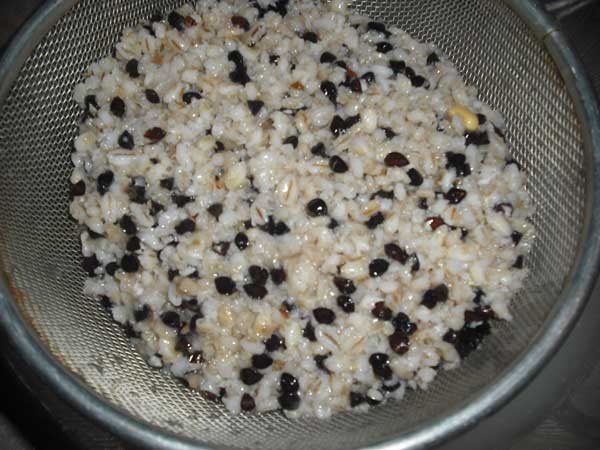
Actually, today I made two versions of of this Barley/Buckwheat/Oat/WW loaf.  To one of the doughs, I added 1//3 cup each of Buckwheat, Barley and Oatmeal, that I had poured boiling water over and left overnight.  The grains were first placed in a thermos, so the temperature was kept high for the entire soaking.

I weighed each of these ingredients before adding water to them:

    •    Pot Barley 62g
    •    Buckwheat 44g
    •    Oatmeal 32g

The next morning, I conserved the liquid for the bread.  I had to add a little bit extra water to it, but most of this second dough's hydration was from these boiled grains.  The water was cooled, but it was still slightly higher temperature than room temperature, and of course, warmer than the usual cool water that comes from my double-filtered water from our sand-point.  And right away, even before I added the grains to this second loaf, after turning it a couple of times in the bowl, I knew that this dough was substantially different in feel.  It was far more slippery.  I could stretch it a long, long way, and it wasn't elastic enough to snap back.  I knew I was going to have problems with it.

Why this water should have acted this way in this dough is a curiosity for me.  Was it merely the temperature?  Was it due to the way the yeast in the starter became super-activated due to the increased starch in the water?  Was it because there was mucilage (i.e. liquified gums from the grains) in the water?  Was it an alteration in the pH?  I just don't know.  But when I added the grains to the dough, it just got worse.  I could stretch this dough really really far, but it seemed to be flaccid, it had no snap.  The other dough, supposedly the same hydration (75%) seemed tight and less stretchy, and snapped back when folded.
the flopped bread
Hence the flop when I put this grain-filled dough into the dutch oven.  It had expanded beyond the rim of my banneton, and I knew I was going to have problems with it, so with the worst of the two doughs, I upended it first onto a pizza peel, coated liberally with cornmeal.  This was a disaster, as it twisted coming off the peel and into the dutch oven.  The second loaf, I decided I would not bother with the pizza peel, and I upended it directly into the dutch oven.  These breads were flat and flaccid.  Nothing I could have done about it except add more flour much earlier on in the process.


Results
These loaves are tasty, but although they are supplemented with other grains (for health reasons) they do not taste any different than an ordinary whole wheat sourdough bread I make.  The one with the grains is a lot more moist, and the moistness keeps it fresh longer.


Despite the problems I had in forming those loaves due to the sloppiness of the recipe, I think I prefer the loaves with the added grains.  Even if occasionally -- long after eating bread -- you sometimes find yourself spitting out a black buckwheat husk.


Notes to Myself
  • The problem with adding wholegrain buckwheat to the bread is that the boiled grain leaves its husk behind. I'm sure its entirely indigestible (not that, in the days of our awareness of the uses of fiber, that is a bad thing). Even after boiling and soaking overnight, it is really tough, and the teeth can barely chew through it. After chewing and swallowing some bread one can generally still find a bit of black buckwheat husk in one's teeth. Not a selling feature of this bread.
  • I have been thinking about buying a digital pH meter (something like this one) to test my sourdough and the various hydrations I add to the dough.  But lots of other bread heads have done this already: it might be simply cheaper to go through their results and do a metastudy of it, and devise a simpler kitcheny method to determine pH and peak times for starters.
  • I really have to fix my old doughed-up camera, or get a new one.  This old Fujifilm camera really sucks for taking closeup bread photos.  These photos are all blurry and crappy.

Tuesday, March 27, 2012

A Whole Wheat version of Jennifer Reese's Bagels


WW Bagels from Jennifer Reese's Recipe

I recently reviewed Jennifer Reese's book "Make the Bread, Buy the Butter" in this blog.  Although her bread recipes all contain mostly All Purpose or Bread flour, I liked the simplicity of them.  So I thought I'd try her bagel recipe using nothing but Whole Wheat Flour.  I've never made bagels before, I guess I was always intimidated by them.  But Jennifer made it sound easy.  Her shaping method is the easiest I've read.

You can watch Jennifer make her bagels in a short online video (although the book's recipe is somewhat different -- different volume of ingredients, different oven temperatures, etc.).  For my part, I did not change the amounts given in the book even though I'm using only whole wheat flour.  I weighed the ingredients as I mixed it, so I came up with these baker's percentages (your mileage may vary), which she claims makes 10 bagels (I made 8, but I probably made my bagels a bit large):

  • WW Flour 100%
  • Yeast 2.6%
  • Sugar 7%
  • Salt 2.28%
  • Water 58%

    The photos:


I didn't weigh the malt, that just gets tossed in the boiling water anyway, so its not officially part of the dough.

Results
These mix up and bake quickly.  That means they are extra yeasty, extra sweet.  And to me, who hasn't eaten anything but a sourdough or wild yeast bread for so long, they taste a little flat.  But they are still better (when fresh) than almost any bagel I've ever bought.  And I used to eat a lot of storebought bagels (before the quality of the ones I could get locally went appreciably down -- the poor things they call bagels now are one of the reasons I began to make my own bread.  They are that bad).


What about Sourdough Bagels?

Because I had the malted water boiling so nicely, I also dropped in a bit of rye sourdough discard that I mixed with some (unmeasured) whole wheat and (unmeasured) salt and made into a bagel shape -- just to use up the discard.  This dough wasn't allowed to rise or ferment further.  I just tossed it into the boiling water.
There's actually a couple of my sourdough-experimental bagels in the bottom of this boiling malt-water
And it sank.

So I had no high hopes for these two extra bagels.  I knew they'd be dense.  But they came out of the water and oven very nicely.  They have a nice bagel-crust sheen.  They smell quite sour, and look almost pretzely.

Perhaps because they were so dense, they didn't bake all the way through in 25 minutes.  I'll let them go 30 minutes next time, at 400 degrees.  But to me, they taste better than the yeasty bagels.  With a little cream cheese, I like these a lot.


These dense experimental bagels aren't baked through


Next, I'll have to try making my own cream cheese (like Reese hints in the video, you can do this too).


Notes to Myself
  • The ingredients are supposed to mix to a stiff dough, but I felt that my dough was a bit too wet -- which is unusual, since whole wheat is supposed to require more water to get the same consistency as all-purpose flour.  I think that the dough probably requires more than the amount of flour she recommends in the video, probably even more than the amount she gives in the book.  If I kept the other amounts and went to 4 cups (600g), the percentages would fall out like so:


    • WW Flour 100%
    • Yeast 2.5%
    • Sugar 6.1%
    • Salt 2%  (you can see that the salt amount is more usual with this amount)
    • Water 59.8% 
  • Experiment with some sourdough bagel recipes to find one you like.  No doubt you won't want the sugar, or the yeast.  Of the top of my head, expect to use a 60% hydration, 2% salt and perhaps a 40% sourdough starter.
  • For denser bagels that don't float, bake 400 degrees x 30 minutes.

10% Oat Bread Sourdough WW


10% Oat bread

The health properties of Oats have been known for quite some time.  A lot of science has focused on the ability of oats to lower serum cholesterol.  Oats contain over 9% fiber, much of it water-soluble, and this is one way it tends to pull the cholesterol from the GI tract and excrete it from the body.  Its protein level is about the same as wheat, around 13%, and its ash (mineral) content is somewhere between 2-3%.  Starch makes up the bulk of what's left.

When reading about oats you will likely run across the use of the term "beta-glucans".  This is the main component of oat's soluble dietary fiber.  It is a linear polysaccharide found mostly in the cells walls of the grain's endosperm.  The amount of this substance varies with the variety of oats and where it is grown, but it can make up 1/3-2/3 of the entire amount of fiber in oats.  Scientists have focused on beta-glucan as the main cause of oat's cholesterol-lowering ability.  It has this effect, many studies say, because of the way it affects viscosity.

Bear (down) with me as I talk about poop.  As a nurse, I don't find this too off-putting, but others might find it so. 
Making Oat bread when there is still a partial loaf of buckwheat bread to eat
whole wheat : oat flour
90 : 10

Just before adding the salt


Although other bran fiber-rich grains will have a similar effect of drawing water to the faeces, adding to the bulk and aiding elimination, they can't all claim to have the same effect on cholesterol as oats.  According to Sungsoo Cho, who wrote the book "Dietary Fiber", Oat bran is

"not a true bran and is in fact highly enriched with the thickened outermost cells of the endosperm (subaleurone cells).  The walls of these cells are considerably thicker than those of the general endosperm cells and are rich in mixed-linkage beta-glucans."

And what I find particularly intriguing is that, whereas the bran of many grains will have an anti-nutrient effect on some minerals, scooping them up and excreting them before they have a chance to be absorbed through the  GI tract, the arabinoxylans in oats have precisely the opposite effect: calcium and magnesium are better absorbed.  Huh.

Furthermore, oats have a positive anti-oxidant ability.  Not only will it scoop up cholesterol in the GI tract, its anti-oxidants will scoop up the free radicals in the body and chelate dangerous active metal ions.  This grain has also been associated with greater satiety and better insulin-response -- again, because of the way viscosity is increased in the gut.

 But viscosity, although apparently a good thing in the gut, may not be the best thing for making good bread.  How will adding 10% oat flour change a whole wheat flour dough?  And is 10% oats even enough to have a positive effect on health?

Health Claims
There are legal issues at stake: for products containing oat supplementation to carry the health claim that it will "reduce the risk of coronary heart disease" by reducing cholesterol, it must have 0.75g Beta-Glucans per serving.  How does my bread stack up?

With 100g of oat flour, I should have around 9g of fiber.  The beta-glucans compose about 3-6g of this.  Each of my 2 breads will have about half of that again, or 1.5-3g of beta-glucans.  With 20 slices per loaf, give or take, that means I'm only getting 0.075-0.15g of it per slice.  I'd have to eat 5-10 slices of this bread to get the health benefits we're talking about (1/4-1/2 a loaf).  (Or increase the amount of oat flour I put into the loaf: to ensure I'd get 0.75g per slice of bread, I'd need to start out with ten times the amount: 1000g oat flour, for 90g of fiber, 30-60g of beta-glucans, 15-30g per loaf, with about 20 slices.  But that would leave no room for any wheat flour!  So you see, if you find a bread that makes this claim, it is probably an extruded bread supplemented with oat beta-glucans -- highly processed -- and is probably not whole oat grain.)  We'd be better off with oatmeal porridge.  Paul Pitchford, in "Healing with Whole Foods" says that
"Oat flakes are nearly as nutritious as whole oat groats, as they have been only lightly processed by rolling and steaming; they are the only whole-grain cereal that many people eat."


Results
I find that oat flour feels quite different from many other grains that have been milled fine.  While I do not run it through a sieve, it might be a good idea, when mixing it with other flours, because it has a tendency to clump together.  I have only added 10% to this loaf, and it had a marked effect.  The dough tended to sag under the normal 75% hydration.

And the taste, to me, was a bit more bland.  Whereas with the addition of buckwheat flour I was worried the flavour would be too pronounced, here I should have been worried that the flavour would be flattened by the oat flour. 

Notes to Myself
  • It will be impossible to add enough whole oat flour to a whole grain wheat bread to make it legally "heart healthy" (unless it is all oats, but then you wouldn't have a recognizeable bread). 

    But add oat flour to your bread anyway, for its many other real benefits (e.g. anti-oxidants).  It will change your stool.  It will change your life. 

    And because there are lots of real benefits, eat oatmeal porridge regularly too.