All grains contain peptides that mimic morphine or endogenous opioid substances. This is where I deal with my latest loaf craving. Get your bread-based exorphin fix here.

Tuesday, October 9, 2012

Pumpkin Turmeric Bread


Pumpkin Turmeric Bread

Pumpkins
Pumpkins are squash that originated in Central and North America, and were a staple food of the natives.  Since the continent's colonization by Europeans, squash has been widely associated with Thanksgiving.  Of course humans have modified the shape and size and characteristics of squash over the years, with the result that there are now a large variety.  Today, the ordinary jack-o-lantern pumpkin is mostly used for ornamentation, while other pumpkins/squashes are used for seeds, or for pulp that is used in baking or cooking.  But I regularly cook and eat my jack pumpkin too.

The wiki on Pumpkins contains a lot of interesting info about the rapid increase in size of the Giant Pumpkin (Cucurbita maxima).  Throughout the 19th century, independent growers competed at harvest festivals to grow the largest pumpkin.  The biggest results had been found using a cross with a Hubbard squash and a kabocha squash to form the Atlantic Giant Pumpkin.  In 1981 Howard Dill of Nova Scotia grew one weighing 493 pounds, and from its seed, today's supergiants weighing as much as 1818 pounds have been grown.

Today's local newspaper had recipes using pumpkins and squashes.  One recipe with an acorn squash (or pepper squash) reported that it is a good source of fibre, magnesium, potassium, beta carotene, and vitamins B and C -- and what really caught my eye -- that one cup provides 340mg of Omega-3 oil.  My eyebrows were raised at that, because most sources of Omega-3s are fish or marine (I have mentioned flax and hemp before in this blog, too).  Furthermore, I had thought most of the oil of squash was in the seed.  But indeed (although it is more likely to be 36mg, a factor of almost 10x less than reported -- you can't believe everything in the newspaper) there are more omega-3s in this squash's flesh than omega-6s, according to Nutrition Facts web site.

How the jack-o-lantern pumpkin compares is anyone's guess, of course.  It has been grown for size, not for omega-3s.  A lot more work is being done on squash these days to get it to increase its beneficial lutein, carotenoids, phenolics, and ascorbic acid, etc.  What the pumpkin will look like in another 100 years is anyone's guess, but it will likely still form a large part of our North American diet (whether fed to humans or animals, who knows).  The amount of calories a squash can provide is enormous -- it does contain a lot of starch.  I think it is a shame to use these foods simply as throw-away seasonal ornaments.  Still, there are significant differences in nutritional qualities between various pumpkin varieties (see, for example,  Gajewski M. et al. (2008) "Quality of Pumpkin Cultivars in Relation to Sensory Characteristics." Not.Bot.Hort.Agrobot.Cluj 36(1). pp. 73-39)

A Korean study of the various nutritional components of various pumpkin species indicates that the flesh of the C. maximus has more of pretty much everything -- but the seeds of the C. pepo species have more oils and amino acids (see: Kim, M. et al. (2012). "Comparison of the chemical compositions and nutritive values of various pumpkin (Cucurbitaceae) species and parts." Nutr Res Pract 6(1). pp. 21-27.)

So I have no difficulty with using ordinary jack-o-lantern pumpkins -- especially those that would otherwise be tossed away after Halloween --  as a food source.

Today's bread
It was just a short leap from my recent turmeric loaf and pumpkin loaf to make this "pumpkin turmeric bread".  They're both orange, right?  But would turmeric and pumpkin taste all right together in a bread?

Ingredients

  • 1000g ww flour
  • 50g wheat germ
  • 200g ww sourdough starter @100% hydration
  • 100g pepitas
  • 33g turmeric
  • 800g pumpkin pulp
  • 50g water
  • 20g salt


One thing I've noticed since fasting 2 days a week: I don't eat as much bread.  I make the loaves as usual, but because I don't eat it for a day, it simply languishes.  By the time of the second fast day in that week, I'm not all the way through the original loaf; and since it is beginning to stale, and I want to bake again, I'm not quite finishing each loaf.  It gets soaked and goes to the chickens, who turn it into eggs.  And we end up giving away a lot of eggs too, to friends and family.

Last time I didn't put the pulp through a blender, and it turned out fine.  I think that this time the loaf was even better, but I didn't increase the hydration by much, if any.  The turmeric has a taste, but it is not unpleasant, and it complements the pumpkin somewhat.  I don't like this bread with jam, but it works with some strong cheeses, and it is fine with honey.


Results
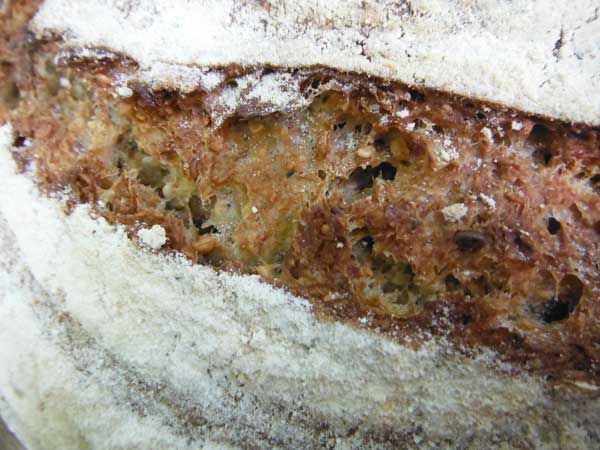
This was a perfectly acceptable bread, but side-by-side on the counter with the recent sesame and dill bread, it wasn't quite as good.  And the colour was a bit off-putting, for some people like my wife.  But as Thanksgiving is upon us, and Halloween approaches, it was a fun bread to make.  The pumpkin seeds added a necessary taste.

I didn't see my friend in time, so I just froze one of these loaves for a later winter treat.  As I did, though, I wondered "Will I ever pull a loaf from the freezer, or do I just keep baking bread because I have fun baking bread?"

I needn't have worried.  I ate the second loaf the very next week, when instead of taking a day to bake bread, I went with some co-workers on a wine tour of Niagara.  The frozen loaf was just as good as the first.


Notes to Myself
  • There is enough pulp in a medium size pumpkin for at least 6 loaves of bread.  I have enough for another couple of breads, if I get to it before it spoils and I have to waste it.  Perhaps we could toss the remainder of the pulp in a soup...

Monday, October 1, 2012

Sesame Dill Whole Wheat Bread


Sesame Dill Whole Wheat Bread

My friend, to whom I am ever grateful for taking half of the loaves that I bake -- without complaint --has made a request that I put some dill into one of my breads.  This came at the same time that I was thinking about extensively using some sesame seeds in a bread.

So I combined the two, and made a "Sesame Dill Whole Wheat Bread".

Ingredients:
  • 1000g ww flour
  • 50g wheat germ
  • 200g sourdough starter (100% hydration)
  • 200g sesame seeds
  • 50g dill seeds
  • 680g water
  • 25g sesame oil, added with salt after autolyse
  • 25g water, added with salt and oil
  • 20g salt


This was a dense dough.  I mixed it and kneaded it to incorporate all the ingredients except salt, gave it an autolyse period of about 30 minutes, and then added salt, oil and water.  i mixed this in the bowl and began stretching and folding it, for a couple of hours until i became tired.  Before going to bed, I put it in the fridge, covered.  


Next morning, I took it out of the fridge and noticed that the cover had come off, and the dough was exposed in places.  I let the dough sit for 2 hours before kneading it again, so that the whole dough was again hydrated evenly.

The loaves were baked on a stone.  One of the loaves had a most curious gringe, the hat being held in place by a mere thread, the sesames and dill seeds beneath it exposed and inviting.

Results
This is a wonderfully interesting bread, and I think it is the sesame oil that has made it so tasty.  The dill  taste is there, but it is mild, more of a scent behind the sesame taste.  Despite the high quantity of seeds, the sesame seeds on their own would not have supplied this blend of flavours and scents, it really took off with the addition of the sesame oil.


There are lots of benefits of dill, and since dill has been used a long time in the kitchen, these are widely known.  I wondered about its anti-microbial properties, and whether it would affect the bread's ability to be leavened by the lactobacillus bacteria (LAB) and yeasts in my sourdough.  There probably wasn't enough dill in the bread to have a major effect on the LAB.  Which makes me wonder whether it would have much of a beneficial effect from eating it?  Would it cause trouble if I had crushed the dill seed, and let the oil permeate the dough?

Sesame oil is more widely available.  My wife is always tossing out old sesame seeds because she believes they go rancid quickly, but the wiki on the oil repeatedly states that the oil is one of the most stable seed oils known, at room temperature.  I'm not sure what to believe.

This was a tasty bread, I liked it a lot.  I would repeat this loaf sometime, for sure.

That is, if I weren't always interested in experimenting with the next loaf, whatever it might be.

Notes to Myself
  • I should have put some dill weed in this bread, too.  We don't have a lot of the plant in our garden this year though.  I've seen bread recipes with about 1/4 cup of the stuff.  Next time, I'll add about 1/2 a cup of weed, so that there is even more dilly taste.
  • I've been making denser loaves lately, and that's okay.  I find them harder to stretch and fold, but I miss kneading dough, so to incorporate ingredients I have made recent doughs less wet.  I also think that they stand up a bit better in the oven when I bake them on a stone.
  •  I wonder if you can buy dill oil the same way you can buy sesame oil? There is a wiki on it, so I guess you can, but I've never seen it for sale... I wonder if I can make some dill oil from garden dill using a dampfentsafter?

Whole Wheat, Hemp and 8-grain Bread


Whole Wheat, Hemp and 8-grain Bread

Wasted bread
There is a report out recently in Canada that more than half of our food is wasted.  It is thrown away.  This is wrong because there is a public cost to throwing food away, and it is particularly sad because so many people in the world go hungry.  This, at a time when obesity in North America is on the rise, and donations to food banks are dwindling in a time of increased need.

Researchers say that one reason we are filling dumpsters and landfills with food is because consumers are buying too much food on sale, and then they toss it before they can use it, which makes no economic sense.  They urge new regulations on labeling: instead of "Best before" dates, they recommend "Use by" dates.  They urge greater awareness by consumers about food distribution.  They urge cities to start collecting and composting organic waste.  They want to change our attitudes and our methods of food distribution, because it is so utterly wasteful at every step in the chain.

Restaurants are also to blame, and are a good example of our careless attitude toward food.  Restaurants throw food away, because they are trying to give people value for their money by giving over-large portions.  Often, fast-food outlets will give bread to their patrons along with fries, when the extra starch is not necessary or requested.  In this case, it is usually the bread that is wasted.

In my recent reading of articles to learn about the staling of bread (which I hope to blog about some day), I turned up an interesting statistic given by Gomez (Gomez, M et. al. "Effect of Fermentation conditions on bread staling kinetics (2008) Eur Food Res Technol 226 pp 1379-1387) who said, "It is thought that 3% of the production of bread is returned for problems of staling in the shape of unsaleable bread."  I suspect that the amount that gets tossed, and not returned, by consumers is far higher.  But curiously, the report did not specifically mention the waste of bread.

I usually eat all my bread, and what I don't eat before it stales, I give to the chickens.  I have seen recipes that use altus, or old bread, but I have never had the opportunity to use my stale bread in this way yet.  With my bread, I might consider it.  But with the present methods of distribution of food, who would consider adding a loaf of stale store-bought white bread to their own home-made bread, to prevent wasting it?  


Today's bread
My bread today is made with whole wheat, cracked hemp and an 8-grain mixture.  


Ingredients

  • 800g ww flour
  • 200g cracked hemp
  • 200g 8-grain mix
  • 50g wheat germ
  • 452g sourdough starter
  • 750g water
  • 20g salt


Here's an explanation of the odd size of the starter in the above recipe.  This began as a mixture of 178g starter at 100%, but 12 hours previous to the use in this bread, it was mixed with whole wheat flour and a tiny bit of water, enough to make a fairly stiff dough.  if I would guess, I would estimate that the amounts in this starter were:

  • 178g backslop starter @100% hydration
  • 200g whole wheat flour
  • 74g water

Many of my 100% hydrated starters sink in water after a minute or two.  But this ~56% hydrated mixture ( 289g ww, 163g H20) had fermented by the time of use, and floated easily in the water, without any sign of taking on water and sinking, or falling apart.  To me, this simply means that there was a fair amount of gas in the mixture, and cells of dough tight enough to keep the gas intact.  It took some effort to break up this stiff starter for use in the dough.  I did it by hand, but was considering that a blender or food processor might be a more efficient method.


Results

This is a tasty loaf: the hemp keeps the dough hydrated, and the 8-grain mix makes it nutty and slightly crunchy, especially at the crust.

Needless to say, I gave away one of these loaves, and ate all of the other loaf, wasting none of it.


Notes to Myself
  • Compared to Canadians, U.S. consumers throw out a mere 40% of their food -- still pretty bad.
  • This is a loaf I would repeat sometime.  It seems to be a good combination of grains.
  • I think I might go slightly higher on the hydration - next time, perhaps 770g of water for this amount of grains/flours (or perhaps what appeared to be a less hydrated dough is merely an effect of using more starter?)
  • How would blending of sourdough starter in a food processor affect the cells of the yeast, including the budding of daughter cells?  Would it break them up, and destroy some of the cells?