All grains contain peptides that mimic morphine or endogenous opioid substances. This is where I deal with my latest loaf craving. Get your bread-based exorphin fix here.

Thursday, August 23, 2012

Calories in my WW Bread


Lens of Bread
I am amazed that I continue to write something about bread almost every time I make bread, and that I keep coming up with different things to say as I try to experiment with breads with whole grain and as I learn about what I'm eating and where it comes from.  Even if it is the same old bread -- like today's loaves -- I've still got something to say about it.

After several years of fumbling about, playing with recipes, coming up against opposition from farmers, millers, bakers, family and friends who think of bread one way while I think of it in another, I begin to believe that bread is a lens, through which one can view many things about humans, and our place on earth -- about life itself.  A good bit of fumbling is still going on, but I assume that I'm still learning something as I try to figure it all out.

Today's Bread
is another whole wheat sourdough -- by which I mean I'm using 100% whole wheat flour, to which I am adding the 5% wheat germ allowable by law that is taken out during the milling process, and I am leavening it with fermented 100% whole wheat.  Water and salt are the only other ingredients.

This is not a Tartine bread.  The jumping-off point was a Tartine Bread recipe, but no doubt Chad Robertson would be sorely disappointed if I were to attach his name to this particular loaf.  I haven't followed Tartine methods at all here.  In fact, I have just fallen asleep and let the sourdough do everything.  

Method
After working nights, before falling asleep, I mixed up some sourdough starter (200g) and some flour (1000g), gave it a short autolyse, added salt (20g) and enough water to bring it up to 75% hydration, folded it once, covered the dough and fell asleep.  No more folds.  No kneading.  No developing of gluten.

I awoke about 6 hours later -- a good sleep, for when I'm working nights, sleeping days, which should tell you something about my nearly constant state of sleep deprivation during these night shifts.  This is hard on the body.  Please be understanding if your nurse friends sometimes tend to be a bit crotchety.


I divided the dough, formed one into a bread shape gently, and the other I was a bit more firm with.  Into the banneton.  Two hours later, they were in the oven.  They didn't keep their shape as well as a dough that is kneaded or stretched and folded, but they turned into bread despite my neglect.  Not bread that I'm proud of, but bread.

Results
The crumb is not well developed, but perfectly acceptable.  It is better than many of my early attempts at making bread.  When still warm from the oven a couple of hours after baking, it was delicious.


Thoughts
I am thinking about fasts today.  

The latest science on longevity says that if you limit your caloric intake, the cells of your body change from replacement mode to repair mode.  Here is some info gleaned from a recent BBC Horizon episode: if the average diet is 2000 calories/day, and your food supplies you with only 5-600 calories/day only, the cells begin to conserve energy.  Building new cells from scratch is costly in terms of energy use for the body, but repairing existing damaged cells -- including damaged DNA -- is less costly.  The result of this repair is that many diseases and problems are nipped in the bud; many cancers are curtailed, heart and peripheral vascular disease are prevented.  This may be true everywhere except in the brain, where new neurones may be forming.  The result is health and longevity.

And all it takes is regular fasting.

Now that Ramadan 2012 is recently over (should have ended Aug 18th), and I just watched Michael Mosley's interesting BBC Horizon show called "Eat, Fast and Live Longer", my attention has been focused on fasting.

I used to do occasional single-day fasts.  They probably didn't have the beneficial results that Mosley described (lowering levels of IGF-1, lowering cholesterol and triglycerides and homocysteine levels, burning fat, switching the body's cells to repair mode, etc.), because they weren't long enough.  But I know that I can fast -- especially if unlike Moslems, I can drink water, or like Mosley, I can drink tea or a bit of miso soup.  The question is, do I have the discipline?  Do I have the drive?  Do I have this monkey on my back where I must have bread, a steady diet of exorphins?

If I did without bread during a fast, how many calories would I be missing?

Calories in My Bread
So I was curious: how many calories are in one slice of my bread?  Assuming I eat it with nothing else on it (butter, cheese, tomato, or something else) -- which I never do?

I cut into this loaf, and weighed one of the slices: the largest that you see here in the crumb picture is 27g; the entire loaf weighed about 840g.  (The entire dough weighed 1000g+750g+20g+50g; divide this by about 2 -- assuming I divide it completely accurately, which I never do --  and you get 960g per loaf, but it would appear about 12.5% is lost in evaporation during baking).  I doubt that I get 35 slices per loaf, but let's assume that I do (The next day I cut another slice slightly thicker and toward the middle of the loaf and it weighed 53g  -- so you can see how variable a 'slice' might be, when you are cutting it yourself.  That would be more like 16 slices per loaf).

Many of the free recipe counters that I found online expect you to measure your ingredients by the cup, not by the gram, so I found them useless.  I checked each ingredient in caloriecount.com:

Water and salt have no calories.
The only other ingredients are whole wheat flour and wheat germ:

120g = 407 calories; 

  • counting the sourdough, I have 1100g; in 1100g, there is 3731cal; 
  • in 1 loaf there is 1865cal; 
  • in one slice there is 53 ( to 116) calories

Wheat Germ: 
115g = 414 calories;

  • in 50g, there is 180cal; 
  • in one loaf there is 90cal; 
  • in one slice, 3 ( to 6) calories

Therefore in each slice of my bread, with nothing on it, I get about 56-122 calories.  Eating an entire loaf a day (1955-1960cal) would nearly give me my daily requirements for caloric intake (but of course, it would be deficient in some amino acids and other required vitamins and minerals, so you wouldn't want to do it for any length of time; and I'd be unlikely to eat bread without anything on it -- e.g. butter, jam, nutbutters, cheese, tomatoes, etc.).

I probably will try fasting again, and I'm curious to see what will happen to my brain when it undergoes detox from exorphins after one or two days of not eating bread.


Notes to Myself
  • Try to keep your caloric intake below 2000 calories/day.  You are eating more than just bread. But with nothing else but bread, you would have to keep your intake less than 1 loaf/day.
  • Try fasting again.  See what happens to your IGF-1 levels, triglycerides, cholesterol, weight.  Try fasting 2 days out of every 7, for 5 weeks, like Michael Mosley, to see what happens to these levels.
  • What will happen to your interest in bread if you fast regularly?  What will happen to your addiction to exorphins?  Will you be able to fast like you used to?
  • My wife bought me a 3 1/2 quart size RachaelRay square 'stoneware' casserole dish, rated for 500 degrees F, for my bread.

    I tried the casserole dish out on one of these loaves, and found that it is too small for my baskets.  The dough didn't fit.  I don't have a square proofing basket, so I won't be using this again soon.  But one nice thing about it: it is light weight, meaning those who have trouble with heavy dutch ovens might find this stoneware easier to use, for baking Tartine or Lahey-style loaves (although I'd probably choose a different shape).  To me, it feels so light it simply won't stand up to use.  But we shall see.  Meanwhile, it sits on top of the stove because our cupboards remain ripped apart due to the water damage we experienced, before we went away on holidays.  There is no place to put this new dish.

    My wife warns me that this will only get worse:  "Better bake lots of bread and freeze it," she told me.  "Your cupboards are about to entirely disappear."  I may be baking on the barbecue before long.  We shall see.
  • I don't watch much TV, we don't have cable, so I never heard of RachaelRay before this.  I assume she is some foodie guru with her own TV show, and now selling cookware, etc.  I searched for some bread recipes on her website.  There aren't many, but they are difficult to search for.  Rachael Ray seems to be a cook rather than a baker.  She does a few interesting things with bread, but she rarely bakes it herself.  These are the only recipes that caught my attention:


Breads:


Things to do with Bread:


Saturday, August 18, 2012

Experimental Mushroom Flour and Whole Wheat Bread


Adding mushroom flour to sourdough whole wheat bread to enhance phytase

I've discussed phytate before, and even a little about phytase (although I think now that what Laurel Robertson said about sourdough increasing phytase is wrong; a longer fermentation may simply allow existing phytase to work longer, it will not increase the amount of phytase).

But it was only the other day that I learned about fungal phytase.  Since then, I've been reading Patrick Collopy's 2004 thesis, "Characterization of phytase activity from cultivated edible mushrooms and mushroom substrates" with great interest.  Thanks, Patrick, for providing this thesis for free to interested people.  I have gleaned some interesting info, which I give here in point form.  I would refer questions about this to the original work:

  • Plants store their phosphorus as Phytic acid (myo-inositol-hexakisphosphate)
  • Ruminants can digest phytic acid, but humans and other single-gut animals can't
  • Phytic acid binds calcium, iron and zinc, reducing their bioavailability
  • Phytase (myo-inositol hexakisphosphate 3-phophohydrolase) breaks down phytic acid into my-inositol phosphates, myo-inositol and inorganic phosphates
  • most seeds contain phytase, but in addition to this, many bacteria, yeast, and other fungi produce extracellular phytase.
  • Microorganisms produce 3-phytase, and plants contain 6-phytase, which perform differently depending on the pH.
  • Optimal pH of wheat phytase is 5.15.   The human gut has a pH of 1.2-3.0, so whole wheat's own enzyme will not help us break down the phytate
  • Microbial phytase is active over a wider range, and would remain active in the human gut; but it is not likely to survive baking temperatures.
  • Some fungi may be sources of phytases that are stable in high heat
  • Many mushroom phytases are most active at pH 5.5, so they would be most active in the mixing stage of breadmaking
  • The addition of 285 U/kg phytase, and 3.125g/kg to bread dough can enhance the absorption of iron 15x.  ("One 'phytase unit' (U) is defined as the amount of enzyme which liberates 1 micromole inorganic phosphorus per minute from 0.0051 mol/L sodium phytate at 37.0 degrees C and at pH 5.50")
  • Collopy's purification of phytase was accomplished by extracting protein by homogenization in a solution of sodium acetate with phenylmethylsulfonyl fluoride, centrifuging and filtered through 0.2 μm polyethersulfone membranes.  This filtered protein extract is then placed in an ion-exchange column with piperzine buffer. Unbound phytase-inactive protein is eluted, and then NaCl is added to supply a linear gradient of salt, to collect further fractions.  Those showing phytase activity were then pooled and concentrated by ultrafiltration.  Results were calibrated and tested with Gel filtration chromatography.  Collopy indicated that his method was unwieldy and was not going to be used by industry, as it was not cost-effective or fast.
  • Following the multi-stage process of purifying phytase, 100g of mushroom material resulted in the purest yield of only 1g phytase; earlier steps resulted in inpure forms but as much as 5g of phytase.
  • Collopy has identified the mushroom genes responsible for production of phytase, and there is a suggestion that one day it may be possible to insert this gene into yeast, or enhance it within yeast that already have it, for bread production.  (But why stop there?  One could insert it into other DNA -- perhaps even into humans.  Then we would have no trouble digesting phytate).


So it certainly behooves us to try to get some extra phytase into our sourdough (or allow it to work longer), so that the phytate is broken down and we can better metabolyze crucial vitamins and minerals.  Could adding phytase to dough be done during the mixing period of breadmaking?  Would that be enough to increase the bioavailability of the whole grain's nutrients?

Questions proliferate
I wanted to know: 
  • if I ground up some dried mushrooms and put it in my flour, would I get the benefit of the phytase?
  • Would phytate survive the mushroom drying process?
  • How much mushroom would I actually require to have an effect?
  • How long would the enzymes need to do their work, converting phytate?
  • Would mushroom phytase work at the pH of my sourdough?
  • What would happen to the viscosity of the dough?  
  • Would I still be able to have a bread that held its shape while baking?


My Mushroom Bread Experiment
I had some dried mushrooms on hand.  I think that these were ordinary Agaricus bisporus, button mushrooms, described by Collopy -- but they may have been portobellos, I can't be sure now that they are dried.  I read his thesis fairly carefully, but I couldn't find anything that would lead me to believe that the mushrooms in dried form would, or would not, have any phytase in them.  He indicates that the phytase is stable at 4 degrees C (but only for the 2 weeks he kept them), but that at 60 degrees C, they are denatured.  I am not sure how hot the mushrooms got during the drying process in my excalibur dehydrator.
The dried mushrooms I used are on the right

Mushroom 'flour'

Two doughs: 75% hydrated mushroom-fortified dough on the right: should be more viscous but it isn't.
80% hydrated whole wheat and 20% whole spelt Pizza dough on the left

Dough is too relaxed, holes appearing in the gluten structure
I ground them in the food processor until I had some mushroom dust, or "mushroom flour".

I mixed it with an ordinary Tartine 100% Whole Wheat Dough, supplemented with 5% wheat germ, at 75% hydration.  By itself, this is usually a fairly nice dough to work with.  I can bake a pretty decent loaf with this mixture, and have it stand up on its own.  I can even add more water to it, and I have had pretty good results with dough at 80% and 85% hydration.

Compare this dough to one without mushroom flour that I was making pizza with.

My mushroom flour dough felt different.  I turned it q30min for the bulk fermentation period, but even at the very first stretch and turn I realized the dough was quite different.  It smelled like mushrooms -- some of the pieces of mushroom were still flecks big enough to identify.  But it was how this tiny addition of material affected the dough's viscosity that was interesting.  Holes were appearing in my dough; it remained elastic and extendible, but it tore too easily.  During the proofing period (which I cut short by 30 minutes), the loaf spread out drastically and over-relaxed.  I gently placed the dough into the hot dutch ovens, but it simply flattened out, sagging into the pan.  I scored it, not expecting any drastic rise because the dough seemed to have destroyed its own gas-cells.  Indeed, the loaves were pretty flat.

Is this what phytases will do?  Will they break down gluten proteins as well as phytate?  If so, they may be of little use to bread bakers.

Results
Although I could smell the mushroom while mixing, I could not detect it either by smell or taste during the baking, storing or eating phases of the bread.  Once every so often one gets an aftertaste, that is all.  It is not unpleasant -- I like mushrooms.


Very flat


Crumb

Stales quickly
I could not bring myself to eat a slice of it on the day it was made, I was so full of pizza.  But the very next morning I sliced into one loaf to get a picture.  And I was disappointed to learn that the bread was obviously staling quickly, far more quickly than my other breads.

Conclusions
I'm not too worried about phytate in my diet.  I believe that I get enough minerals from other parts of my diet, and I don't eat bread at every meal.  

I still believe that my whole grain bread is healthier for me than other kinds of bread.  If you saw the effects of bowel cancer as I do, you'd probably elect to eat more fibre to scrub your gut a bit too.

Furthermore, I believe that even phytate is not all bad.  It has anti-oxidant properties, so may have benefits preventing cancer, and one study suggested it may even protect kidneys, teeth and heart/blood vessels, which are prone to form dangerous calculi.  Prieto R. et al. (2010) "Effects of Mediterranean diets with low and high proportions of phytate-rich foods on the urinary phytate excretion" Eur J Nutr. 49(6) pp 321-6.  But I have also heard that some middle eastern diets high in phytates (a diet heavy in whole grain flatbreads) have caused zinc deficiency (e.g. see Gocmen, D. et al. (2009) "Flat Breads" Bulg. J. of Agric. Sci. 15(4) pp.298-06); however, one must also realize that many soils and plants grown in that region are zinc deficient to begin with (e.g. see Roohani, N. (2012) "Human zinc nutrition in arid regions with zinc deficiency in soils and crops - a case study in central Iran", thesis, Shiraz University.)

I believe that my sourdough and long-fermentation method naturally eliminates a lot of the phytate naturally (see Lopez, below).  

But these are merely my beliefs.  Like those who propose the Paleo diets, who put blinders on when it comes to evidence that excessive protein intake carries its own dangers, I have my own set of blinders.  The fact is, excess phytate in the diet is something to be aware of -- and to watch for things like calcium, iron, magnesium, and zinc deficiency.  Symptoms are easy to look up online.  Blood tests may be required.


Notes to Myself
  • Here is an idea: measure your bread dough as usual, but first remove the bran by sieving or fine bolting. In addition to fermenting a sourdough starter to leaven it, set aside the bran in some or all of the hydration for the bread, and add to this your mushroom flour. The phytase should act on the bran before it is added to the dough. The solution of hydrolyzed phytate & phytase mushroom bran solution would be added to the sieved flour with the sourdough starter, on the mixing day. A rapid fermentation might be better; adding commercial yeast to the sourdough wild yeast would quicken the rising time, and prevent the breakdown of gluten, by the mushroom's other proteinases.
  • You could back the hydration of this dough off to 70% or even 65% -- but would that leave enough water for phytate hydrolysis to occur?
  • If phytase must be chemically extracted from mushroom to be a workable ingredient, it may not be the solution to reducing phytate levels for health-conscious consumers. It will be seen as just another additive, which will be considered suspicious, and avoided. And not being a chemist, I am always suspicious of their claims that something treated with formaldehyde or phenylmethylsulfonyl fluoride or any other possibly dangerous chemical, is entirely free of it, never mind how much filtration it undergoes.
  • Spier has studied the enzyme's viability at cold and room temperatures. The cooler, the better; but some of the enzymes (perhaps over half) will lose their ability to work the longer it is saved. So perhaps my mushroom mixture had no phytases at all. If that is so, what happened to my dough to break it down so?
  • Phytase added to animal feed (pigs, chickens etc.) may be one of the solutions to increased phosphorous pollution downriver from their excrement.
  • There may come a time (or a place, like Iran) when phytase is governmentally mandated as an additive to whole wheat flour -- much the same as governments mandate additives to flour with bran and germ removed, and we call them "enriched".
  • Harland and Harland tested the levels of phytate in bread to find out how much they are reduced by mere fermentation. More yeast and longer fermentation times meant far less phytate. They did not test sourdough, which generally means more fermentation and typically longer rises.

    Lopez H. et al. (2001) "Prolonged Fermentation of Whole Wheat Sourdough Reduces Phytate Level and Increases Soluble Magnesium" J. Agric. Food Chem. 49(5) pp. 2657-2662  Lopez' team found that sourdough fermentation reduces a lot of the phytate in bread dough, almost 2/3. And they also tried treating the bran with microbes containing phytase separately -- hey, that was my idea! They just had it 10 years before I did! -- and found that phytate was 9/10 eliminated, using sourdough and sourdough-like techniques.
  • I've tried to use properly the terms phytate (the storage form of phosphorus) and phytase (the enzyme that breaks it down) throughout this blog entry.  But re-reading it a couple of times, I've found I sometimes interchange them by mistake.  If there are further errors, I apologize.

Friday, August 17, 2012

2 breads of different viscosity


A rainy day at home, perfect time to bake bread.

Today I am thinking about the viscosity of dough (its resistance to flow).  I'm making two breads that are completely different in the way they feel and perform:

Dough #1
The first is a Tartine-style loaf, approximately 90% whole wheat, with 10% hemp.  It is at 80% hydration, with 5% wheat germ and 2% salt.  This is an extremely wet dough.  I've stretched & folded it Q30min for the full 4 hour bulk fermentation, and it just felt so sloppy that I decided this would best be baked in tins.  It simply would not hold its shape.

Reiterate ingredient list, dough #1:

  • 900g ww flour
  • 100g hemp meal
  • 800g water
  • 200g sourdough starter @100% hydration
  • 50g wheat germ
  • 20g salt


Dough #2
The second dough was made to empty a container.  Long ago I had measured out flour for a 20% rye bread, but I used 80% all purpose flour instead of whole wheat by mistake.  This flour has been sitting in a closed bin for some time, and I've been passing it by in favour of whole grain breads.  But when we got back from holidays, someone who doesn't know I bake bread (i.e. who doesn't know I am a bread snob), out of the kindness of her heart, gave us a raisin bread made with white flour.  I wouldn't touch it, but my wife gobbled it up.  She is frankly tired of my whole grain breads.  She likes mushy white breads.  So I figured I'd make a raisin bread for her out of this old AP&rye dough.

Furthermore, I've been refreshing my sourdough a lot recently since I've been home, getting it back into good shape, and there has been a bit of discard.  In addition to the regular 20% of starter for this dough, I've included some discard that I combined with some 8-grain mix.  I wasn't really measuring anything when I added the 8-grain mix to the starter discard.  But what I ended up with was a ball of mixed grains, that looked to be the size of a fist, and overnight became extremely hard.  It looked like cookie dough, but it was as solid as frozen cookie dough.   I weighed the final result and it was 554g; about 200g of that was sourdough starter that would have otherwise been discarded (so 354g of 8-grain mixture was added).

To use this rock hard ball of fermented mixed grain, I put it in the water (originally 70% hydration, but later I increased this to 85%), broke it up by hand, and then put it in the food processor for about 10 minutes.

Reiterate Ingredient list, Dough #2:
  • 800g all purpose flour
  • 200g rye flour
  • 850g water
  • 400g sourdough starter @100% hydration
  • 350g 8-grain mix
  • 20g salt
  • lots of raisins
  • some liquid barley malt


A careful look at this ingredient list suggests that the true hydration is not 85% but rather 67.7% (total flours, including what was in the sourdough and that pulverized 8-grain mix = 1550g, total waters, including what was in the sourdough = 1050g).  That alone could explain why this dough was so stiff -- but I think also that there were a substantial number of gums in the 8grain mix that were released by the long time they spent in the food processor, and they functioned like glue in the dough.  But I could have added another 120g of water to bring it up to a true 80% hydration!

I mixed the dough by hand, but this dough was far too tight to stretch and fold.  I would knead it by hand q30min, during the bulk fermentation period.  This dough would certainly tolerate forming into a free-standing loaf.  I decided to add the raisins during the final roll-up of the dough.  But I only added the raisins to one of the loaves, because just then my wife walked by.  I had painted on some malt, and sprinkled a few raisins and was rolling up the dough. "Oh no, that's too many raisins", she said.  So I decided not to add any to one of the loaves.

The point is, I had 2 doughs, one very sloppy to work with, and the other very tight to work with.  It had me thinking about rheology.


Rheology (study of the flow of matter) 
and Rheometry (measurement of rheological properties of materials)

The study of Rheology is seeing a huge research investment these days, as people are scrambling to learn about the movement of glaciers, which are disappearing at an alarming rate around our greenhouse planet.  It turns out that everything we've learned about glaciers' movement recently has applications to our bread dough; and everything we've learned about bread dough -- since Newton first conceived describing the flow of materials with forces and vectors -- has applications to glaciers.

Besides Newton, a name keeps popping up when you study the viscosity of dough.  Most articles about bread rheology will reference the work of Dr. Arie H. Bloksma, whose mathematical models of dough are still widely in use.  Bloksma was a mathematician and scientist working at the Institute for Cereals, Flour and Bread in Wageningen  the Netherlands.  The Wageningen labs later became the Nutrition and Food Research International devision of TNO (which stands for: "Applied Scientific Research", a very big independent research company).  Bloksma received his doctorate in Amsterdam, did a post-doc in Winnipeg for the Canadian Research Council, and returned to Wageningen where over his career he published about 30 studies (almost one per year), laying much of the foundation for further scientific study into dough rheology.

Bloksma originally worked with machines like TNO's Chopin Alveograph, and later used other tools to measure flour and dough: the Brabender Farinographs, Weisenberg rheogoniometers, etc.; he also developed his own cone and plate rheometers, to help him plot and predict rheological changes in dough.

Although the tools Bloksma used and the scientific trials he conducted allowed him to develop mathematical models of dough's viscosity, many of which are still used in industry, the ultimate goal of finding a rheological constant eluded him -- and it eludes us still. Dobraszczyk, B and Morgenstern, M. (2003). "Review: Rheology and the Breadmaking process" Journal of Cereal Science 38. pp. 229-245 pointed out that "rheological properties [such as 'stress, strain, strain rate, (elastic) modulus and viscosity'] should be independent of size, shape and how they are measured; in other words, they are universal, rather like the speed of light or density of water, which do not depend on how much light or water is being measured or how it is being measured…(but although)…the (many and varied rheological measuring) instruments … have provided a great deal of information on the quality and performance of cereal products… these instruments do not fulfil the requirements of a fundamental rheological test."  In other words, we still don't have a truly objective yardstick that will give accurate quantitative descriptions of the dough's mechanical properties, or that will accurately describe the dough's molecular composition and structure as it changes, nor predict its performance while mixing and baking.   

Simply put: dough undergoes rapid changes in viscosity and rheology during ordinary mixing and baking conditions, and our understanding of rheology is not yet able to accurately model those changes through the dough's entire cycle.  Weipert, D. (1990) "The Benefits of Basic Rheometry in Studying Dough Rheology" Cereal Chem. 67(4). pp 311-317 and others have continued to stress that the right rheological tests must be done for the correct phase of bread dough development, or the data is meaningless and non-predictive.  Often you find research that measures dough at one mass, through one or two deformations, but these measurements are not applicable to other dough amounts or in other deformations in the creation of bread.

Dobraszczyk and Morgenstern suggest that many bakeries that depend on rheological tests and data are not applying the research in a way that truly benefits them.  Bloksma always tried to simplify the many variables in dough, to make his measurements meaningful and specific to the dough phase studied.  However, he recognized early that many of the most profound changes in dough occur in the interfaces between different stages.  See for example: Bloksma, A. (1981) "Effect of Surface Tension in the Gas-Dough Interface on the rheological behaviour of dough."  Cereal Chemistry 58(6) pp 481-6.

I was browsing through all the rheological articles I could access for free that reference Bloksma on the Internet the other day, and found one that really interested me: Haros, M. et al. (2006)  Rheological Behaviour of Whole Wheat Flour. Institute of Agrochemistry and Food Technology, Spain.

I have reported on the possible dangers of phytates in whole grains before and in this article Haros has used a Chopin Mixolab to measure the dough's rheological  features in different phases of development, comparing doughs with different bran size (phytates are found mostly in the bran layers), or when phytases and other enzymes are added -- the idea being to improve mineral bioavailability in whole wheat bread.  To reduce phytates (which bind nutrients), you require small bran size, longer proofing time, higher temperature, the proper enzymes to break them down -- and calcium salts.  Unfortunately, the author's original language is Spanish, and some of the writing is difficult to decipher.  I still don't quite understand what the absorbability of water, or the viscosity in dough has to do with removing phytates -- I don't immediately see the correlation to rheology.  But it seems that everything that helped break down the phytate required time, and sourdough-like conditions.  The smaller bran sizes (<500 μm) allowed increased water absorption, but the dough took longer to develop; adding fungal phytase (in doses of 0, 100 and 200 μL/100g flour) had a dramatic effect on the water absorption, but detracted from the dough's viscosity.  Adding phytase meant there were more free calcium ions, and alpha-amylase was able to use this to lower staling.

But the most interesting line to me was


"During transformation of flour into bread, phytate content decreases as consequence of the activity of native phytase, but usually not to such extent to greatly improve mineral bioavailability in whole wheat products."
The Mushroom Connection
So I wonder where I can get my hands on some natural fungal phytase?  Would any ground-up mushroom work?  Probably, though Maitake mushrooms seem to have it in generous amounts.  Collopy, P (2004) "Characterization of phytase activity from cultivated edible mushrooms and mushroom substrates"  PhD. thesis, Pennsylvania State University.   But only a few mushrooms have been properly studied (Zhu, M. et al. (2011) "Purification and identification of a phytase from fruity bodies of the winter mushroom, Flammulina veluptipes" Afr. J. Biotechnol. 10(77) pp. 17845-52

It would appear that any given phytase works at its own optimal pH, so not every (mushroom originated) phytase is going to work the best for your particular sourdough.  And the enzymes would be denatured in the cooking process, their only role is during the mixing of the dough, to make the nutrients more available for digestion.

The math of these articles (multivariate analysis, multiple regression equations, etc.) is way beyond me, of course.  But I find it interesting that even the mathematicians continue to argue over the properties of dough.  

Bread still eludes genius.


Why bother with Dough Rheology
Why do I care?  I'm not an industrial baker, and never want to be.  For my part, I merely want to predict what I should do if the dough doesn't feel right.  I can add extra water, or extra flour to get to a consistency that I'm familiar with: but I can't necessarily predict what that will do to my sourdough loaves, when there are so many other variables.

What I would like the scientists to come up with some simple household tests which would assist the home baker to get to know his or her dough better.  I am thinking of such tests as the "windowpane test" (which, incidentally, is not a test I have ever found to be very helpful, because my interest is whole grains, and whole wheat, and the typical windowpane test is not always applicable to my dough.  I have previously blogged about how I originally mistakenly thought that the 'windowpane test' referred to the way in which the dough would slide down if you threw it against your window -- which, if you think about it, should give you some valid rheological data about the dough's stickiness, weight and the deformability of its structure).
WW starter mostly floating on the water.
Some starch is going to begin sinking.
Another easy household test of dough is Chad Robertson's suggestion that a sourdough starter is at its peak to leaven a dough if it can float (which some have said they can never achieve; but their breads still rise.  If you think about it, this floating ability is merely suggestive that the yeasts are already producing gas; but this gas might already be escaping in some cases, because of the texture of the flour used -- so again, this test is another one that may be rather useless if the flour hasn't been mixed in such a way to give you a good gluten cell to contain the gas.  I used to think that the weight of the bran in my whole wheat starter was soaking up water and becoming too heavy to accomplish the water test -- Robertson's starter is a different flour blend, at a constant 100% hydration -- but now I can often get my whole wheat starter to float.  Yet I'm not convinced that it is a good test of what my yeast and dough is capable of).  

My dough is mysterious to me and I long to know what's in it, and how to improve it.  Tiny variations -- ingredients, method -- seem to make a lot of difference to the final loaf that is created.  Subtle changes occur in my dough that I am only beginning to notice, let alone appreciate or understand the causes.  There seems to be an infinite number of things to learn, and it all must be learned first, before I can even begin to ask the right questions.  I'm just a rank beginner, and I suspect I always will be, compared to my dough (which seems to know what to do already).

Bread Results
Dough #1, the one with hemp, made in rectangular tins, turned out nice and moist and lovely.  Lots of flavour.  Didn't rise too much in proofing, but continued to rise a bit in the oven, although I wouldn't exactly call it oven spring.  I suspect that the problem with the hole on the side of the loaf is because of the too-close other pan, changing the flow of heat around the rising dough there.


Dough #2, the one with all-purpose flour and rye, with extra fermented mixed grains, plumped up during proofing but had little oven spring.  I find it a bit dry to eat, although it has an acceptable taste.  There are not too many raisins.


Conclusion: if a dough has more viscosity, more resistance to force when kneading or stretching, it will be a much denser dough.  Denser dough will give you a bread with smaller air bubbles in the crumb, and the dough will not rise as much during the oven stage (although this may not effect the rise during the proofing stage, since denser cells may actually be able to keep the gas that the yeast is producing.  Less viscous doughs may see more and faster yeast gas production, but may not have the cell structure to trap the gas, and it may escape through the bread pores prior or even during baking).


Notes to Myself
  • Examine how phytase is isolated from mushrooms. You don't want to go through the laborious process of isolating the enzyme, but if something as simple as drying and pulverizing mushrooms will allow access to the mushroom phytase without destroying it, you ought to try to add some mushroom powder to your bread dough.
  • Try sieving your whole wheat flour and pulverizing the bran chunks ever smaller -- but toss 'em back in once the gluten is developed.!
  • The gums of multigrain mixtures will create a more viscous dough, especially if they are pulverized in a food processor as they were here.  Remember to check your actual hydration when you do this, and do not forget to add the weight of the multigrain to your flour amounts when calculating hydration.
  • Learn the definitions for all the terminology used in rheology:
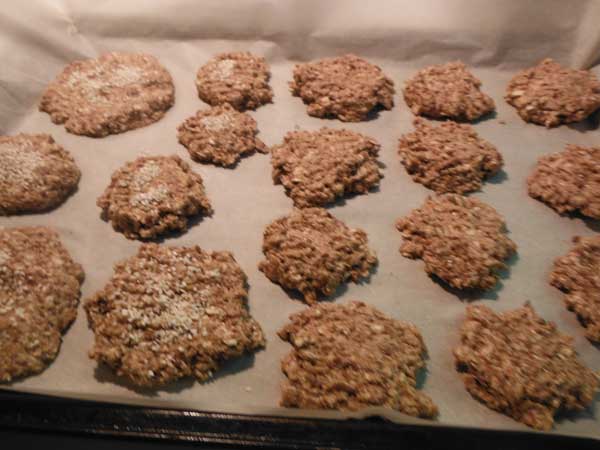
  • Sweet and Sour 8grain cookies 

    Because my wife suggested that the dough I was playing with looked like cookie dough, I thought I might try to make some sourdough cookies with what would otherwise be a discard.  I took about 400g of sourdough, and added a bunch of 8grain mixture to it, in the same amount of weight. This was moister than the last time I mixed the 8grain mixture with sourdough. I left it to ferment.

     The next morning, I made hamburger-sized patties with it, and tried eating some -- toasting one, frying one with a couple of eggs in butter. I wasn't too impressed with either. Then I squished all the dough back up and measured it: 450g of sourdough/8grain mixture remained. I looked up some cookie recipes and this is what I tried next: 
    • 450g sourdough & 8 grain mixture 
    • 66g vegetable shortening (1/3c) 
    • 77g water (1/3c) 
    • 118g brown sugar (2/3c) 
    • 2g salt (1/2 tsp)
  • This was pulverized and mixed in a food processor.  I shouldn't have pulverized the shortening I guess.  The result was far too wet -- I was going to add a couple of eggs, but it didn't seem appropriate. I needed to add more dry ingredients, so I added more 8grain mix, and brown sugar, by hand, to get a moist cookie-dough texture:
    • 270g 8grain mix (45g= 1/3c; I added six of these, so 2c) 
    • 59g brown sugar (1/3c) 
  • I dropped balls of this dough on a parchment and pressed it down with fingers and fork, baking at 350 degrees F for 14 minutes. On some of them I sprinkled some sesame seeds. A very strange, sweet and sour taste. Edible, but suspicious.  My wife can't get them past her nose, so kids would likely be the same.


     Probably not a crowd pleaser.  Back to the drawing board.  With cookie in hand.