All grains contain peptides that mimic morphine or endogenous opioid substances. This is where I deal with my latest loaf craving. Get your bread-based exorphin fix here.

Monday, August 13, 2012

Freezing Tartine Dough


"While you sleep" Tartine Loaf

I've been noticing there is a widening credibility gap between the idea and the reality of various things that happen in life.


Return from Vacation
When I returned from vacation, as soon as I got in the door and before I was unpacked, I got a call from work.  They desperately wanted to change my schedule from working days to working nights, because no one else was available to cover a sick call.  So it goes: welcome home.

Idea: vacations are restful, a time to reduce stress and recharge your batteries.
Reality: vacations add to stress, and they poison your attitude about the work environment when you return.  After all, what have you got to look forward to, after a vacation?

I needed bread in a hurry.  I had one loaf in the freezer, which would only just get me through the weekend.  And I had to refresh my sourdough, which had been languishing in the fridge for 2 weeks.

But after the first night, I needed desperately to sleep, not fold bread every 30 minutes.  What to do, what to do?

I mixed up the Tartine recipe (my latest version of which is 100% whole wheat, 20% sourdough starter, 2% salt, 5% wheat germ, mixed all together at 80% hydration), and accomplished a mere single "stretch and turn" before placing it in a covered bowl and setting it in the fridge.  Then I slept.

the dough comes out of the fridge


beginning of bench rest

sag after 20 minutes

placed in tins -- beside reside from left-over crab-apple jelly making

I awoke about 5 1/2 hours later, divided the dough and had it do a short bench rest, even while the dough was still chilled.  I knew that the gluten in this dough was not well developed, it had not been stretched enough.  There is no way that it would stand up to being baked as a free-standing loaf, it would simply sag onto the stone.  And I wouldn't have time to bake it before my second night shift anyway.  I decided to stretch the dough as best I could and place it in an oiled tin.  

Idea  Then the idea was: send the dough back into the fridge overnight, until I could bake it the next morning.
Reality  Reality, however, showed me a different way.  The small fridge downstairs was in so desperate a need of defrosting that the door wouldn't close properly.  When I awoke I spent the late afternoon before work defrosting it.  There wasn't enough room in the upstairs' kitchen fridge for storing dough in tins, it was full of stuff left over from camping.

So the dough in tins had to sit out, covered, in the warm kitchen, until I could get the downstairs fridge defrosted.  Unfortunately, this wasn't accomplished before I had to return to work.  So the tins, which had bulk proofed only about an hour and a half, went into our freezer for the time I would be away and at work (about 14 hours, overnight).

Freeze the dough?  I wasn't sure this would work at all.


The Tradition of Frozen Dough

Frozen dough has a long tradition, in industrial settings.  It has been heavily studied by the Big Bakeries as a method of bread delivery.  Fast on the heals of the success of the Florida Citrus growers, who marketed their lowest grade oranges as 'freshly squeezed' juice in the form of frozen concentrate thereby creating demand across North America (as detailed in the book 'Squeezed: What you don't know about Orange Juice' by Alissa Hamilton), a lot of big bread companies have thought perhaps that freezing dough might be a good way to give consumers their daily "fresh" bread.  

Idea
The idea was, they would make the dough, flash freeze it, and send it in refrigerated trucks across the continent.  Point-of-sale bakeries or Consumers could pop it in the oven at the point of need, and they would have their bread "fresh" from the oven, with all the attendant scents and flavours.  

Such a thing might have military applications, too, since an army travels on its stomach.  If Julius Caesar had frozen dough, he would have been invincible. Well, Napoleon had frozen bread, but that's different.

Reality
But there were lots of problems with freezing dough.  One word that keeps popping up when one studies this is "syneresis".  Syneresis refers to the way water separates within gels when frozen.  And a frozen dough is largely starch and water -- it can be thought of as a gel, in one of its phases.  The first line of Jinhee Yi's PhD. thesis "Improving Frozen Bread Dough Quality Through Processing and Ingredients" is cautionary if not specific: "The quality of bread made from frozen dough is diminished by changes that occur during the freezing process."  You can read the entire sad story if you wish, at several hundred pages.  One fact I gleaned from skimming it: in 1990, 50% of all supermarket-bakery products were made from frozen dough.  I would like to know the stats for today's supermarket breads, I bet it is even higher -- because it is convenient for big companies to ship frozen dough to store bakeries, and the work of many scientists like Jinhee Yi have continued to improve the frozen dough delivery system.  

But it turns out that turning frozen dough into bread is anything but easy.  Freezing destroys some micro-organisms, including some strains of yeast and lactobacilli (so sourdough is going to be hit and miss).  Freezing dough causes bread to stale faster.  It changes dough strength, damaging its structure.  It decreases loaf volume.  It increases proofing time.  It negatively affects the crumb and texture of the bread.  It changes the colour of the bread, and many other organoleptic properties that we love about bread.  In short, the frozen dough people had their work cut out for them, if they were going to make this work.

One covey of scientists began working on yeast.  According to Gelinas (2009), between 1927 and 2008 there were "165 inventions on more than 337 baker's yeast strains" patented.  Part of the interest in modifying and/or selecting these many yeast strains was to solve the problem of yeast that could tolerate freezing and still create the gas that would leaven a frozen dough once thawed.  Not all yeasts were artificially genetically modified: ordinary natural selection via repetitive freezing and thawing will ultimately provide yeast strains that can tolerate this.  (Tanghe A. et al (2000) "Identification of genes responsible for improved cryoresistance in fermenting yeast cells" Int J Food Microbiol 55(1-3). pp 259-62.)

Other dens of scientists examined which types of wheat performed best when frozen (waxy wheat, a strain of almost starchless wheat, triumphed, whether or not it is the healthiest for consumers).

Early on it was determined that adding some lipids (either endogenous ones like the wheat germ I add, or exogenous ones like oil or lard) have a positive effect on staling.  Suddenly there was a rush to determine which lipids were best, for which frozen dough (Aibara, S. et al. (2005) "Microstructures of Bread Dough and the Effects of Shortening on Frozen Dough" Biosci. Biotechnol. Biochem 69(2) pp 397-402).  The longer dough is kept frozen, the more pockets of lipid molecules enlarge, such that after a month of storage, the loaf volume suffers.  And it appears that the harder the oil (the more saturated fats it contains), the better it works in frozen doughs.

Scientists like to visualize things, either from direct scanning methods, or through mathematical modelling.  It was learned that "the protein matrix of bread underwent depolymerization during storage in frozen conditions".  The gluten network itself lost water and destabilized, meaning it could not trap as much gas from the yeast.  The water was moved by the sineresis due to freezing, attracted to broken starch molecules  (Ribotta P. et al. (2001) "Effect of freezing and frozen storage of doughs on bread quality" J. Agric Food Chem. 49(2). pp. 913-8).

Mathematical models are useful to gauge how much fermentation is best for doughs, prior to being frozen. (Loveday S and WInger, R. (2007) "Mathematical model of sugar uptake in fermenting yeasted dough".  J Agric Food Chem 55(15) pp 6325-9)  It turns out that less fermentation is better, because metabolites that yeast leave behind in the dough will affect the freezing point, and ultimately the shelf life of the frozen dough.

Still other scientific clubs concentrated on which food gums would better control sineresis.  Several additives are tried: sodium alginate, xanthan, carageenan, hydroxypolymethycellulose, sodium carboxymethylcellulose, etc.  Assuming you are a major industry that supplies bread to the teaming masses, depending on what you want, you can change the ingredients, you can alter methods and through trial and error (science) you can eventually make a decent recipe.  Never mind whether it is good for consumers or whether the new creation is an improvement in taste or health-giving properties: there are chemists waiting to develop a frozen dough to your specs.   

Maybe this isn't a very generous characterization of what motivates big industry.  I mean, they are trying to supply food and sustenance cheaply to a majority of people; there could be a lot of people who went into this business to save lives, to provide affordable and convenient food.  But people with original good intentions who have made innocuous little decisions over the years in their effort to meet their goals of feeding the world's poor and hungry are today left scratching their heads: 

"It used to be that food and food makers were seen in a very positive light by consumers, health professionals and government alike.  Food consumption was seen as the solution to ensuring proper health and, indeed, over the last 100 years many diseases have been eliminated or their impact reduced simply because we have been able to improve overall nutrition.  Food and food makers were therefore seen as the good guys -- we made people healthier.  Well, as they say "that was then" -- today, I would say to you that the public, health professionals and governments no longer view us in that same light.  Food consumption is no longer seen as the solution to our health problems -- it is viewed as the cause of them.  Increasing rates of obesity, hypertension, diabetes, etc. are all being blamed on the food supply -- and thereby the makers of that food."            - Outgoing Chair of the Baking Association of Canada, Pete Plaizier, in his speech at the 16th Annual General Meeting held May 6, 2012. "A Paradigm Shift in How Consumers Think of Food" Baker's Journal, July 2012


Perhaps Plaizier is right, maybe this is a shift in paradigm for consumers.  But it is not a new paradigm for healthcare.  It is a very old idea, older than medicine itself:

Make food your medicine; make medicine your food.
- Hippocrates

Nor should it be any surprise for bakers.  This is all known.  Bakers have often taken the brunt of blame for health problems of people who eat their product -- frankly, because they have all too often tried to pass off inferior product for excellent product.  The history is there for anyone to examine.  Think "white bread".  It is why we have laws that regulate the industry.  Furthermore, this practice still goes on.  I am thinking of the way grain producers, millers and bakers market their product with extremely misleading labels.  "Whole wheat bread"?  "Unbleached flour"?  Give me a break.  That's a credibility gap that gets wider every year -- wider than the North American ass (I think Michael Pollan was the first one to put it that way).

But bakers are not alone to blame.  The other people in the food production networks are equally liable: seed developers, seed distributors, farmers, the storers and movers of grain, the millers, and on the other side of the bakers, the bread distribution networks, government regulators and ultimately the consumers.  Each has a stake in these bits of grain.  Each is trying to eke the most amount of profit from each tiny kernel.  

The Idea  We all have to start acting like we are paying attention to what we eat.
Reality  We are sold what we are told we should want.

Nobody has time to make everything from scratch.
Nobody is as interested in their food as they are in other things that give their lives meaning.
Just sayin'.


My Frozen Dough Loaf

Idea   It was to be baked with steam, covered with a roasting pan.
Reality   I took the dough out of the freezer when I got home, and left it to come to room temperature until I awoke at 1:30 pm.  The dough was in the tins, and the tins were in the roasting pan.  They don't sit very pretty in there, it is tight, and the dough rises a bit unevenly.  Can't be helped if you want to do 2 tins at a time.
I preheated the oven, and popped it in by 2 pm.  The first 20 minutes were at 450 degrees F, lid on.  When I popped the lid off, the loaves were already looking nicely tan, so I backed the temperature off to 350 degrees for the final 20 minutes.  I tested the loaf, and it appeared that this didn't bake the loaf properly all the way through.  I cranked the oven back up to 400 degrees F for another 10 minutes, but it was probably too late to give me a good finished loaf.  The uneven baking may have made the side of the loaves separate worse than they might have.


Results
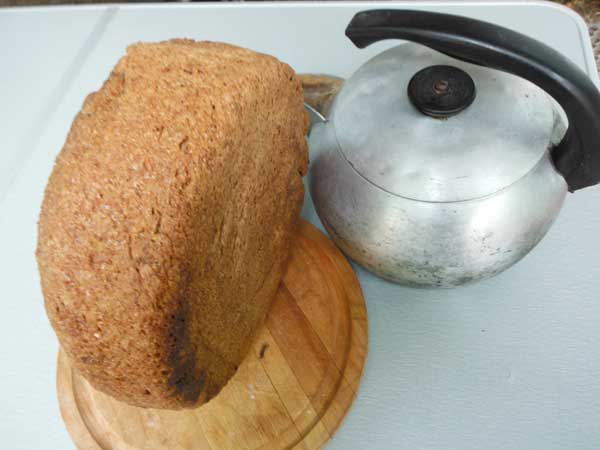
The dough wasn't well proofed, but probably was the best it was going to be in any case.  To fill 2 tins I probably need a bit more than 1000g of whole wheat to begin with.  The finished bread is a nice, soft sandwich loaf, moist and suitable for toasting.  The crust is only a tiny bit crunchy.  I like it just fine.  Tastes good (said the man jonesing for his exorphin fix).


Just out of freezer, still frozen
Should have slept a bit longer and let it proof longer?

getting some colour after 20 minutes @ 450 F., lid on

No, these are not quite done, back into the oven with you!

That's a bit better

Some problems here.


There is a significant problem with the sides of the loaf near the tin, probably indicating that there was a problem with the proofing -- I am guessing it was not long enough.   And obviously the gluten was not well developed, a true Tartine loaf will require a lot of folding and stretching, and an ordinary bread will require kneading -- none of which this dough got before baking.
Freezing didn't hurt all my yeasts, they still performed and made pockets of gas.

Crumb: This dough was frozen?
Yes: it could have been so much better.

Notes to Myself
  • It is unlikely that I will use this technique of freezing dough very often, for bread. I was driven to it here by necessity, and timing (and then decided to learn something about it). But perhaps in the future I may keep some pizza dough this way, if necessary.  I don't know. In the future, I think that adding some oil to the dough might help give it some longevity and prevent the syneresis.
  • The frozen dough turned into bread by your supermarket bakery is an inferior product to a genuine freshly baked loaf, period.  All sorts of things have been done to it to make it almost as good as fresh baked.  But it isn't.
  • It is unlikely that frozen dough will be good for very long.  Mine was only frozen half a day.  The literature I've read suggest that a lot of degradation happens, and the longer you keep dough frozen, the worse it gets.  In one of the articles it mentions that one month is an outside limit for the gluten matrix, before it is entirely worthless to keep enough gas to raise the bread.
  • The Aibara article (Aibara, S. et al. (2005) "Microstructures of Bread Dough and the Effects of Shortening on Frozen Dough" Biosci. Biotechnol. Biochem 69(2) pp 397-402) is doubly interesting because it gives a nice chart of dough's many phases -- "gas phase", "Continuous liquid phase", "Continuous protein phase", "disperse phase" etc. -- (according to the model proposed by Bloksma, 1990).

Saturday, August 11, 2012

Camp Breads 2012


Camp Bread 2012

I've made bread over a campfire with a dutch oven before:

I think that if you check out those previous years' loaves, you can see the progression of my ideas and ability to bake bread over a campfire.

Something different
This year I wanted to try something different: I took no recipes, I took no flour, and the only actual leavening I took was in dried form.  I had to reconstitute the sourdough over a couple of days to get it going.

Dried Sourdough

Rather than use flour, I decided to take some grain -- mostly wheat berries, some rye kernels, some oats and other seeds -- and grind it right there in camp with an old coffee grinder, to see what I could come up with.

 Grinding the berries

But I chickened out.  While developing my dough, I could see that the gluten wasn't going to develop properly with this coarsely ground stuff -- it was closer to milled flour than it was to cracked wheat, but the grinder may have damaged the starch or perhaps the bran was just too chunky or something.  I had no recipes, but I could feel that the gluten wouldn't develop, so I did end up buying some flour and adding a bit of it to the mixture of sourdough.  Anyone other than me might have found this acceptable.  But I was disappointed because the only flour available to me was enriched flour -- there wasn't a decent grocery store for hundreds of miles around, and the local gouger/retailer only had white flour.  

For the last loaf only, I managed to obtain some whole wheat flour, after a rainy-day trip to a real grocery store, hours away.

There were other problems I had to contend with: the water had a distinct chlorine odour.  I mostly used boiled and then cooled water.  Often I used leftover tea.

 Adding ground grain to tea

And the weather had been so dry throughout northern Ontario (before we got there), there were strict fireplace bans in effect.  You could only make fires between the hours of 7-9 in the morning, and 7-10 at night.  This meant my bread dough had to be timed to be ready for baking when the fire was available.

Of course, as soon as we arrived, the dry period ended, and we had a lot of rain.  This did not immediately change the fire ban.  But it did make it difficult to make the fire, with damp firewood.  

Those are just some of the things you have to contend with, when you are baking over a campfire.


The weather could be forgiven because it made the sky spectacular.  The problems with the bread could also be forgiven because it tasted so good.

Camp Bread #1
I built up this bread over a number of days.  I had taken some bread with me, so I had time to play.  First, I reconstituted the sourdough with some freshly milled grain and some tea.  It took a couple of days of gradually adding freshly milled grain before it was beginning to properly ferment.  I kept this fermentation fairly dry as I built up the dough.  Remember, I had no recipes.  I just added some ground grain ad lib until I was satisfied with the texture.  Then I'd leave it for a day to ferment inside a covered container.


Adding a bit of ground grain and hydration daily

On the day of baking, I add a bit of salt.  Not measuring anything.
Saving a bit of sourdough before the salt is added (for the next loaf).
The first dough I raised in a tea towel.  Big mistake.
Risen dough in tea towel


Tea-towel scrapings make a nice bun

The day before I was going to bake bread I reserved some sourdough and then added some extra ground grain and some liquid.  Unsatisfied with the way it kneaded, I ended up adding some all-purpose flour.  I did try to develop the gluten with stretches and folds, but after a while I gave it up and went kayaking or swimming or something.  The dough mostly bulk fermented in a floured teatowel inside a steep bowl.

This was a mistake, as the dough stuck badly to the teatowel.  I scraped off as much of the dough as I could, and made a bun with it, after baking the main bread.

The dutch oven was heated while the flame was still quite hot, for a minimum of 20 minutes on the grate.  This is near enough to the flam that you can't keep your hand there for more than a second or two, but it may not have heated the cast iron all the way through, I don't know.  I turned the pot several times, to ensure that the heat had a chance to get the pot good and hot.

For the first part of the baking, I kept the dutch oven on this grate, but although there were still some flames, the pot wasn't in the direct fire.  There were some coals, and these went onto the top of the lid.  The bread is baked on top from heat radiating through the lid.  Again, I would turn the pot every 20 minutes or so, and I would also  put new hot coals on top, and check the top of the bread for doneness.  Baking took a long time this way.  The first loaf, I started the fire at 7 pm, put the dough in at 7:20, and turned and checked it until 8:50.  Then it was starting to get pretty dark, and the fire was dying, so I placed the pot in the embers for the final 20 minutes.  This seemed to work, for this dough, and I repeated the process for the other loaves.  This was the fastest loaf -- the other loaves took 2 hours to bake, after the pot was heated.

But with this loaf I had to bake the bun afterwards, too.  And the fire had to be out by 10 pm.  I made the pot very hot, kept it in the coals, and checked it frequently.  Smaller bun-sized doughs don't need as long to bake anyway.


The final loaf, campfire bread #1:


Toast with Board's Honey and last years' homemade wild blueberry jam.
I was pleased that the bread was not overly sour.  I was afraid that the dough, elaborated this way over days and days, would develop too much acidity, too much lactobacilli, not enough yeast.  But because I had kept the ferment fairly low in hydration, it was not sour tasting at all.  It had a faint sour odour, but not a sour taste.  A couple of other people tried this bread and said it was good, but I ate most of it.


Camp Bread #2
On the day of baking bread #1, before adding some salt, I reserved some sourdough.  Happy with the way the first bread turned out, I developed the dough for bread #2 over several days too, from the reserve.  Again, I didn't keep detailed notes of how much cracked grain I used.  I did keep some notes, but I regard these now as suspect and incomplete.  I was grinding grain when I felt like it, and not always writing down what I did.  I was on vacation.

But this time I added some rye kernels, and at the same time as the salt I added some sunflower seeds and some pumpkin seeds.


seeds in dough
Bulk fermented dough in large oiled bowl:
deflated and deformed getting it out and into the hot dutch oven

About 20 minutes into the bake
Towards the end of the bake

finished loaf still in pot
  
Cooling atop the grill before the coons came


Because I frequently turn the pot, no one side gets too well-done

This bread felt mushy on top even after an hour and a half of baking.  It was probably too moist, and the top trapped the steam inside the pot.  I baked it for a full hour, and even when I finished I was worried that the top was just not well baked.  But as it cooled it became fine, an ordinary crust.

A couple more people arrived at camp and they tried this bread too and pronounced it good.


My son brought me a couple of nice Glänta Bread Basket bags for my bread.  I think that he just wanted to see my reaction.  He was amused because he bought them at Ikea -- and he knows how I feel about Ikea.  I have to admit that the bags are made of good sturdy material (though they smell a bit funny, like a chemical that the fabric has been treated with), and I think they are meant to hang somewhere in your kitchen.  My wife has made me several fabric bread bags with ties on the top that we just load up and toss in the bread drawer at home, but these Glänta bags would probably be quite nice for people with less drawer space.  I think they did a pretty good job of keeping the bread from developing too much moisture during the humid days, whereas my wife's bags became damp and wouldn't dry out.  Supposedly the bread bags are designed to keep the bread warm.  Uh-huh.


I didn't keep the bread in the tree, that's just asking for trouble from the critters of the woods.  I was just taking a picture of the bag.  We actually did have trouble the night before when we were playing cribbage by lantern light, and the bread was cooling on the grill: a whole family of coons came by because they smelled the bread.  We had to drive them off.  I cooled the bread in the car after that.

Flash evidence of coon by hot Dutch Oven in the dark
run away


Camp Bread #3
My final bread.  No one was really helping me to eat bread at camp this year (other than trying a slice or two), so I didn't make as many loaves this time.  For this loaf, I added more rye and even some ground up oat groats.  And I had whole wheat flour now.

We thought it was going to rain any minute so set up the umbrella

earlier in the baking

later in the baking

finished loaf cooling
lopsided loaf


I liked this loaf's flavour.  I also was pleased with the darker colour, almost pumpernickel-like.  But I didn't add quite enough salt.

About half of this loaf came home with me.  Now all that remains is memories of loaves and sky.

Goodbye you northern beaches


Notes to Myself
  • The Five Roses All Purpose Flour that I was forced to use because nothing else was available is "enriched" with a few of the mandated vitamins and ascorbic acid, amylase and benzoyl peroxide.  Benzoyl Peroxide is a common way to simulate the aging process of flour.  It is an oxidizing agent, and like many of the other artificial aging ingredients added to flour over the last 50 years that have been banned in many places (e.g. chlorine dioxide, ammonium, potassium persulfates, potassium bromate, iodate, etc.), this molecule has raised some concerns.  WHO has rubber stamped its use at low levels.  But I believe that in some places, benzoyl peroxide is banned for treating acne (another of its common uses here), and I don't think that the EU allows its use in flour (although apparently it is still used to bleach certain cheese).  At the very least, it can be a skin irritant. 

    [Once home, I learned that China has also banned the use of Benzoyl Peroxide in flour since May 2011.  Chinese scientists have since pioneered many different methods to detect Benzoyl Peroxide in flour, using tomography, bioassays, and ever more inexpensive techniques.  You might see a substantial change in the way flour is treated here too, since China is such a huge consumer of our wheat, and they are no longer going to buy the stuff we send them that contains Benzoyl Peroxide.  I believe that China is responding swiftly to the new findings of Jia X, Wu Y, and Liu P of Shangdong University, Jinan China, who have detected some potentially serious problems with how Benzoyl Peroxide interferes with mice liver antioxidants (X, J. et al. (2011) "Effects of flour bleaching agent on mice liver antioxidant status and ATPases" Environ Toxicol Pharmacol 31(3) pp. 479-84).  This ingredient has been in our flour for a long time, and we still don't know how it affects humans, we keep learning about ways in which it may be harmful.]

    So is it appropriate to use Benzoyl Peroxide in flour?  Despite the WHO pronouncement, a lot of people are beginning to question its widespread use.  Personally, I'd like to do without it.  It simply makes sense that we try to increase our antioxidant intake, and avoid things like Benzoyl Peroxide that will destroy antioxidants.  But when at camp, one eats a lot of stuff that one might ordinarily not.  I actually had part of a soft drink while at camp.  Yuck.  I tossed it away.  How can anyone drink this stuff?

    People might be interested to know that Five Roses now makes a "never bleached" version of their all purpose flour.  Look for it, if you must use Five Roses flour.  Beware of gouger/retailers that don't know the difference.  The flour I picked up at the gouger/retailer might have been very old stock.  Five Roses now makes a bleached flour that uses azodicarbonamide. It is legal as a bleaching agent for flour, in very low amounts, in the U.S. and Canada.  Personally, I'd stay away from that one too, for the same reasons.
  • There is a subtle difference between ground grain and milled grain.  You can feel the difference.  Good bread requires milled grain, or flour.  You can make a bread with ground grain, but it will be dense and the gluten from the wheat will not be well developed.
  • Dried sourdough takes a few days to reconstitute and get going again.
  • Dutch ovens are heavy, as are grains and flour.  This is probably not the thing to take with you on a long canoe trip.  But fresh campfire bread at a base camp is marvellous.
  • On rainy days we found some shops that sold old books, and I found a few bread books to add to my collection.  Several are quite old and mysterious.  One recipe book is coverless and quite old, with recipes submitted from various women (probably church ladies) from the Ottawa area; it has a chapter on "bread and biscuits", and the first entry there is "Six-hour yeast" made with mashed potatoes and a "yeast cake".  Because the cover is off, I can't tell the name of the recipe book, or when it was printed.  But there are full and half page ads in the book from stores around Ottawa, one of which toutes the benefits of "The New Empress Steel Range" (which came out around 1910).  The Home Ec book is cute: it is heavily notated by hand and may have been a manual given to teachers of baking courses sponsored by the Ontario Dept of Agriculture and Food and administered by either the 4H club or Women's Institute back in the 60s.  Training Schools on various household subjects (like quilting and breadbaking) were sponsored by the government and communities throughout Ontario took advantage of them -- not just in the north.  This pamphlet, and the Better Homes and Gardens cookbook, have some interesting and overlapping info on shaping loaves.  The book by Ingram & Shapter has nice pictures.  I may peruse the recipes too.  The book by the Evan's in particular looks quite interesting, and I will have to delve into it. 
    • Jones, Judith & Evan (1982) The Book of Bread: the pleasures of breadbaking including uncomplicated techniques & 240 wonderful recipes both traditional and unique
    • RP(?), Ontario Department of Agriculture and Food Home Economics Branch (1968) Baking with Yeast: member's pamphlet.
    • Ingram, C. and Shapter, J. (2001) The World Encyclopedia of Bread and Bread Making.
    • Gerras, C. et al. [Rodale Press] (1982) The Good Grains: Featuring Breas, soups, Casseroles, Souffles, Snacks and Desserts
    • Dooley, D. et al. [Better Homes and Gardens] (1973) Homemade Bread Cook Book

Friday, August 10, 2012

A loaf to take camping: 25% rye, 75% ww loaf


Last bread baked at home before holidays:
25% rye, 75% ww loaf


This 80% hydrated bread has 5% wheat germ, and is made with sourdough starter.  The oven temperature was different: I kept it at 500 degrees for the first 15 minutes, then backed it off to 425 degrees.  After 5 minutes at this lower temperature, I pulled the lids off the dutch ovens, and continued baking for 20 more minutes.

The dough was mixed late at night, and stretched/turned 3 times after adding the salt before I placed it in the refrigerator.  It was brought out of the fridge in the morning, and allowed to sit only 30 minutes before another stretch/turn -- the dough was still cool to touch.  After a second stretch/turn, it was divided and placed in bannetons to rise.  Total proofing time once it hit the basket was 2 hours and 20 minutes.


Curious Fact about Rye
I've been dipping into Sandor Katz's new book, "The Art of Fermentation: An In-Depth Exploration of Essential Concepts and Processes from Around the World," and I highly recommend it -- but then, I also loved his earlier book, "Wild Fermentation."  The books do have some overlap, but in the newer book, Katz goes even deeper into varied techniques.

Discussing how humans and plants have "co-evolved with bacterial symbionts," Katz gives the following fact about rye plants that is sure to awe:

"Roots and their surfaces for soil interaction are actually far more elaborate than meets the eye.  A single rye plant, growing but a season, has millions of rootlets, altogether running an estimated 680 miles/ 1,094 km, and each of the rootlets is covered with still smaller root hairs, numbering in the billions on each plant, altogether running 6,600 miles / 10,600 km.  All these microscopic hairs release exudates into the soil, highly regulated excretions including sugars, amino acids, enzymes, and many other nutrients and unique chemical compounds, creating a very selective environment in which they 'literally call the proper bacteria to the area where [the plant] is growing…"

This simply reminds me of the facts we learn in anatomy, when we take up the topic of the human gut: how the intestinal folds are coated with villi, which are in turn composed of microvilli -- all designed to increase the surface area of the gut membranes, to allow passage of more nutrients from digested food.  The villi and microvilli together increase the surface area of the gut to about 100 times the surface area of the entire body's skin surface.

I'd like to learn a lot more about the human gut, and especially how it digests grains.  I have heard it suggested that some parts of some grains will somehow join with the villi and microvilli and allow passage of some rather unexpectedly large molecules into the lymph and bloodstream -- perhaps through enlarged ion channels.

There are a lot of mysteries in the human gut, and obviously a lot of mysteries in the soil beneath our feet in the fields where grains are grown.

This loaf
was excellent.  I took both loaves with me when I went camping, and didn't require any other bread for several days.


camp toast


Notes to Myself
  • Research more on the gut and how grains are digested. What molecules are involved? How is grain broken apart by the body's enzymes? Get into some specifics about how the parts of grain embed themselves in the microvilli -- if indeed this is true. How would you find out? Does it occur in all people, or just in the ones who can't tolerate gluten? What molecules pass through the brush border of the gut? What molecules don't?
  • Become more knowledgeable about the sizes of the microscopic world around you. Become familiar with the sizes of molecules and cells.