All grains contain peptides that mimic morphine or endogenous opioid substances. This is where I deal with my latest loaf craving. Get your bread-based exorphin fix here.

Wednesday, March 24, 2010

Everyday Bread #2

Time for another experiment: I'll be working nights for the next couple of days and won't be able to do another of Reinhart's intensive breads.  For my everyday bread this time I will use the Master Recipe from 'Healthy Breads in Five Minutes a Day'.  But the experiment will be to add some sourdough starter again.

I'll just back off a bit on the amount of sourdough starter that I had been playing with in my last bread test.  That was with the 'Artisan Bread in Five Minutes a Day' Master recipe.  But I am after whole grains: I'm leaving that first book behind for now.  That is why I'm changing recipes for this next experiment.  So I've put in about 1/2 cup of whole wheat seed starter (or Barm, or MotherStarter -- I still haven't determined what I should be calling it), and I've taken out 1/2 cup of the whole wheat.  This should change slightly the hydration, making it even wetter.

The first thing I noticed, in fact, was that it stirred up a lot easier than I am used to.  Here is a picture of the mix prior to its rise:


I was going to let it sit it out at least 2 hours before going to work.  If it wasn't doubled by then, I thought, I'll leave it sit out until I get home again -- over 12 hours of ferment.

I needn't have worried.  It was doubled in 40 minutes.  But I'll give it the full 2 hours at least to ferment.


I let it sit out a couple more hours before refrigerating.  In that time, it actually rose another 1 1/2 inches or so (even after it had reached the level you see here).  I stuck it in the refrigerator overnight, and when I came to make the bread (24 hours after mixing), it had fallen about 3 inches in the fridge.

I shaped the dough into 2 forms, and discovered that the gluten strands were not well developed.  I was reading somewhere in Reinhart's first book that the mixture of commercial and wild yeasts might leave more glutathione in the dough, which will break apart the gluten.  Maybe that was it.  The theory is that the commercial yeast caused the rapid rise, but then died, leaving all this glutathione, which broke the gluten strands that had bee developing.  The wild yeast was more hardy, but after the commercial yeast ate everything, there was little they could do.  That is why the dough fell so far, in the fridge.

The other thing is, these doughs are very wet.  They simply do not rise in the proofing stage, they spread.  That is why I opted for the pan, and for the parchment paper.  I've had bad luck with the pizza peel, because the moisture from the dough just oozes out onto the cornmeal and makes it stick to the wood.

I also thought that this time, since I had one dough in a pan, I could slip it into the oven when the oven was hot enough, and not wait for the stone to get hot (our oven pre-heats in 15 minutes, while the authors of the 5 min/day books suggest the stone and the pan need to be pre-heated at least 30 minutes).

The only problem with doing this was, the loaf in the pan didn't get fully proofed.  What difference could 15 minutes possibly make?  Take a look.  Here are the results of the experiment. 

Once again, I forgot to score the loaves.  The one that was underproofed 'popcorn exploded' again.  Someone recently gave me a link to the Northwest sourdough bread webpage that gives a lot of troubleshooting advice.  He says that this is precisely what you get if you underproof a sourdough loaf.

After 25 minutes in the oven, I removed it from the oven, and turned it upside down to try to get the loaf from the pan.  It was stuck -- so I was just going to wait a bit, to let the steam soften it, as per the suggestions of the 5min/day people.  But when I looked underneath my cooling rack, after setting aside the pan, I noticed this big blob of uncooked dough.  My shaking had emptied much of the uncooked middle of the loaf out onto the counter, through the split in the top.  Another bread disaster.  It wasn't even cooked inside despite that ruptured crust!  I plopped it back into the oven for another 20 minutes.

The other bread that I had formed into a boule was proofed okay because it had those extra 15 minutes -- but it really had no oven spring at all.

Now for the money shot.  How was the crumb?  Well, as you can see from the first picture, the blob that fell out of the middle left quite a hole.  In the second picture, the boule looks okay, even though the crust separated a bit.  There's a word for that, but I can't remember it.

 Actually this bread (both of them) tastes great.  And the crumb isn't too bad, even if it didn't get a decent oven spring.  But here's the other thing: this bread stales very quickly.

I still have a tiny bit of dough from that 5min/day bucket, and the next time I bake, I want to try something else.  I want to add something to it, and knead it, and see if I can't get the texture to stand up a bit instead of just oozing outwards.

Notes to Myself:

  • add something to the dough so that it is a teensy bit less wet.
  • add some more yeast, the commercial yeast died and left too much glutathione.
  • let it proof a full 90 minutes

Whole Grain Breads Master Formula - wild yeast version


This is the very first bread that I've made from Reinhart's Whole Grain Breads book. I probably should have made the yeasted version, or better yet, made the yeasted version and the motherstarter version side by side. But since this was my first try at any recipes in this book, I wanted to be careful and I didn't want to get mixed up. And I had refreshed my starter within 3 days, so now was the perfect time.

This bread is a 100% Whole Wheat Sandwich bread, and like most of the breads in this book, it comes together 'like epoxy' by creating first a soaker, and then a biga, and a little bit more raw material on baking day. It takes 2 days to make. The whole idea is for some pre-fermentation to occur before you bake it. Reinhart says that this allows the enzymes to work at the whole grains, so that more complex flavours are developed. I am not willing to swear to that, but having eaten a couple of slices now from my first loaf, I have to agree that it tastes good. On the other hand, is that due to the addition of honey and scalded milk? There doesn't seem to be all that much, but the addition of fructose and lactose is going to sweeten the loaf. So you are getting some extra sugars on top of all that carbohydrate.

On to the pictures of the process.
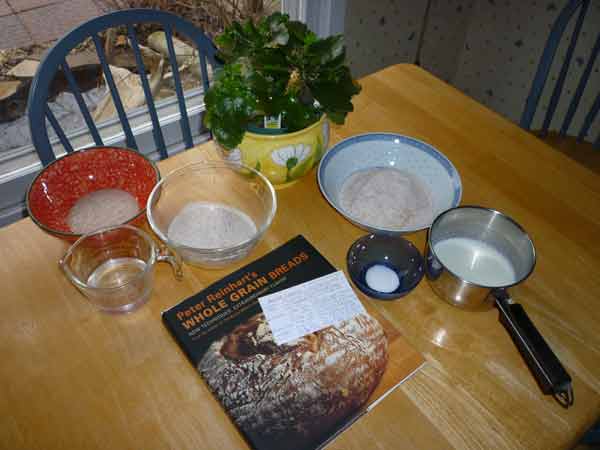
Day 1, Mise En Place, the ingredients for the Biga and Soaker:

The Soaker (on the right, below) is just mixed and you can forget about it. It gets to stay out at room temperature 12-24 hours, i.e. until you bake with it the next day. The Biga has to sit out only 8 hours, and then it can be refrigerated. The first thing I noticed was that the Biga didn't rise so much. I assumed that was due to my newly refreshed 100% rye motherstarter not knowing what to do with whole wheat. It was room temperature from the fridge; but perhaps it was stunned. Eventually it did decide that whole wheat was worth fermenting, however, and I did get some sort of a mucky increase in volume, although I wouldn't call it a rise.

Day 2. Now we are mixing dough for bread.

I had all my instructions written on a card, which I misplaced at just the worst moment, when I was trying to time my mixing and kneading to Reinhart's direction. In the end, I overworked the dough by giving it about 3 minutes more kneading than I was supposed to.  I'm not sure why I wasn't getting the rise that I wanted.

Not knowing what to expect from the bread, I decided my first loaf would be made in a pan, rather than on my baking stone.

The second rise took about 4 hours, much longer than Reinhart said it would. I had spent all day watching this dough, and I was beginning to feel like mine was a wasted life.  To pass the time, I tried to find some information on how healthy whole grains are.  What I found was controversial.  I will have to report on this in another blog.

Despite the crooked way the dough ended up in the pan, it baked up all right (even though I forgot to slash it). Now I had oiled the pan, but the dough still didn't want to come out easily, so I just sat it down until the pan cooled a little, and then it slid out better. The only problem was, it was now a little moist on the bottom, so I stuck it back in the (still warm) oven so that some of this moisture could evaporate. It did, but because I had placed it upside down on the oven rack, the loaf had settled a little.

So the crumb was a little more dense looking than the picture of Reinhart's bread in the book.

Notes to Myself:
  • double the recipe, at least. It is a lot of work for just one loaf. 
  • Next time, try the batard shape.
  • Make the yeast version of each recipe first
  • Check your motherstarter.  Did you miss a step, going from barm to motherstarter?

Monday, March 22, 2010

Everyday Bread #1

I began my bread-baking monomania following a Mother Earth News magazine article about making bread in 5 minutes a Day. I read the article while on vacation, tried it when I got home, and then bought the book Artisan Bread in Five Minutes a Day, by Hertzberg and Francois. Baking bread was so easy, it started me on my quest. I figured if I could make bread this easily, I could eventually make one that I actually liked. Because frankly, I felt that something was missing from these 'artisan breads' made with the no-knead methods.

I began to cast about for other bread recipes, and discovered that I liked heavier breads with more bran, and more whole grains in them. Unfortunately, my early attempts at these breads were inedible for my wife. I baked a lot of bricks. I needed to find a way to get the bread to become more airy.

Eagerly I awaited Hertzberg & Francois' second book, 'Healthy Bread in Five Minutes a Day'. This book had a lot of new recipes that used whole grains. But most recipes also used Vital Wheat Gluten, and even with this additive, I was unimpressed with many of the breads, both for their taste and their structure.

I was still searching. I discovered that many online bakers at the various web sites that I frequented were following Peter Reinhart's book 'The Bread Baker's Apprentice'. I did purchase that book, but I only made a couple of breads from it, surely not enough to master his techniques, and not even enough to develop a refinement of my taste. I can't say that I preferred his bread over the five minute a day breads. So, why make a bread that takes 2-3 days of effort when you can just stir it up and refrigerate the dough and make bread whenever you need to?

One thing I did, however, was follow Reinhart's roadmap to make a sourdough starter. I actually originally made 4 different starters! One was made with rye, one was made with all-purpose flour, one was made with whole-wheat flour, and I think the final one was made with a combination of rye and all-purpose flours. Eventually I tossed away all but the rye and the all-purpose mother starters. I still call these starters 'Barm' because that is what Reinhart called them in 'The Bread Baker's Apprentice'.

I too rarely used these starters, because the recipes called for a lot of preparation, which is difficult for me and my nursing schedule. I found myself returning frequently to the 'Five Minute a Day' breads, just to have something to take to work.

In fact, I mostly used these starters when I was discarding them! Loathe (and too cheap) to simply toss them into the compost when I was replenishing them, I was casting about for a way to use the throwaway part in bread, and found something on the '5 min/day' website. There, Hertzberg says that if you are using a 100% starter (i.e. an equal water:flour ratio as Reinhart's are), you can use 1 1/2 cups of that starter in the 5 min/day recipe(s) and simply cut out 3/4 cup of both the water and flour. You can also cut out some (maybe even all) of the yeast, but you may have to wait for varying lengths of time for the initial rise's doubling.

I first tried this with a discard, using their master artisan 5minday recipe:

2 1/4 c water
5 3/4 c flour
1 1/2 c barm discard
1 1/2 tbsp yeast
1 1/2 tbsp kosher salt

This made a decent tasting loaf, but it had a funny odor to it that wasn't all that appealing to me -- it could have been the high bacteria content of my expired barm, I don't know.

Tonight I'm doubling the amount of barm discard to 3 cups. That means the recipe is:

1 1/2 c water
5 c flour
3 c barm discard
1 1/2 tbsp yeast
1 1/2 tbsp kosher salt

To get this amount of discard, I actually had to dip into my active barm. Despite that, and despite the fact that I kept all the yeast, this dough took almost twice as long to rise as the first recipe; but then, the house is rather cold tonight, so maybe you can't compare. (Note: this bread was a disaster.  Since it was more goo than gluten, it wouldn't rise, and the baking was uneven.  I tried to make some baguettes and the goo was simply running all over the place in the 90 minutes after refrigeration and before baking as it warmed to room temperature.  In panic mode, I put it in the oven too early when the stone and the pan were not yet hot enough.  Although I slashed the loaves, they blew apart in the oven like popcorn, totally uncontrolled.  I ended up throwing most of it into the compost, even though some of it was a sourdough bread, and it had a decent taste and scent.   This is just one more in a long line of bread disasters that I have endured.  Maybe I should have called my blog 'Bread Disasters'.  But only an Exorphin Junkie would continue on trying to make bread in the face of so many awful bread fails and obvious lack of talent.)

But all this got me to thinking: if I could do this with the discard, how much better would it all taste (and smell!) if I did this with 100% active starter?

Reinhart no longer calls his wild yeast starters 'Barms'. He corrects the nomenclature in his next book, 'Whole Grain Breads', where he simply calls it a mother starter. I have just recently purchased this book, and tonight I am starting the master recipe from that book for the first time, using my 100% rye starter. If the mother starter works, I will be baking the first loaf tomorrow, since it takes two days to make a single loaf of bread. Will it be worth it?

I have it in the back of my mind that I might like to bake my way through his entire 'Whole Grain Breads' book (others have done this with his other book, 'The Bread Baker's Apprentice'. But this all depends on whether this initial test goes well.

I'm really hoping that I can find something that both my wife and I will like.

Notes to Myself:
  • Use your refreshed motherstarter.  Don't wait until it is all worn out.
  • Let the wild yeast fully rise your dough before baking
  • Make sure the oven (and stone and water pan) are fully pre-heated, 30 minutes minimum.