|
| 20% Rye, 80% Whole Wheat sourdough breads |
My loaves, Thursday Dec 27:
1. 20% Rye loaf.
It makes sense to make a rye loaf on Thursday, if you are going to work and fast on Friday, so you can crack into the loaf on Saturday. Rye keeps better and actually improves in flavour on the second day. It does, however, stale like any other loaf. I doubled up on the sourdough starter for this loaf, and it did taste more sour than usual -- not that this is a bad thing. Once in a while it is nice to have that extra flavour and acidity for taste.
 |
| Cherry Pie, Pumpkin Pie, and another Raisin Walnut Bread with the Rye Breads |
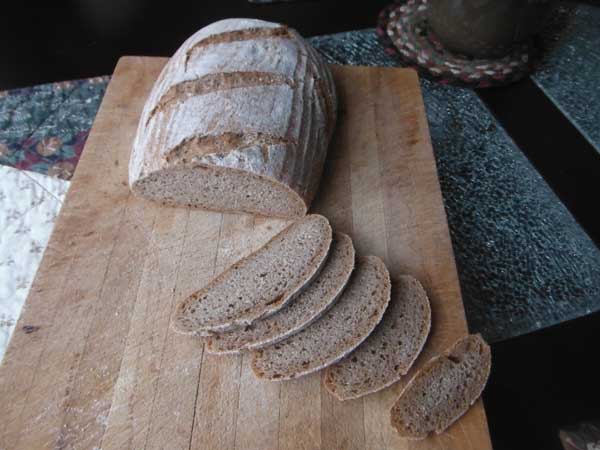

2. The Sourdough Raisin Banana Walnut Bread
Same recipe as before, this time I added some walnuts. Wasn't proofed quite long enough.


3. Sunday baking: 20% Semolina loaf.
On the Friday, after working nights, I mixed up some more dough and placed it in the fridge. It sat there until Sunday morning, when I took it out and baked it. This was a 20% Semolina loaf.
This dough contained:
- 800g ww flour
- 200g semolina
- 400g sourdough starter (!)
- 50g wheat germ
- 100g wheat bran (!)
- 720g water
- 20g salt


The dough was scored and placed in the oven, where it baked on a hot pizza stone, using water in the base of the oven for steam. Despite the scores, it blew apart on the side of the loaf, which indicates to me that it was underproofed. I suspect this was because it was not out of the fridge long enough prior to baking.
Despite this defect in appearance, my wife said that this loaf really tasted great. I too liked it, but felt it was a bit too moist. A couple of things that were different about this loaf: there was so much starter, it made the bread wetter. But the starter was still ripening, so the bread was not all that sour. The starter acted more like a pre-ferment. The final bread had a good taste.
Secondly, I added wheat bran to this dough. Semolina is not a whole grain, but it is full of taste. Adding more Aleurone to the mixture made it less workable, but brought it closer to its whole grain goodness. The semolina is a softer wheat, and has a bit more taste than the hard red winter wheat from Canada that I usually use, making this bread taste better than usual -- hence my wife's perception of the nice taste.
The gluten wasn't well developed in this bread, but it still worked fine.
Ubiquitous Bread
"God must have made the builders first,
or else where did all the houses come from?"
- a 5 year old that I spoke with, long ago
This is a story of bread that I grew up with. Or bread that I grew up on. Or grew out of. And its also about bread I grew into. Take your pick.
It is a story of the influence of a bread that has been so profound, it became the environment. Think for a moment about all the things that you take for granted, because they are all around you. Your home, on this street: your car, your soap, that song on the radio, the clothes you wear. And yet these things were once not even here. They were put there by people like you and me, who used their will to create something, to put something into place. You have purchased them. Your hard-earned money was exchanged for them, because on some level, you value them.
Sometimes we don't even remember how those things got there, we just assume that they always were there. But they weren't. They have a history, a history of choices made by us, and by our ancestors.
Take the bread that most everyone eats, for example.
George Weston (1864-1924) was a baker in Toronto, who left behind a family and a business that put his bread in virtually Canadian's mouth. I have not seen much written about the influence of his Methodist upbringing on what he achieved, but I have strong suspicions. He was a man of integrity, who "grew in the favour of God and man," like the men of character in the old stories.
Back in the days when price-fixing was acceptable, he abided by the gentlemen's rules until the gentlemen tried to shut him down by undercutting prices. He fought back, and the people he baked for believed in his integrity. They had confidence in Weston and enjoyed what they perceived to be the quality of his loaf. That is what made him survive, when each of his competitors (his 'old friends') fell by the wayside.
George's son, W. Garfield Weston (1898-1978) expanded the Weston influence and continued to build the family fortune. He could have, at many stages in his corporate career, said "enough is enough," -- but he did not. Something drove him to invest in ever more profitable ventures. Many were risky -- like the purchase of Loblaws. But he usually ended up on the top side of every good deal. And it must be said, he benefited society because of what he produced, and what he made available to the purchasing public.
And the present generation of Westons continues to insinuate themselves into the fabric of our Canadian -- indeed, North American, even the entire world's -- cultural environment. George Weston Limited has their hand in virtually every pie out there -- or perhaps a different way to put it, a finger in everyone's mouth. Apparently, that is how billions of dollars are made -- by making things that almost everyone uses or needs, and by leveraging new acquisitions. Today Loblaws has positioned itself to become one of the leading Real Estate brokers in Canada. The Weston family name has properly earned its place in Diane Francis' books "Who Owns Canada" and "Who Owns Canada Now". In the earlier book, the Weston family is painted as a Canadian retailer success story; in the later book, they are shown as one of the few remaining families with "old money" in the increasingly meritocracy that is Canada today.
The Wonderbread Connection
In the US, Indianapolis-based Taggart Baking (purchased by Continental Baking in 1925) gave the world Wonder bread.
The influence of Wonderbread has been extensive, and it may go down in history in the US as being the bread that got behind the enrichment of flour and bread, that ended the diseases of pellagra and beri-beri (on the other hand, you could actually say that they caused the proliferation of these diseases, too: it was, after all, primarily the demand for cheaper flours that caused roller mills to proliferate, to feed the industrial bread machines). The roller mills took out so many vitamins from the grain, and because so many people ate the cheap bread, this caused the widespread nutritional deficiencies that brought on the plagues. Continental Baking had little choice but to cooperate with the government who was sold on the new science that told them that white flour produced from roller mills was dangerously deficient in vitamins.
Over the course of decades, in corporate takeovers and mergers, the Wonderbread brand name was purchased in the US by Hostess Foods (1994). Recently, in November 2012, after the US had its economic meltdown, Hostess declared bankruptcy. You probably heard about it, as I did, when several late-night comedians made reference to the demise of Hostess Twinkies. Lets face it: few people will really miss that chemical concoction that could never go stale or mouldy. But over 18,000 people out of work? That's a tragedy. And Wonderbread in the US was another casualty of that bankruptcy, although the assets will be sold off.
Meanwhile in Canada, "Wonderbread" never faltered for a moment, and continues to soldier on (and still, I believe, sells it to the US). Weston bakeries owns the Wonderbread name here. They made a fortune from the pennies of profits from the sale of those ubiquitous loaves of squishy bread over the years. They rolled those pennies into Weston Bakeries, and Loblaws food stores, and countless other corporate entities, and created our modern cultural environment. We ate it up.
The new formula for Wonderbread touts "No artificial ingredients". It's true, I guess, in the literal legal sense: sugar is not artificial, and the laboratory-designed enrichment of the white flour that is required by law is also not required to be labelled on the package.
I waded through Weston's corporate website's history pdf's. During expansion into England, Weston was quoted as saying his bread and biscuits were "for the masses, not the classes." And that, I suppose, has been the secret of the Weston success, if it can be boiled down to a simple recipe: give the masses the highest value calories for the least amount of money.
Weston means cheap bread.
I myself was raised on it. I have one fond memory, when I was about 14, finishing an entire loaf of it one morning while visiting my Gramma & Grampa's farm, topping it with my Grandmother's black currant jam (the fond memories are from the jam, not the bread). To this day, Wonderbread is my father's preferred bread. You can't fault Weston for giving everyone what they wanted (or was it what he said they wanted?).
But somewhere along the line, I came to understand (like most people, except perhaps my dad) that this is not a quality loaf. Eating this loaf will not make you healthy. You can survive on it for a while -- it has got to be better than nothing -- but you cannot live on it indefinitely. Sure, you can get your calories this way, but you will eventually succumb to the problems brought on or exacerbated by your choice: diabetes, heart disease, atherosclerosis, stroke, kidney failure, cancer -- the new plagues of the 21st century. And you will remain hungry.
The manufacturers of Weston's Bread will tell you there is no proof of this. And they do try to keep up with the latest sci-research that tells us fiber is good for you, etc. With all due respect to what Wonder bread and Weston has achieved, there is little doubt that we can make healthier bread and ought to eat healthier bread. In short: the stuff is crap. Their bread sales are falling, and they have painted themselves into a corner, tying their distribution largely through Loblaws. At this rate, how long can they continue to survive? Or will they follow Hostess in the US, and either go broke or sell off assets?
Just because they are ubiquitous now doesn't mean they will always be here.
Quality Bread you can buy
I was tempted at the outset of this blog posting to begin in the Dickensian manner: "It was the best of breads, it was the worst of breads…" You see, just because a loaf is made using Industrial Methods, doesn't automatically mean it has to be crap.
While I was raised on Wonderbread and knew no better because of my dearth of experience, I first learned of good bread when I began dating my wife. Her German family always had some bread on hand that was made by either Dimpflmeier Bakeries, or Rudolph's Bakeries out of Toronto. Her family enjoyed several different loaves. In particular, I remember these standbys:
These breads were not the only bread in my wife's family's household (there were often white brötchen that could be eaten for breakfast; and they usually had a pumpernickel loaf, too, but it was not made by either of these companies; they didn't like Dimpflmeier's Pumpernickel. The pumpernickel they bought was moister; it was made by Mississauga-based Kasseler Food Products, who began their business by importing these breads. I tried it, and I never much cared for it -- I always assumed that pumpernickel was an acquired taste, and that I have never yet acquired it; but it could be that I simply have never yet tasted a good fresh pumpernickel bread). But Dimpflmeier or Rudolph's breads could often be found on the table for a fast and filling supper meal (following the big weekend dinner at noon), and the family used specific breads to serve up different cheeses, meat, pickles, jams and jellies.
This was a huge culture shock for me. Imagine, someone raised on nothing but white bread, tasting these denser, full-grain loaves for the first time! It was marvellous. It was revelatory. It was a challenge to my sense of taste. "This is bread?" I asked myself as I ate it. "Where have you been all my life?"
It was inevitable that I would become the Exorphin Junkie.
My father, who still likes his Wonderbread, nevertheless has started to eat -- and love -- the Dimpflmeier Light Rye, too. My wife still buys it too, occasionally -- or sometimes Rudolph's Siegel -- because I refuse to compromise and make loaves with white flour (i.e. the impoverished but so-called "enriched" all purpose or bread flour).
I remember the first time I went to the store to specifically find and buy my own Dimpflmeier bread, after tasting it for the first time at my girlfriend's (later, my wife's) family's home. I was alarmed and surprised at the cost of the denser loaves, compared to the soft white Wonderbread loaves. I recognized that they had higher value, but I wasn't sure that I really wanted to pay that cost. It was just bread, after all, right? And raised on Weston bread as I was, one doesn't expect value when it comes to bread, one expects cheap.
I did buy some, but I used it sparingly, since it was so valuable to me. I savoured it. I stretched it out. I made it last. I enjoyed each mouthful. It remained a treat to be indulged in. I believed that I could never afford to buy this bread all the time. But I also recognized that you didn't need to eat an entire loaf just to feel satiated. With this bread you could be well fed on just a slice.
If everyone believed that these loaves are too expensive, these bakeries wouldn't survive, though. So how are these bakeries doing today?
Rudolph's Bakery
Rudolph's Bakery was reportedly the first Rye Bread bakery in Canada, and has operated since 1951 in Toronto. It was started by a German Immigrant named Rudolph -- although I don't know if this was a first or last name, online sources aren't explicit, they like to keep a myth in place. The original baker that came with bakery expertise reportedly came from a German baking tradition that could be traced back to the 17th century, but that family sold its interest in 2006 to David Reed and his partners (Reed is also involved in Cymat, a supplier of aluminum foam for military and industrial uses; bread foam, aluminum foam, they both present the same industrial problems and solutions...).
Rudolph's bakery is now run by George Paech; several other Paech family members are employed there in executive positions. The bakery seems to be doing all right, in its niche. They do their best to use organic ingredients, and I learned that they even produce a zero-salt bread, which has been given the nod by Gerson Therapy. Not sure which particular loaf that is, though. Paech apparently has enough money to recently buy a half-million dollar Florida home for cash, if the Internet can be believed.
The company has been experimenting with some new industrial bread baking techniques. Between this and their trucking of the loaves, they remain quite strong in the specialty bread marketplace. Imagine baking a 16 pound loaf at home, and chopping it up into a more reasonable home-use 1/2 kg sizes. These are some huge loaves!
Dimpflmeier Bakery
Dimpflmeier Bakery was similarly started by German immigrants. Because they are a private company whose influence is not nearly so entrenched in our Canadian culture as is the publicly traded Weston set of corporations, Dimpflmeier is not nearly a household name yet. But give it time. This bread bakery is certainly poised to cash in on the current health concerns about alternative, non-wheat-based bread and healthy bread. They too use organic ingredients for many of their loaves, and they seem especially proud of their spring water, which they truck in fresh from Terra Cotta Ontario.
Compare the Weston Story and the Dimpflmeier Story. Today, the Dimpflmeier Bakery is run by entrepreneur and philanthropic Susan Dimpflmeier in the Toronto area. But the enterprise was launched by Alfons Dimpflmeier, a master baker from Munich who emigrated to Canada to start his own bakery here in the late 1950s (various websites refer to the date 1957, others to 1959. I suspect that he began making pastries, but moved to bread in this time period).
Since they remain a private company, I haven't been able to check out their bottom line from this chair of mine at home. Nor have I been so crazy interested in it that I surfed beyond a couple of the top pages that Google's search engine dished up.
But these Dimpflmeier loaves are pretty much everywhere today -- they have become the next ubiquitous loaf, for people who want quality bread (which seems to be nearly everyone of Eastern European origin). Dimpflmeier's Bakery seems to be doing all right. Susan Dimpflmeier recently donated a half million dollars to Toronto's German International School. They also recently won an award for sustainability practices (but before you get too impressed, remember: the award was put out by oilseed producers, who simply like the fact that Dimpflmeier is using more hemp in its bread).
I see more of the Dimpflmeier breads now than I used to, and more of their brand than I see of other specialty loaves in the grocery stores these days (since 2003 they are nation-wide in Canada). They might even become the "next" Westons in the Canadian environment -- that is, if the next generation of Dimpflmeiers can one day prove they have some of that old Weston integrity. Can they?
I see more of the Dimpflmeier breads now than I used to, and more of their brand than I see of other specialty loaves in the grocery stores these days (since 2003 they are nation-wide in Canada). They might even become the "next" Westons in the Canadian environment -- that is, if the next generation of Dimpflmeiers can one day prove they have some of that old Weston integrity. Can they?
Or will the next generation of influential Canadians come not from the Westons or Dimpflmeiers but from the descendants of other breadmakers like Christian Burdan of Red Cat Farm? The future has not yet been written. The bread builders of the future have not yet been decided by God and man.
It will always boil down to who we trust to produce our food.
---
If I wasn't baking bread of my own, I most certainly would be buying some of these German-style loaves, because I feel they are the best you can get from a grocery shelf. They are substantive, they are filling -- unlike most Italian or French or British style loaves. However, my own sourdough whole grain loaves don't contain whey or milk powders, or calcium propionate, or enriched wheat flour with vitamins sourced from God-knows-where, or Sodium Stearoyl-2-Lactylate, or unnamed enzymes, or sugar, or canola oil, or monoglycerides -- ie. the softeners that the giant extruding machines favour, nor the preservatives that the transportation of the loaves seems to require.
In short: I feel that Dimpflmeiers and Rudolph's have done a pretty good job of making bread, and delivering an alternative to Wonder Bread, an alternative which our Canadian landscape desperately needed. I think that they are in fact better than many of the so-called Artisan loaves that you find everywhere, that contain so much enriched flour.
In the olden days, the whitest bread went to the "upper crust" and the "black bread" went to the plebes. Today, with the industrialization of bread and the use of additives, this has entirely reversed. The very poor will never be able to afford Dimpflmeier or Rudolph loaves. But I've often wondered if buying them would be cheaper than what I do -- i.e. making these kind of loaves myself.
You might say that their loaves have inspired me to bake my own whole grain bread. After all, if I can't make a loaf at least as good as theirs, why bother baking?
Well, now I'm finally caught up. These were my last loaves of 2012. Now I can get finish up with my 2012 crumb gallery, and start another.
Here is hoping 2013 is a good year for you. May the world sustain us and there be healthy bread for all.
Notes to Myself
- Not all of Dimpflmeier's loaves are great. I have a coworker who said her newest, favourite loaf is their Healthy Living Prebiotic Loaf . I may have mentioned that I saw some on sale so I bought some, thinking I might reverse-engineer it, and make my own homemade version of it for her to try. But I can't bring myself to put that much sugar and other sweet stuff in any loaf. I was surprised that there are so many sugary carbs in this bread, which is supposedly healthy.
- Beware those who claim a lower Glycemic Index for their bread: after all, table sugar and fructose is lower on the Index than some bread, so they can get a lower number by simply adding more sugars to the loaf!
- Giving an obese man a loaf of Wonder Bread is rather like giving a drowning man a drink of water. Since so many North Americans are obese, it stands to reason we just don't need as much bread like this as we once thought we did.
- Imagine the despair of someone who is the reverse of my situation: someone who was raised on denser German-style loaves, but who can now only eat mushy Wonderbread-style loaves. This is precisely the position my Mother-in-law has found herself in: she has recently been put on a low-potassium diet, which among other things, means NO MORE WHOLE GRAIN BREAD. Yes, there are some people who are advised not to eat whole grain breads -- in particular, people whose kidneys are not functioning optimally. This doesn't mean that whole grains will destroy your kidneys. It means that once your kidneys can't properly filter and balance the sodium and potassium (in her case, as a result of taking medicine for another problem), levels of potassium can build up in your bloodstream and affect muscle tissue and organs. So you need to try to take in less potassium. Unfortunately, everything has potassium in it, it is in virtually every cell of every living thing. Whole grains have a lot of it, but the pure starch of white bread has less. And so it goes. For her, the taste of great bread is gone. But recognize that even though I hate white bread now and all it stands for, there will always be people who need it -- for whatever reason.