All grains contain peptides that mimic morphine or endogenous opioid substances. This is where I deal with my latest loaf craving. Get your bread-based exorphin fix here.

Monday, February 7, 2011

Reinhart's Whole Wheat Hearth Bread #1

Reinhart's Whole Wheat Hearth Bread:
an experiment in time management


This is an experiment in time management, and baking a Reinhart bread around a nurse's schedule. 

The context:
I knew that I was going to work for 3 days straight, and I knew that I was having trouble baking bread on my first day off from work (see the section "scheduling bread", on the last blog), due to physical and emotional exhaustion.

I decided to put together the ingredients of Reinhart's Whole Wheat Hearth Bread on the day before (Thursday night) I worked that trio of days (Fri Sat Sun), so that I could try and bake a bread on the first day off after work (Monday).

Here is what I forgot: I had to go to a retirement luncheon for a friend on Monday morning.  That meant I had to either bake the bread in the morning of the day off before the luncheon, or else later in the day when I returned home.

Originally I was going to bake it when I got home.  But Reinhart's recipe says that the refrigerated starter and biga are only good for 3 days.  I had already passed that point, by waiting until morning to bake.  Further delay would only make things worse.

The nice thing about getting up before 5 am for work, though, is that one's body gets used to it, and even on my days off, I tend to wake up the same time without an alarm.

The cat helps too: he is used to being let outside when I wake up, so if I don't wake up on time on my own, he will make it happen.

So I woke up before 5 am, and began gathering the ingredients from the refrigerator.

Timing is Everything: The Method:


1. Measuring and mixing the ingredients before work:
Frankly, this is more time consuming and laborious because I am documenting it all with photos.


 starter
 biga
final dough prep

2. Baking Day, after work:


0445
The starter and biga are to be allowed 2 hours to come to room temperature.  I felt that, while I was making myself a cup of tea, I could at least cut these two preferments into smaller pieces, roll them in flour, and let them sit like that in a bowl to wait. Someone (one of Reinhart's recipe testers? on a forum somewhere? or a margin note?) said that it is a time saver to put the biga and starter atop one another to cut it.  Well, not a huge savings, I guess.  I still separated them to roll them in flour, and that took longer probably.


0645
The final dough is mixed, then kneaded.  This stage takes only a few minutes, but it is the most time-critical part, full of timed mixing, resting and kneading -- all part of Reinhart's secret enzyme-activated recipe.  I probably take a bit longer than most people in this stage, because I am photo-documenting everything, and have to fight with gooey hands on the camera.  The dough felt great, though, coming together, which is always a surprise.  It took very little mixing: I used one hand, no spoon. 


The kneading could also be done one-handed for the most part.  I incorporated a bit of the flour on the surface of the counter into the dough as I kneaded.    This took 4 minutes, plus 5 minutes of rest, plus 1 more minute of kneading.  The coolness of the dough at the beginning of kneading is quite different from the warmer, slippery texture of the dough at the end of kneading.


0700
Then comes an hour of bulk fermentation, during which the dough is supposed to increase to 1 1/2 times its original size.  Reinhart suggests this will take 45-60 minutes at room temperature.  Now, our house at night is quite cold in the winter.  But in the two hours that I had been waiting for the dough to come to room temperature, I had built a cosy fire in the family room, to warm up the house.  Woodfire stoves give a very nice, even heat.  I've found that this is really helpful on these cold winter days to get the bread to rise quicker.  I checked the dough at the 45 minute mark.  I felt it was ready.


0750
The dough is shaped.  This also is meant to only take a few minutes.  Here the dough feels distinctly poofier.   I made a boule using a few stretch and folds with the pastry cutter -- not exactly Reinhart's method, but one that has worked for me in the past.

 
0800
Then comes the final proof, during which the dough is again supposed to double.  I placed my dough in a basket lined with a floured towel.  Reinhart suggests that this stage might take 45 minutes.  My wife was stirring by this time (she loves to sleep in, if she can).  I had just enough time to clean up the kitchen, with every extra utensil and bowl I used, washed and dried -- she likes a clean kitchen to start the day.

0830
Began preheating the oven and stone 30 minutes.


0900
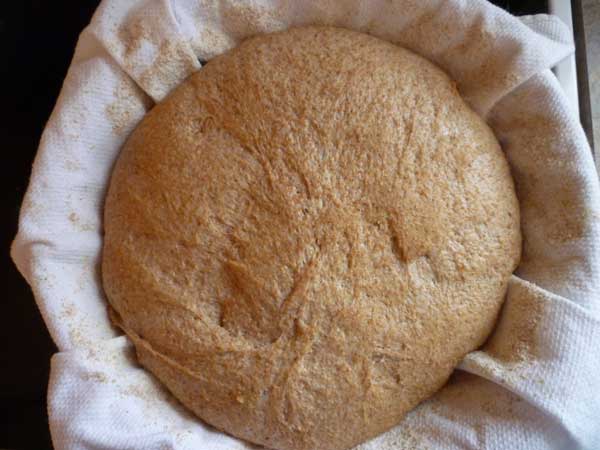
The dough was quite jiggly, like a bowl of jello when I brought it back to the kitchen.  I knew that it would deflate substantially when I inverted it onto the hot stone.  At that point, it still had to be scored, and pictures taken, and steam added, before I could close the oven door -- so this bread, again, does not follow Reinhart's directions 100%.  I was frankly a bit disappointed that the dough flattened out so much, when I put it on the hot stone.

This dough is baked in a preheated 500 degree F. oven with steam.  After the first couple of minutes, I turned the temperature to 450 degree F. and set the timer for 20 minutes


0920
The bread is turned.  It looks like there has been some nice oven spring, but it hasn't come back to the original size of the dough as it was in the basket.

0940
I checked the internal temperature of the bread with a thermometer before removing it from the oven.  Target core loaf temperature:  200 degrees F.


Results

Disappointed in the way it didn't sit up, but flattened out too much.


Obligatory crumb shots:

In my opinion, this loaf is not overly sweet (I found the enriched breads in the front of Reinhart's book to be too sweet for my taste).  In fact, although the interior crumb is nice and tasty, there is a bitter acrylamide taste to the outer crust that could be tempered somewhat, in the future: perhaps by the use of rice flower in the lined basket, rather than whole wheat; or perhaps by using an egg wash, or maybe a wheat berry gum wash, at just the right moment, during the baking cycle.  I do personally like the bread as it is, though. 


Notes to Myself

  • As usual, I don't know if I'm pulling the dough tight enough on the bottom.  The sealing that is supposed to happen during shaping and pinching the bottom of the boule tends to pull apart quickly when it sits upside down in the basket.  Perhaps that is the major thing I'm doing wrong, and the cause of the sideways sag or oven deflation.
  • These preferments were in the fridge for just more than 3 days: did that negatively effect the sagginess or lack of spring in the loaf?  Did it negatively affect the taste?  Did it ruin the healthful benefits of the loaf?  So far, I can't say.
  • I plan on trialing many different versions of this bread for different sweetening contents.
  • Got to get me a real banneton, and forget these baskets.  If there was one in a store nearby me, I'd buy it, but if I have to send away for them, I dawdle.

Thursday, February 3, 2011

Variations on Firtig's Caraway Rye

A Quick Rye based on Firtig's Caraway Rye

Scheduling Bread

I find I tend to gravitate toward no-knead breads, for convenience, when I only have a couple of days off work: the first day off, I am often physically and emotionally exhausted, and just need to catch up on my sleep and other bad habits.  I simply don't have the energy to mix up ingredients.  The next day, I can bake bread: but by then, it is generally too late to build a sourdough or let a biga soak, etc., before I have to return again to work.  And that means, making a Reinhart style bread in those two days I'm off, is not going to work.  There are times when I have 3 days off in a row, and making those (better) breads is going to work; but if I only have 2 days off, I have trouble fitting his recipes in with my schedule.

I think that today, in addition to this no-knead loaf, I will also try setting aside the ingredients for one of his loaves that will not get made for several more days: I will try to bake it on my next "first day off" from ingredients I put together today (my "last day off before working again").


Today's No-Knead Bread

But for today, so I am certain I'll have some bread to take with me to work this weekend, I'll bake a no-knead bread.  The base ingredients and methods for this rye bread came from Judith Fertig's book, "200 Fast and Easy Artisan Breads", a book that I have had for a long time but haven't used much.  The recipes in this book are all mostly just variations on a theme, and all of them have unbleached bread flour, none of them are (completely) whole grain.


Ingredients are slightly altered

For this recipe, I have just swapped out the bread flour for some whole wheat flour, not doing any further adjustments in how much liquid I add.  Let's see how the recipe performs without tweaking it any further than that.

Curiously, the measurements are all cups and millilitres: it seems rather strange to be measuring flour and other ingredients by volume rather than weight, but that is what Fertig does.  Here, I have ignored the volume measures and have used the cup measurements, weighing ingredients as I went.  Here is what I got (your mileage may vary).


  •    697g Whole Wheat flour
    •    257g Rye flour
    •    22g Yeast
    •    15g Caraway Seeds
    •    15g Kosher salt
    •    115g Molasses
    •    723g Lukewarm water

The other innovation I made on the recip: I added

    •    1 cup of rye kernels (181g dry weight),

that were pressure cooked for 25 minutes (the whole process, with our blasted whirlpool stove, took 50 minutes).  I should have measured the cooked kernels before adding them to the mixture, but I didn't think of it.


The recipe uses Caraway Seeds, which my wife hates, so I guess this bread is going to be for me alone.  She has actually been buying bread lately, so I'm not going to worry about her tastes too much anymore.  Every time she buys bread to eat, it is a commentary on how inedible she finds my loaves.  It is only when I bake with all-purpose flour that she likes it.  But she knows I'm trying to find a different way: I so very rarely use all-purpose flour any more in my breads.  This has to be a conscious effort, and it is always an uphill battle, because breads are so much easier and nicer looking with bread flour and all-purpose flours.  You really have to insist on whole grain if you believe in it (and for me, the jury is still out), or it just ain't gonna happen.


Method is Slightly Altered

As per the instructions, I mixed the dry ingredients, warmed the wet ingredients, and when my rye kernels were fresh from the pressure cooker, I mixed them into the water mixtures and added it all to the dry flour mixture.  When this mixture is fully moistened, I was supposed to move it to a bowl and do about 40 stretch and folds.


At this point, my mother phoned: I had only done about 5 stretch and folds.  After talking with her for a couple of minutes, I asked her to wait, did a couple more stretch and folds, and set it back into a container for its 2 hour rise by the hearth.  Then I picked up the conversation with my mom.  So I didn't give it as many stretch and folds as I might have otherwise.

before bulk fermentation

Results
30 minutes

60 minutes

The dough rose nicely and rapidly.  So rapidly, in fact, that after 1 hour (rather than the 2 specified), I decided to try and set it in a basket for the final proofing.  I lined a basket with a cloth and some flour, and tried my best to stretch and fold this goo before setting it to rest.  This is extremely moist dough, and probably would have been better off in a tin than to try and make a free-form loaf from it.

end of bulk fermentation

It is at this point that I decided to figure out the percentages: how hydrated is this dough, anyway?  And what percentage of rye is the loaf?  These are things that Fertig should have told us.  Why is it such a big secret?

    •    total flour weight: 954g
    •    total ratio of rye to whole wheat by percentage: 27% : 73%
    •    total water by percentage:  76%
    •    total molasses by percentage: 12%
    •    total ratio of all hydration to all flour: 88% : 100%

So this (nearly) 1/3 rye is (almost) 90% hydrated.  No wonder I had some trouble gathering up the dough to put it into a basket. 

Likely it will be a very flat, free-form loaf.

A loaf only a crusty baker could love.

very moist dough, pretty tricky to stretch and fold: extravagant gooeyness.

basketed for the final proofing

Problems

Thirty minutes into the proofing, and I was in trouble.  For one thing, the dough was climbing out of the basket.  I did scrape some dough off, which probably negatively affected the bread, but it couldn't be helped.  I set that smaller amount in another smaller basket to proof.  It was either that, or scrape it up off the floor.

dough climbing out of basket on the hearth

turned into 2 loaves.

More importantly, my mom & dad were now coming for lunch, and my wife needed the oven just when I thought I might require it.  This dough had to sit longer than I thought it might require.  I decided that I would retard it in the refrigerator (or rather, because our fridge is currently full, I would put it out into our very cold garage).  That might slow things down until I could use it.  It might also help firm up the dough, so it would retain its shape while it baked on a hot stone.


Innovation

My wife gave me another idea.  I knew that this loaf was going to spread sideways as soon as it hit the hot stone in the oven.  I thought I might use something to shore up the sides, and I was looking at a plastic ring that she uses for cold cake flans.  With alarm, she told me I couldn't use that -- surely it would melt in oven temperatures -- but that I might try some foil instead. 

Hmmm.  A Foil Dam (patent pending).  That just might work  I would have to make a foil dam (patent pending) just larger than the basket, and hope that it would contain my high hydrated dough just long enough for the interior to set.  Worth a try.

I made myself a foil dam (patent pending) by wrapping it around a similarly sized basket.  I baked the first loaf for 30 minutes with this home-made foil dam (patent pending) at 450 degrees F., and another 15 minutes at 400 degrees F.
foil dam, patent pending
The second loaf got about 30 minutes at 400 degrees F.  As predicted, the loaf did not rise well; but the foil dam (patent pending) did seem to contain the loaf from spreading sideways.  Clever girl.


the dough on the hot stone, surrounded by foil dam (patent pending)

I can smell the caraway in the freshly baked bread.  I'll crack into this loaf tomorrow when I'm making a lunch to take with me for work.  When it cools, I'll knock some of that extra flour off, outside in the snow.


I sliced up part of the small loaf, the next morning.  It is baked evenly, and it has a scent and flavouring of caraway.  Without that spice, it probably would be fairly tasteless.  I had an end piece with a bit of havarti cheese, and a larger middle slice with some native chokecherry jam.  I found the bread complemented each nicely.  Because of the caraway, I doubt if my wife will eat this.  Too bad: she might otherwise like it.


Crumb of the bread made in a foil dam

Notes to Myself
  • No, there is no real "patent pending" on the foil dam idea.  It's a joke.
  • No doubt the flavour of this loaf would improve if you were to refrigerate it; or better yet, use sourdough to raise it, not the commercialized yeast.  But this is a FAST loaf.
  • I think I would try 30 minutes for a whole grain like rye in a pressure cooker, at the quantities I used (1 cup of grain to 3 cups of water).
  • I kept the boiled rye water for use in the next bread.  Probably contains some vitamins and minerals and flavours that would be hard to get any other way: I'll plop it in my next rye bread.