All grains contain peptides that mimic morphine or endogenous opioid substances. This is where I deal with my latest loaf craving. Get your bread-based exorphin fix here.

Sunday, October 10, 2010

Laurel's Kitchen Black Turtle Raisin Bread


Laurel's Kitchen Black Turtle Raisin Bread

The next loaf of Reinhart's that I am going to bake is a Cinnamon Raisin Bread.  I had it in the back of my mind that I ought to bake someone else's Raisin Bread, for taste comparison (the way I did with the Reinhart's Anadama Bread recipe by testing out various others, here, there, and elsewhere).  I had a look through my recent cookbook acquisitions, and found nothing appropriate in Viet's book ('No More Bricks'), and I thought, from looking at the index, that there was nothing in the 'Laurel Kitchen's Bread Book', either.   But after looking at the index, I thumbed through the book and found a rather different raisin bread, and one that I thought I might try for our Canadian Thanksgiving this weekend.  This is not a cinnamon raisin bread, and it sounds so different, I was unsure of how it might taste.  But it was intriguing enough to try.  This is the first loaf I have made from the Laurel's Kitchen Bread Book.

Ingredients

Black Turtle's Raisin Bread from Laurel's Kitchen uses Black Turtle Beans.  Now, frankly I don't know a black turtle bean from a black garbanzo.  But I did find some black beans when I was out shopping the other day, and here I've used those.  They fit the description.  But have you ever noticed that no one ever puts the scientific name, e.g. Phaseolus vulgaris, on their packaging? 


 Beans come to a boil
 Raisins are steamed
Raisins left to cool after 5 minutes of steaming

Dutifully, I boiled the beans for an hour; I could have used more than the 3 cups of water as suggested on the bean pack, because after the pot had simmered for an hour, there was not even 1 cup of liquid left over.  I had to add to the amount, to bring the liquid up to the 2 cups that was needed.  During the boiling of the beans, I steamed the raisins over the pot for 5 minutes.

Reserve all the liquid that's left over from boiling the beans

I made a mistake and added 60 g of molasses and 30 g of oil -- grams rather than millilitres -- but it didn't seem to matter to the recipe too badly.  I didn't have enough raisins, so I added about 17 g of currants to bring the total of dried fruit to 145 g.


I blended the beans and the reserved water together when it had cooled slightly, mixed in the oil and molasses, and poured it over my flour mixture.  I wasn't sure if I should just stir the mixture or use my hands to mix it.  I opted to keep my hands out of it for now.  But it didn't really entirely mix until I poured it onto the counter and started kneading.


Dutifully, I kneaded the dough for 20 minutes.  Frankly, I find it difficult to rationalize that length of time kneading.  When you are kneading that long, it is, however, interesting to feel the changes that take place within the dough -- and within yourself.

Pre-kneading

 Kneaded about 17 minutes -- about to add the raisins
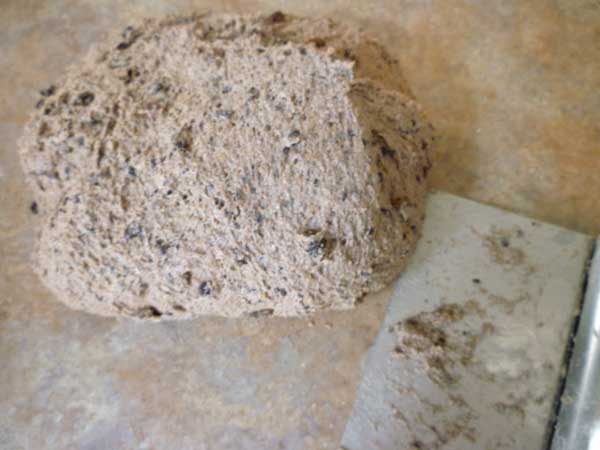
Dough at 20 minutes: stop, already

The Changes in the Dough -- and in you -- as you knead for 20 minutes
1 minute -- there is still flour that needs to be incorporated, from the initial mixing in the bowl.
2 minutes -- I think I've got all that flour incorporated, but I still see blobs of material.  Are those beans?
3 minutes -- Really, the dough is just being mixed still.  The flour in the dough is just being hydrated.
4 minutes -- Okay, this thing under my hands could now be named, it is one thing rather than a conglomeration.
5 minutes -- The dough is starting to cooperate.
6 minutes -- I could stop now and be happy.  Can I stop now?
7 minutes -- I don't perceive I'm doing anything more here.  How much time is left?  Crap.  I've barely started.
8 minutes -- The dough is getting sticky.  Wet your hands.
9 minutes -- It's sticking to the counter.  It's sticking to my hands.  Yuck.  Oh well, keep going.
10 minutes -- The dough feels like it is getting tight, the gluten acting like gravity.
11 minutes -- okay, better get the scraper to take this stuff off your hands.
12 minutes -- some of the books say to rest the dough.  Maybe I should rest... the, uh, ... dough.
13 minutes -- better use the scraper to knead with.  When it sticks to your hands or the counter, it just makes things worse.
14 minutes -- glad I had that bowl of water nearby to dip the scraper into periodically so it doesn't gum up.
15 minutes -- this dough felt stronger at 10 minutes.  Now it is feeling worn out, flaccid.
16 minutes -- gee, I think I 'zoned out' there for a little bit.  Where was I?  Better add the raisins.
17 minutes -- now the dough is getting stronger again - but not as strong as at 10 minutes, curiously.
18 minutes -- What time is it?  How much time do I have left?
20 minutes -- Done already?  I was just starting to get into this.


 Dough after kneading and before the first rise

 Dough following the first rise, or bulk fermentation

The first rise was accomplished at 95 degrees F. in my Excaliber Dehydrator.  I was really happy with the results.  But I was running out of time, and I wouldn't be able to do the second rise and bake it before we had to get to the party.  I was amazed at how long this loaf takes to make, and I think it is primarily because the beans have to be boiled and then cooled somewhat, and you just can't rush that.


Dough is about to be divided

 The divided dough is formed and placed into some baskets

After 30 minutes, they've fluffed up a bit: time to preheat oven.

So I followed the recipe fairly strictly until I got to the 2nd rise.  Since I was running out of time, here, I just divided my dough and shaped it after the first rise.  I was making 2 free-form loaves, so I placed them in some baskets in which I had placed a couche that was sprinkled with some whole wheat flour.

The dough smells pretty darn good when baking, but my dough experienced more sag than I thought it should.  Both loaves turned out pretty flat. Come to think of it, most of my free-form loaves have this sag.  Maybe they are just too hydrated.

I took one of the loaves to our friends' house for a Thanksgiving Dinner celebration.  David cut the slices thick, and then we cut those in half.  I think it was well received, by those who tried it.  The bread was quite tasty, not at all what you might expect from beans.  I forgot my camera for the crumb shot, though.  I will have to try to remember to take a picture of the next loaf.

Fresh from the oven, cooling on racks

Thanksgiving Weekend in Canada.  The temperature was 25 degrees C., and the sun was shining.
 

Notes to Myself
  • Leave yourself enough time to let the dough perform a second rise before dividing it.  The dough might rise nicer if you follow the recipe methodology.
  • Get an Iron Pot in which to boil these beans, so you get more iron in your diet!
  • Try using slightly less hydration, next time.  Use more than 3 cups : 1 cup beans in the initial boiling, so you have more beanwater for the recipe, but use slightly less than 2 cups in the recipe.  Oh, wait: I just realized that I used 475 g of hydration, not 475 ml.  So now I have to figure out the hydration that I used in the recipe, and next time, cut back on it a bit.
  • Although I didn't measure the weight of the fully boiled beans (which surely took on some water and weighed more?), here is the baker's formula for the recipe based on my experience (your mileage may vary):

    Ingredient weight % Next time try
    Flour 750 100% 100%
    ID Yeast 14 1.87% 1.87%
    Beans 200 (raw) 26.7% 26.7%
    Hydration (Bean water) 475 63.3% 60% or 450g
    Water for Yeast 60 8% 8%
    Salt 16.5 2% 2%
    Molasses 60 8% 8%
    Oil 30 4% 4%
    Raisins & Currants 145 19.3% 19.3%

    If you add up the water percentages, you see that this dough is at 71.3% hydration.  I would suggest backing this off to 68% for a free-standing loaf next time.  Keep the yeast water at 8%, and reduce the bean water slightly - to 60% or 450g.

Thursday, October 7, 2010

Nils Schöner's 70 percent with Rye Meal Soaker

Nils Schöner's 70 percent with Rye Meal Soaker

The picture of this loaf in Nils' Recipe Book ("Brot: Notes of a Home Bread Baker in German") is what caught my eye.  I decided to make it even though I didn't have the Einkorn meal.  Instead, I used Red Fife flour to coat the exterior of the proofed loaf.

Meal Sourdough
This soaker, made with coarse rye meal requires 18-24 hours of sitting.  I left it overnight while I was working nights. But I made a mistake when making it originally: I added the teaspoon of starter before the boiling water had cooled sufficiently.  It felt lukewarm on the surface, but underneath, it was still very hot.  I was afraid that the yeast would have died in contact with the boiling water so I added another teaspoonful about 15 minutes later when it had sufficiently cooled.  I felt better about that.

The Rye Meal and Seed Soakers

Seed Soaker

This soaker only has to sit for 4 hours, but I left it overnight with the meal sourdough.  I had no idea what to expect, but I was unexpectedly surprised by how much the flax seeds had swelled; and the water had become almost gelatinous from the gums within the seeds.  I had no idea that these seeds could contain this much gum, nor that by simple soaking in water, they would impart this gluiness to the solution.


This is a moderately firm dough full of seeds and meal
The dough is stirred, bulk fermented, shaped, rolled in Red Fife, and proofed

Dough
My ambient dough temperature was precisely what Nils said I needed for 37 degree C water to combine this.  Unfortunately, I only needed 10 grams of the water, nowhere near the 100 g max that Nils suggested, to make a moderately firm dough from the other ingredients.  Mostly, this dough stayed at room temperature, nowhere near the 29 degree desired dough temperature.  So after an hour, I really didn't notice any rise. 


No oven spring, just deep fissures form in this dough


On the difference between Einkorn and Red Fife
I would love to try growing Einkorn in my backyard.  Triticum monococcum is sometimes called "Stone Age Wheat" (see this description of grains from Prairie Garden Seeds catalog ).  For an interesting history of the plant that supposedly was mentioned in the Bible, and brought out of Jericho, look at this heritage seed page

The story of Red Fife (a landrace of Triticum aestivum) is equally interesting -- to Canadians, at any rate.  This wheat was among the first grains grown with success in the northern reaches of the New World, and this wheat became the forerunner of many Canadian varieties.  From the breadbasket of Europe to the breadbasket of the new world, all from a few seeds in a Scottish farmer's hatband, the story of this grain has to be apocryphal, it has such a mythological element to it.

But isn't it interesting that wheat has the potential to inspire these origin myths? 


 Lots of seeds that complement the rye flavour


Oh, but this is a wonderful tasting loaf.  It is, to my taste, a very mildly flavoured loaf for the most part.  But the crust is quite nutty.  And the pumpkin seeds, when you hit them, impart their characteristic taste, which complements the rye nicely.


When cut, the crumb looks furry, but it is fully baked.  Lots of meal in this loaf, lots of flavour.


I ate my first slice with a bit of butter, and part of it with a tiny slice of mild cheese.  Very pleasant.

Yumb Crumb

Notes to Myself
  • Recently I picked up a couple of new bread books: Laurel's Kitchen Bread Book, and "No More Bricks" by Lori Viets  
    • Viet's book is interesting to me because she starts with whole grains for health (not just flours and meals made from whole grains, as I have mostly been doing).  The book is home published, and she could have used a good editor.  Her breads all seem to be American-style Sandwich Breads (i.e. things her kids might like);  I don't see anything in this book that makes artisan-style, nutrient-dense loaves like the ones found in Germany, for example -- the kind I prefer.  But she has loads more experience in breadmaking than I ever will.  Viets is uncompromising when it comes to grinding her own grains for flour, but she makes compromises elsewhere; still, I cannot fault her.  The book is inspiring in some ways, but feels awfully deficient in others. 
    • The Laurel's Kitchen book is another bread-making classic, and it is well-written.  I have read through the preface and the introductory 'Learning Loaf' at length, and I have skim-read the interesting Desem Sourdough technique.  This is another book that is inspirational.  These people have far more vision than Viets.  I get the feeling that I will be taking the best of both of these books, and building my own baking techniques.  
    • What I want to do is, grow my own grain, grind it into flour as needed, and bake just enough bread -- the kinds that I like! -- for my needs without freezing it. 
  • Next time, double this recipe for a larger loaf.
  • Find some Einkorn seed and try growing this heritage wheat.
  • Find some Red Fife seed and try growing this heritage wheat.
  • Should I have scored this loaf?
  • Get your sourdough starter ready and potent before making this loaf again.  It is worth making this loaf again!

Saturday, October 2, 2010

A Spent Sourdough Rye and Whole Wheat Loaf


A Spent Sourdough Rye and Whole Wheat Loaf

It was inevitable that I would try this. I have been monkeying around with the no-knead rye and no-knead whole wheat breads from my motherstarter discards. Why not put them together in a single loaf?

 Spent Motherstarters, ww and rye flours, yeast, salt, water, bread spice, flax seed

This was very old sourdough motherstarter (MS) discard. It had been in the fridge, since I refreshed my MS, not last time, or even the time before that. But refrigerating it didn't guarantee that it was any good any more: this MS was truly ancient. I had dipped into it occasionally for other breads, but I knew it should really have been tossed. It wasn't just boozy. It was smelling a bit like acetone. But I just can't bring myself to waste anything.

Consider this stuff 'Preferment'. Okay, it was probably 'Postferment'. It was still grains, and it still had lots of flavour. Maybe it wasn't good flavour any more, but it was flavour. It had reached the stage, though, that I said to myself, "I better use this up, or get rid of it." I decided to use it, with no expectations that I would get anything useful out of it.

I just weighed them together and called that 'the starter' in this baker's recipe that I have been using recently for a no-knead rye:

  • Starter 92.7%
  • Flour 100%
  • ID Yeast 1%
  • Salt 1.5%
  • Water 85.4%
  • Bread Spice: 1 1/2 tsp

My amounts:

  • Starter 726 (381g Whole wheat, 345g Rye MS; ie what I had, aprox. half ww, half rye)
  • Flour 783g (half ww, half rye)
  • ID Yeast 8g
  • Salt 12g
  • Water 669g
  • Bread Spice: didn't measure it.
  • I also tossed in a handful of flax seeds, didn't measure it.
  • Sesame seeds, for the top, didn't measure it.

I used half whole wheat, and half rye flour for this loaf. The rye flour I used was the light rye that has been sitting around here far too long.


Method

Think of how much fun it was to make mud pies as a kid

I mixed it up with wet hands -- this is extremely wet dough! -- and stuck it in that long thin tin I have for ryes. I sprinkled some sesame seeds on top.

Then I went to bed.

Spread it out in a tin, sprinkle some sesame seeds on top, let it rise, spread yogurt on top

Are you getting the picture?  I am working nights this weekend, I don't have a lot of time to fool around with Reinhart-style timings and preferments, and kneading for x amount of time, resting for y amount of time, etc.  I just wanted some dough and ingredients to bake something, and I wanted to fall asleep.  This thing is was literally thrown together before a daytime sleep after working all night.

Five hours later, I awoke and turned on the oven to preheat. The dough had risen a bit, but it wasn't overflowing the tin or anything. I glopped some yogurt on top and spread it around, and baked the loaf for about 55 minutes at 450 degrees, with a tray of water for steam.

I forgot to dock it with a fork. I had wanted to do that. Oh well. Have to leave something to experiment with next time.

Finished loaf sits 5-10 minutes in the pan cooling before I attempt to take it out
Voila.  Go back to bed you still have a couple of hours before you have to get up.

The loaf baked nicely, and all the booziness of the old MS had burned away in the oven, I hope.

I left it on the table overnight while I was working, and in the morning I sliced a bit of it before falling asleep.  It does have a bit of acetone scent to it, between the whiff of bread spice you get.  Furthermore, although the crust is well cooked, the center could have been baked a bit longer.  The knife comes out clean, but it could stand to be a bit more baked.  Despite the off smell, the taste is not off-putting.  It tastes okay, but is not something I'd rave about.


This is one heavy loaf.  It must be greater than 2 kg even after baking, because it sets my tiny scale to read E for Error.

Notes to Myself
  • Next time dock it with a fork before baking.
  • Try this without a yogurt topping to see what it looks like.  Try an egg wash topping too.
  • Try sprinkling the top with sesame seeds after it rises.
  • For heaven's sake, use some new motherstarter, don't always use this extremely old stuff.  Why do you keep that stuff, anyway?